Did the yen intervention work?
2026-09-26 00:58:12
There are generally two opposing views on the Japanese yen in the market.  The first school of thought argues that Japan, as a massive net creditor nation, cannot afford to ignore the yen's depreciation due to its debt problem. The yen's weakness stems from market irrationality; the Japanese government, with its vast foreign exchange reserves, can intervene to bring the market back to rationality. According to this logic, intervention would be effective because the yen is undervalued, and the government can intimidate the market, forcing speculative funds to back down. The second school of thought, however, believes the yen's decline is rooted in the Bank of Japan's continued suppression of Japanese government bond yields. Given Japan's massive public debt, allowing yields to rise freely would have triggered a sovereign debt crisis; now, with yields suppressed, the crisis manifests in the exchange rate. Those holding this view believe that unless the yield cap is removed, the yen's depreciation trend will not end. This article will examine the evidence and compare these two opposing theories. I personally support the second view, but the purpose of this article is simply to review the current situation and examine the evidence.
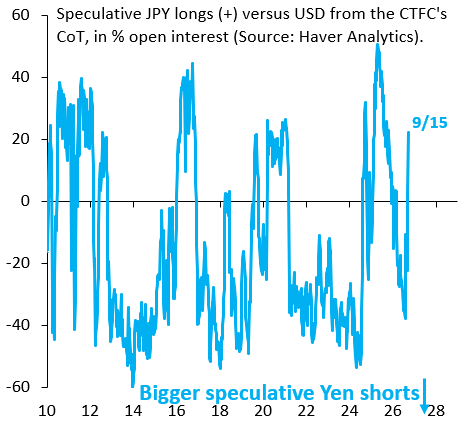
 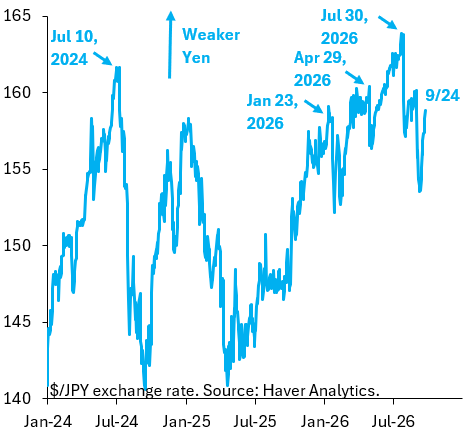 The chart above shows the USD/JPY exchange rate, which is how many yen can be exchanged for 1 US dollar. An upward curve represents a weakening yen, and a downward curve represents a strengthening yen. I have marked the timing of previous interventions to support the yen on the chart, focusing on the large-scale intervention in July 2024, as well as all the operations this year to curb the yen's decline, including the intervention implemented by Japan through an agency earlier this month. The chart's conclusions are mixed. On the one hand, this year's intervention did prevent the USD/JPY from significantly breaking through the 160 level. On the other hand, the yen's exchange rate is testing 160 again, making it difficult to say that the market has "learned its lesson." Perhaps the most apt assessment of this year's intervention is that it forced speculators to reduce their short yen positions. The chart below shows that speculative funds have now shifted to going long on the yen and short on the dollar.
  My skepticism stems from the fact that the yen will resume its decline once Japan stops intervening. The chart below shows the daily USD/JPY exchange rate during the three major intervention events this year. I've aligned the events by time: 't' represents the day before each intervention, marked by a gray dashed vertical line. The red line represents the first round of intervention: the New York Fed's exchange rate inquiry on January 23; the blue line represents the second round, Japan's large-scale unilateral intervention on April 30; and the black line represents the current round, which began on July 30. I've included the intervention on September 3 in this round, and yesterday is marked as September 24 in the chart.
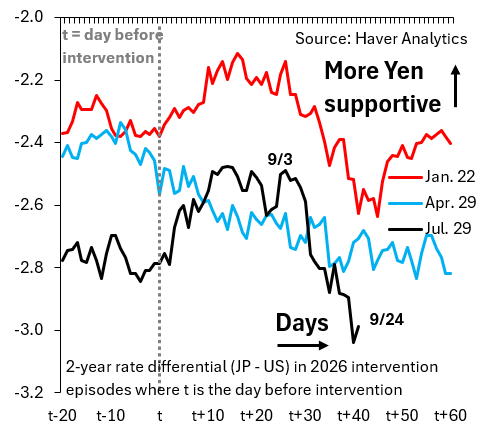
 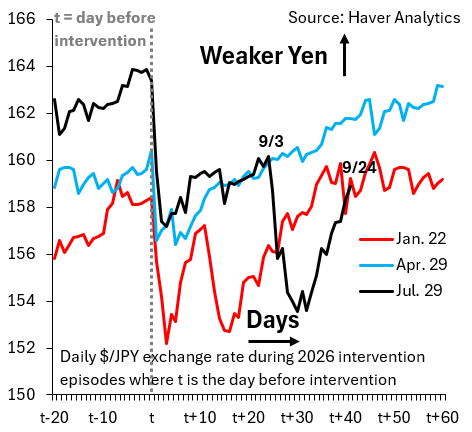 It's obvious that intervention can temporarily boost the yen, but the effect fades very quickly. Just look at the intervention earlier this month: the USD/JPY exchange rate has returned to pre-intervention levels, erasing all the yen's appreciation potential. Another question is: can intervention hold the key 160 level? In my opinion, the answer is no. The reason is shown in the chart below: the chart shows the two-year interest rate differential corresponding to the USD/JPY exchange rate. Since this month's "implicit intervention," the interest rate differential has been significantly bearish for the yen, so the USD/JPY's return to around 160 is not surprising.
  In short: only the Bank of Japan can save the yen. That is, only rising yields can ensure sustainable exchange rate stability. However, higher yields mean a significant increase in Japanese government interest payments, therefore policymakers cannot allow yields to rise sharply. This is why I remain bearish on the yen. The yen will continue to weaken because the other option—a sharp rise in yields triggering a debt crisis—would be far more costly for those in power in Japan.
The first school of thought argues that Japan, as a massive net creditor nation, cannot afford to ignore the yen's depreciation due to its debt problem. The yen's weakness stems from market irrationality; the Japanese government, with its vast foreign exchange reserves, can intervene to bring the market back to rationality. According to this logic, intervention would be effective because the yen is undervalued, and the government can intimidate the market, forcing speculative funds to back down. The second school of thought, however, believes the yen's decline is rooted in the Bank of Japan's continued suppression of Japanese government bond yields. Given Japan's massive public debt, allowing yields to rise freely would have triggered a sovereign debt crisis; now, with yields suppressed, the crisis manifests in the exchange rate. Those holding this view believe that unless the yield cap is removed, the yen's depreciation trend will not end. This article will examine the evidence and compare these two opposing theories. I personally support the second view, but the purpose of this article is simply to review the current situation and examine the evidence. The chart above shows the USD/JPY exchange rate, which is how many yen can be exchanged for 1 US dollar. An upward curve represents a weakening yen, and a downward curve represents a strengthening yen. I have marked the timing of previous interventions to support the yen on the chart, focusing on the large-scale intervention in July 2024, as well as all the operations this year to curb the yen's decline, including the intervention implemented by Japan through an agency earlier this month. The chart's conclusions are mixed. On the one hand, this year's intervention did prevent the USD/JPY from significantly breaking through the 160 level. On the other hand, the yen's exchange rate is testing 160 again, making it difficult to say that the market has "learned its lesson." Perhaps the most apt assessment of this year's intervention is that it forced speculators to reduce their short yen positions. The chart below shows that speculative funds have now shifted to going long on the yen and short on the dollar. My skepticism stems from the fact that the yen will resume its decline once Japan stops intervening. The chart below shows the daily USD/JPY exchange rate during the three major intervention events this year. I've aligned the events by time: 't' represents the day before each intervention, marked by a gray dashed vertical line. The red line represents the first round of intervention: the New York Fed's exchange rate inquiry on January 23; the blue line represents the second round, Japan's large-scale unilateral intervention on April 30; and the black line represents the current round, which began on July 30. I've included the intervention on September 3 in this round, and yesterday is marked as September 24 in the chart. It's obvious that intervention can temporarily boost the yen, but the effect fades very quickly. Just look at the intervention earlier this month: the USD/JPY exchange rate has returned to pre-intervention levels, erasing all the yen's appreciation potential. Another question is: can intervention hold the key 160 level? In my opinion, the answer is no. The reason is shown in the chart below: the chart shows the two-year interest rate differential corresponding to the USD/JPY exchange rate. Since this month's "implicit intervention," the interest rate differential has been significantly bearish for the yen, so the USD/JPY's return to around 160 is not surprising. In short: only the Bank of Japan can save the yen. That is, only rising yields can ensure sustainable exchange rate stability. However, higher yields mean a significant increase in Japanese government interest payments, therefore policymakers cannot allow yields to rise sharply. This is why I remain bearish on the yen. The yen will continue to weaken because the other option—a sharp rise in yields triggering a debt crisis—would be far more costly for those in power in Japan.
- Risk Warning and Disclaimer
- The market involves risk, and trading may not be suitable for all investors. This article is for reference only and does not constitute personal investment advice, nor does it take into account certain users’ specific investment objectives, financial situation, or other needs. Any investment decisions made based on this information are at your own risk.