Gold prices fell below the $4,200 mark as expectations of a Fed rate hike intensified and the dollar strengthened.
2026-09-28 13:10:14
Spot gold continued its weakness in early Asian trading on Monday, with XAU/USD falling back to around $4190 at one point. The main pressure on gold prices recently has come from a stronger dollar and renewed expectations of US interest rates. The Federal Reserve's September meeting raised the target range for the federal funds rate by 25 basis points to 3.75% to 4.00%, and recent comments from officials have further strengthened market expectations that further policy tightening is possible. Official data from the Federal Reserve shows that the policy meeting on September 16 unanimously approved the decision to raise interest rates, noting that inflation remains at a relatively high level.  Several Federal Reserve officials have recently reiterated their emphasis on inflation risks. Cleveland Fed President Beth Hammark stated that inflation risks remain high and restrictive monetary policy needs to be maintained; Fed Governor Michael Barr also indicated that further policy adjustments may be needed to push inflation down. St. Louis Fed President Alberto Musaleem similarly stated that persistent inflationary pressures may require further interest rate hikes. The Fed's policy stance has shifted back towards "maintaining high interest rates for a longer period," becoming the core macroeconomic factor behind the short-term pullback in gold prices. Changes in interest rate expectations directly affect the cost of holding gold. Gold itself does not generate interest income. When the market raises its expectations for policy rates again, the relative attractiveness of yield-generating assets such as US Treasury bonds increases, while the US dollar usually receives some support, thus increasing downward pressure on dollar-denominated gold. Recently, market expectations for another rate hike in October have clearly intensified, with a probability exceeding 70%, significantly higher than previous levels. If future US inflation data continues to show stickiness, the real interest rate pressure on gold may further expand. Meanwhile, changes in energy prices are becoming an important variable affecting gold. Recent tensions in the Middle East and soaring oil prices have brought renewed market focus on the risk of energy price transmission to inflation. While rising oil prices provide some safe-haven support for gold, if energy inflation prompts the Federal Reserve to maintain or even strengthen restrictive policies, the pressure on gold from interest rates and the dollar could outweigh the support provided by traditional safe-haven demand. This logic is a key reason for the recent complex gold price movements. Historically, gold has typically attracted safe-haven inflows during periods of heightened geopolitical risk, but the current market faces both rising energy prices and a hawkish US monetary policy. Geopolitical risks haven't fully translated into upward pressure on gold because the market is reassessing the relative impact of "safe-haven demand" and "high interest rate pressure." The dollar's performance further intensifies the pressure on gold. Following the Fed's September rate hike, the market began to readjust its future policy path, and the dollar's interest rate advantage has been somewhat restored. For international gold, a stronger dollar not only increases holding costs for non-dollar investors but also weakens the allocation intentions of some short-term funds. Therefore, until US economic data shows a significant weakening, gold will continue to face pressure from changes in the dollar and US Treasury yields in the short term. However, the current decline in gold prices has also begun to accumulate conditions for a technical correction. The 14-day RSI on the daily chart is around 39.9. While it hasn't yet entered typical oversold territory, it's significantly lower than strong market levels. Meanwhile, gold prices are approaching the lower Bollinger Band, suggesting potential buying support during further declines. Gold is not currently in an extremely oversold state, so a technical rebound is possible, but not enough to confirm a trend reversal. From a daily chart perspective, XAU/USD is currently trading below the 100-day simple moving average and the middle Bollinger Band, indicating a generally weak trend. The first support level to watch is the lower Bollinger Band around $4180. If gold prices can stabilize in this area, a short-term rebound is possible; however, a sustained break below $4180 could extend the downside potential. On the upside, key levels to watch are $4250 and $4300. The $4300 level corresponds to the 100-day moving average and is a crucial area for bulls to reclaim; further up, the upper Bollinger Band around $4350 is a significant resistance level, but it's currently quite far away. From a 4-hour chart perspective, gold has entered a weak recovery phase after a continuous decline, but the short-term trend remains bearish. If the $4180 area can effectively absorb selling pressure, the price may experience a technical rebound, recovering towards $4250 and $4300. However, if the rebound is consistently resisted near $4250 and breaks below $4200 again, the bears may strengthen again, and further support levels to watch are $4150 and even lower. While current short-term indicators show some exhaustion of downward momentum, a clear bottom reversal structure has not yet formed. This week, close attention should be paid to US inflation, consumption, and employment data, as well as further statements from Federal Reserve officials regarding the future interest rate path. If US economic data continues to show resilient demand and persistently high inflationary pressures, expectations of an October rate hike may strengthen further, thus continuing to suppress gold. Conversely, if economic data cools significantly and prompts the market to lower its rate hike expectations again, a decline in the dollar and US Treasury yields may provide room for gold to recover. Furthermore, oil prices remain an external variable that cannot be ignored in the gold market. If the situation in the Middle East continues to push up oil prices, the market will need to find a balance between two transmission paths: on the one hand, geopolitical risks can increase the safe-haven demand for gold; on the other hand, rising energy prices may exacerbate US inflation and prolong the period for the Federal Reserve to maintain high interest rates. Therefore, whether gold can stop falling depends not only on whether safe-haven funds flow back, but also on whether rising oil prices further change expectations for US interest rates.
 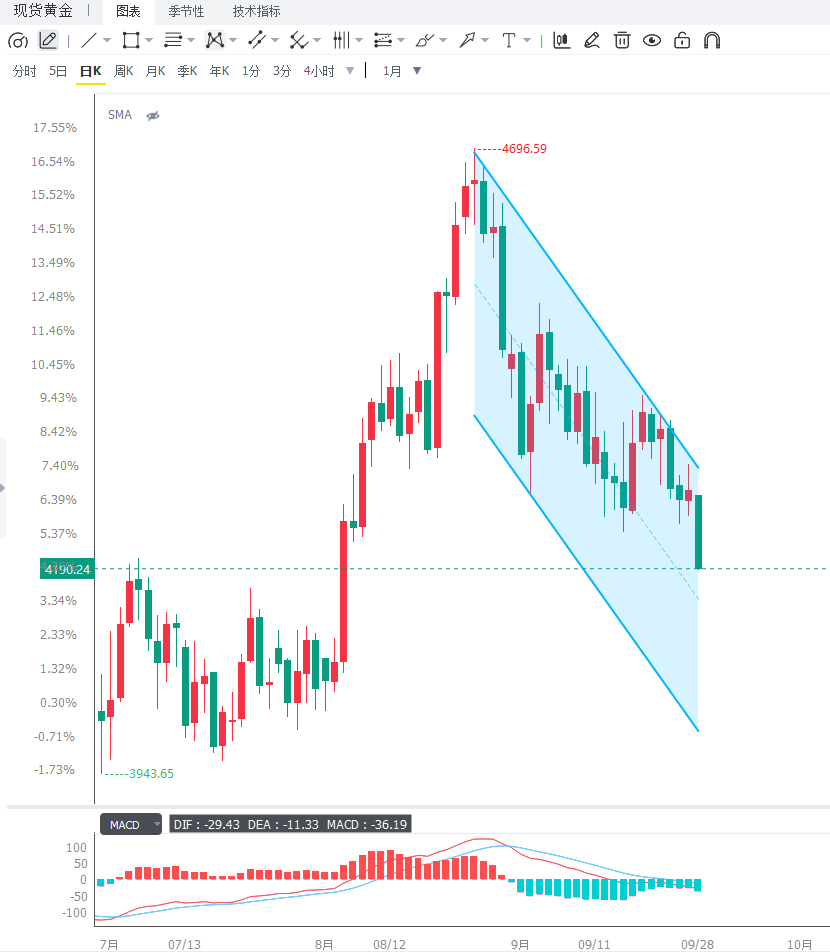 Editor's Summary: Gold is currently in a phase of oscillation between a strengthening US dollar, rising expectations of a Fed rate hike, and geopolitical safe-haven demand. Following the Fed's September rate hike, officials continued to emphasize inflation risks, reigniting market focus on subsequent rate hikes and putting significant interest rate pressure on gold. At the same time, the Middle East situation and rising oil prices have limited gold's downside. In the short term, $4180 to $4200 is a crucial area for judging whether gold can stabilize, while $4300 and $4340 are key resistance levels that need to be broken successively during a rebound. If US inflation remains high, gold prices may continue to weaken; if economic data cools and pushes down the dollar and yields, gold may see a technical correction. Currently, the market has not yet formed a clear one-sided reversal signal, and it is still necessary to pay close attention to the synchronized changes in the dollar, US Treasury yields, oil prices, and Fed policy expectations.
Several Federal Reserve officials have recently reiterated their emphasis on inflation risks. Cleveland Fed President Beth Hammark stated that inflation risks remain high and restrictive monetary policy needs to be maintained; Fed Governor Michael Barr also indicated that further policy adjustments may be needed to push inflation down. St. Louis Fed President Alberto Musaleem similarly stated that persistent inflationary pressures may require further interest rate hikes. The Fed's policy stance has shifted back towards "maintaining high interest rates for a longer period," becoming the core macroeconomic factor behind the short-term pullback in gold prices. Changes in interest rate expectations directly affect the cost of holding gold. Gold itself does not generate interest income. When the market raises its expectations for policy rates again, the relative attractiveness of yield-generating assets such as US Treasury bonds increases, while the US dollar usually receives some support, thus increasing downward pressure on dollar-denominated gold. Recently, market expectations for another rate hike in October have clearly intensified, with a probability exceeding 70%, significantly higher than previous levels. If future US inflation data continues to show stickiness, the real interest rate pressure on gold may further expand. Meanwhile, changes in energy prices are becoming an important variable affecting gold. Recent tensions in the Middle East and soaring oil prices have brought renewed market focus on the risk of energy price transmission to inflation. While rising oil prices provide some safe-haven support for gold, if energy inflation prompts the Federal Reserve to maintain or even strengthen restrictive policies, the pressure on gold from interest rates and the dollar could outweigh the support provided by traditional safe-haven demand. This logic is a key reason for the recent complex gold price movements. Historically, gold has typically attracted safe-haven inflows during periods of heightened geopolitical risk, but the current market faces both rising energy prices and a hawkish US monetary policy. Geopolitical risks haven't fully translated into upward pressure on gold because the market is reassessing the relative impact of "safe-haven demand" and "high interest rate pressure." The dollar's performance further intensifies the pressure on gold. Following the Fed's September rate hike, the market began to readjust its future policy path, and the dollar's interest rate advantage has been somewhat restored. For international gold, a stronger dollar not only increases holding costs for non-dollar investors but also weakens the allocation intentions of some short-term funds. Therefore, until US economic data shows a significant weakening, gold will continue to face pressure from changes in the dollar and US Treasury yields in the short term. However, the current decline in gold prices has also begun to accumulate conditions for a technical correction. The 14-day RSI on the daily chart is around 39.9. While it hasn't yet entered typical oversold territory, it's significantly lower than strong market levels. Meanwhile, gold prices are approaching the lower Bollinger Band, suggesting potential buying support during further declines. Gold is not currently in an extremely oversold state, so a technical rebound is possible, but not enough to confirm a trend reversal. From a daily chart perspective, XAU/USD is currently trading below the 100-day simple moving average and the middle Bollinger Band, indicating a generally weak trend. The first support level to watch is the lower Bollinger Band around $4180. If gold prices can stabilize in this area, a short-term rebound is possible; however, a sustained break below $4180 could extend the downside potential. On the upside, key levels to watch are $4250 and $4300. The $4300 level corresponds to the 100-day moving average and is a crucial area for bulls to reclaim; further up, the upper Bollinger Band around $4350 is a significant resistance level, but it's currently quite far away. From a 4-hour chart perspective, gold has entered a weak recovery phase after a continuous decline, but the short-term trend remains bearish. If the $4180 area can effectively absorb selling pressure, the price may experience a technical rebound, recovering towards $4250 and $4300. However, if the rebound is consistently resisted near $4250 and breaks below $4200 again, the bears may strengthen again, and further support levels to watch are $4150 and even lower. While current short-term indicators show some exhaustion of downward momentum, a clear bottom reversal structure has not yet formed. This week, close attention should be paid to US inflation, consumption, and employment data, as well as further statements from Federal Reserve officials regarding the future interest rate path. If US economic data continues to show resilient demand and persistently high inflationary pressures, expectations of an October rate hike may strengthen further, thus continuing to suppress gold. Conversely, if economic data cools significantly and prompts the market to lower its rate hike expectations again, a decline in the dollar and US Treasury yields may provide room for gold to recover. Furthermore, oil prices remain an external variable that cannot be ignored in the gold market. If the situation in the Middle East continues to push up oil prices, the market will need to find a balance between two transmission paths: on the one hand, geopolitical risks can increase the safe-haven demand for gold; on the other hand, rising energy prices may exacerbate US inflation and prolong the period for the Federal Reserve to maintain high interest rates. Therefore, whether gold can stop falling depends not only on whether safe-haven funds flow back, but also on whether rising oil prices further change expectations for US interest rates. Editor's Summary: Gold is currently in a phase of oscillation between a strengthening US dollar, rising expectations of a Fed rate hike, and geopolitical safe-haven demand. Following the Fed's September rate hike, officials continued to emphasize inflation risks, reigniting market focus on subsequent rate hikes and putting significant interest rate pressure on gold. At the same time, the Middle East situation and rising oil prices have limited gold's downside. In the short term, $4180 to $4200 is a crucial area for judging whether gold can stabilize, while $4300 and $4340 are key resistance levels that need to be broken successively during a rebound. If US inflation remains high, gold prices may continue to weaken; if economic data cools and pushes down the dollar and yields, gold may see a technical correction. Currently, the market has not yet formed a clear one-sided reversal signal, and it is still necessary to pay close attention to the synchronized changes in the dollar, US Treasury yields, oil prices, and Fed policy expectations.
- Risk Warning and Disclaimer
- The market involves risk, and trading may not be suitable for all investors. This article is for reference only and does not constitute personal investment advice, nor does it take into account certain users’ specific investment objectives, financial situation, or other needs. Any investment decisions made based on this information are at your own risk.