The USD/JPY pair fluctuated and declined, and may return to range-bound trading in the short term.
2026-09-28 14:42:15
The US dollar rose against the Japanese yen to around 157.75 during Asian trading on Monday, supported by bargain hunting, partially recovering losses from Friday's highs near 159. Following the release of the Bank of Japan's July meeting minutes, the yen's reaction was relatively limited, with USD/JPY still primarily influenced by the dollar's performance and changes in the USD/JPY interest rate differential. Latest market information shows that USD/JPY had previously broken through the 159 level and is currently still near multi-week highs.  The policy divergence between the Federal Reserve and the Bank of Japan remains a significant factor driving exchange rate movements. The Fed raised its target range for the federal funds rate to 3.75%-4.00% in September, while the Bank of Japan recently raised its policy rate to 1.25%, maintaining a clear gap between the two countries' interest rates. In the US, rising energy prices and expectations of further policy tightening have kept US Treasury yields high, continuing to support the dollar. Meanwhile, the situation in the Middle East has increased demand for the dollar as a safe haven. The situation between the US and Iran remains highly uncertain, and persistently high oil prices could further intensify market concerns about energy-related inflation. If energy prices continue to influence the Fed's policy pricing through inflation expectations, US yields and the dollar may continue to show resilience. The Bank of Japan's meeting minutes, however, indicate that Japan's financial environment remains accommodative. Some members pointed out that rising import costs are pushing up consumer prices, with companies continuing to pass on increased raw material costs to end-user prices, and medium- to long-term inflation expectations have also risen. The minutes also noted that the impact of yen volatility on the economy and prices is increasing, and if the yen continues to weaken, import costs could further push up inflation. This suggests that the Bank of Japan faces a complex policy environment. On the one hand, rising inflation and import costs have provided justification for further tightening of policy; on the other hand, market expectations for the Bank of Japan to accelerate interest rate hikes have not fully translated into a sustained appreciation of the yen. In September, the Bank of Japan raised its policy rate by 25 basis points to 1.25%, but the 7-2 vote and market concerns about the pace of subsequent rate hikes limited the policy support for the yen. Furthermore, the risk of intervention in the foreign exchange market by Japanese authorities remains a variable that cannot be ignored during the high-level movement of USD/JPY. The Japanese Finance Minister previously reiterated that the principle of intervention to stabilize the exchange rate remains effective; after officials conducted exchange rate checks, market attention to further official actions has significantly increased. Since mid-September, USD/JPY has repeatedly approached the 159-160 range, thus requiring simultaneous attention to the speed of the exchange rate rise and the policy statements of Japanese authorities. In the short term, the core contradiction for USD/JPY remains whether US yields and expectations of Federal Reserve policy can continue to remain strong, and whether the Bank of Japan will change the yen's weak position through clearer policy signals or official actions. Meanwhile, the situation in the Middle East and changes in oil prices may also amplify exchange rate volatility through inflation and safe-haven channels. The 4-hour chart shows that USD/JPY has reclaimed the 23.6% Fibonacci retracement level at 157.62 and found support near the 50-period SMA, indicating a still-strong short-term structure. Currently, 157.62 is the first support level; if the price holds above it, the short-term rebound structure remains intact. Further support is seen at the 50-period SMA near 157.17. Deeper support lies at the 38.2% Fibonacci retracement level at 156.71 and the 50% retracement level near 155.98. If the price breaks below 157.17 and further falls below 156.71, it signifies a significant cooling of the previous short-term uptrend, and the market may retest the 155.98 area. On the upside, the first resistance level to watch is the cycle high near 159.08, a key technical area that bulls have been trying to break through recently. If the price breaks through 159.08, the psychological level of 160.00 will become an important price target for the next stage. However, given the escalating risk of intervention by Japanese authorities in the 157-160 area, the subsequent volatility will need to be assessed in conjunction with policy news. The previous pullback in USD/JPY around 159 indicates significant market attention in this area.
 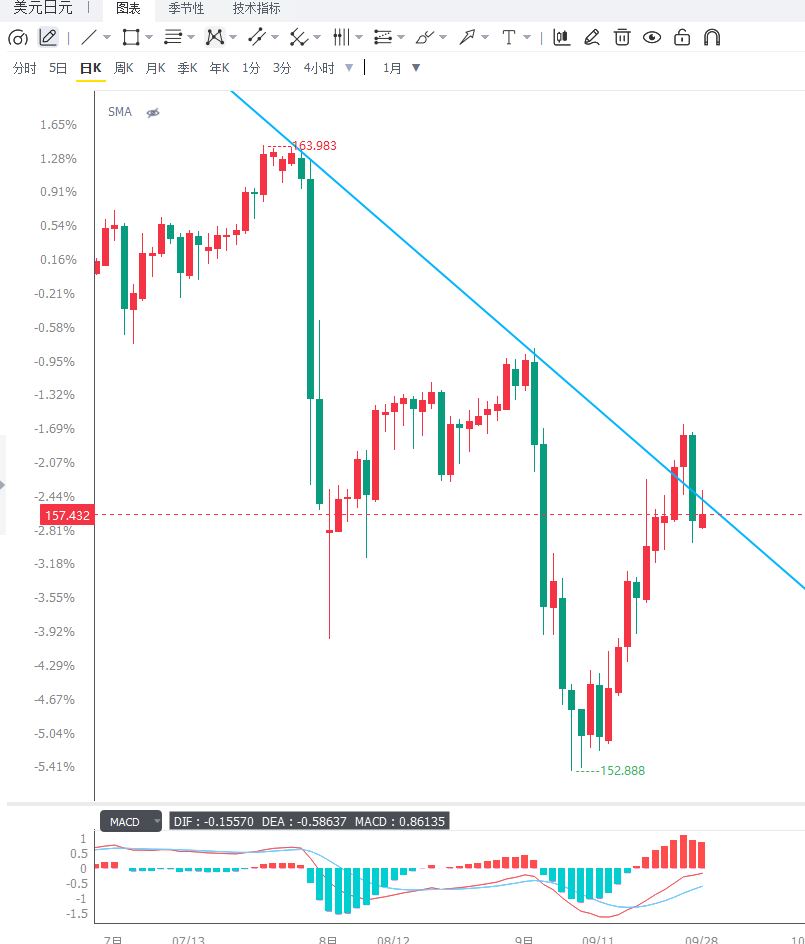 In summary, the USD/JPY pair remains in a relatively strong position, primarily supported by the interest rate differential between the Federal Reserve and the Bank of Japan, US Treasury yields, and demand for the US dollar as a safe haven. Meanwhile, inflationary pressures in Japan are rising, and if the Bank of Japan further signals a tightening of policy, or if Japanese authorities strengthen exchange rate stabilization measures, the yen may receive some support. Technically, 157.62 and 157.17 are key short-term support levels, while 159.08 is a key resistance level. Future price action will depend heavily on speeches by Federal Reserve officials, Japanese policy signals, and developments in the Middle East.
The policy divergence between the Federal Reserve and the Bank of Japan remains a significant factor driving exchange rate movements. The Fed raised its target range for the federal funds rate to 3.75%-4.00% in September, while the Bank of Japan recently raised its policy rate to 1.25%, maintaining a clear gap between the two countries' interest rates. In the US, rising energy prices and expectations of further policy tightening have kept US Treasury yields high, continuing to support the dollar. Meanwhile, the situation in the Middle East has increased demand for the dollar as a safe haven. The situation between the US and Iran remains highly uncertain, and persistently high oil prices could further intensify market concerns about energy-related inflation. If energy prices continue to influence the Fed's policy pricing through inflation expectations, US yields and the dollar may continue to show resilience. The Bank of Japan's meeting minutes, however, indicate that Japan's financial environment remains accommodative. Some members pointed out that rising import costs are pushing up consumer prices, with companies continuing to pass on increased raw material costs to end-user prices, and medium- to long-term inflation expectations have also risen. The minutes also noted that the impact of yen volatility on the economy and prices is increasing, and if the yen continues to weaken, import costs could further push up inflation. This suggests that the Bank of Japan faces a complex policy environment. On the one hand, rising inflation and import costs have provided justification for further tightening of policy; on the other hand, market expectations for the Bank of Japan to accelerate interest rate hikes have not fully translated into a sustained appreciation of the yen. In September, the Bank of Japan raised its policy rate by 25 basis points to 1.25%, but the 7-2 vote and market concerns about the pace of subsequent rate hikes limited the policy support for the yen. Furthermore, the risk of intervention in the foreign exchange market by Japanese authorities remains a variable that cannot be ignored during the high-level movement of USD/JPY. The Japanese Finance Minister previously reiterated that the principle of intervention to stabilize the exchange rate remains effective; after officials conducted exchange rate checks, market attention to further official actions has significantly increased. Since mid-September, USD/JPY has repeatedly approached the 159-160 range, thus requiring simultaneous attention to the speed of the exchange rate rise and the policy statements of Japanese authorities. In the short term, the core contradiction for USD/JPY remains whether US yields and expectations of Federal Reserve policy can continue to remain strong, and whether the Bank of Japan will change the yen's weak position through clearer policy signals or official actions. Meanwhile, the situation in the Middle East and changes in oil prices may also amplify exchange rate volatility through inflation and safe-haven channels. The 4-hour chart shows that USD/JPY has reclaimed the 23.6% Fibonacci retracement level at 157.62 and found support near the 50-period SMA, indicating a still-strong short-term structure. Currently, 157.62 is the first support level; if the price holds above it, the short-term rebound structure remains intact. Further support is seen at the 50-period SMA near 157.17. Deeper support lies at the 38.2% Fibonacci retracement level at 156.71 and the 50% retracement level near 155.98. If the price breaks below 157.17 and further falls below 156.71, it signifies a significant cooling of the previous short-term uptrend, and the market may retest the 155.98 area. On the upside, the first resistance level to watch is the cycle high near 159.08, a key technical area that bulls have been trying to break through recently. If the price breaks through 159.08, the psychological level of 160.00 will become an important price target for the next stage. However, given the escalating risk of intervention by Japanese authorities in the 157-160 area, the subsequent volatility will need to be assessed in conjunction with policy news. The previous pullback in USD/JPY around 159 indicates significant market attention in this area. In summary, the USD/JPY pair remains in a relatively strong position, primarily supported by the interest rate differential between the Federal Reserve and the Bank of Japan, US Treasury yields, and demand for the US dollar as a safe haven. Meanwhile, inflationary pressures in Japan are rising, and if the Bank of Japan further signals a tightening of policy, or if Japanese authorities strengthen exchange rate stabilization measures, the yen may receive some support. Technically, 157.62 and 157.17 are key short-term support levels, while 159.08 is a key resistance level. Future price action will depend heavily on speeches by Federal Reserve officials, Japanese policy signals, and developments in the Middle East.
- Risk Warning and Disclaimer
- The market involves risk, and trading may not be suitable for all investors. This article is for reference only and does not constitute personal investment advice, nor does it take into account certain users’ specific investment objectives, financial situation, or other needs. Any investment decisions made based on this information are at your own risk.