The USD/CAD pair has risen for six consecutive days, nearing 1.4150, with the interplay between interest rate differentials and oil prices intensifying, raising the question of its direction this week.
2026-09-28 14:44:13
The US dollar extended its gains against the Canadian dollar in Asian trading on Monday, trading around 1.4150, marking its sixth consecutive day of increases. The Canadian dollar has been under pressure recently, primarily due to the widening interest rate differential between the US and Canada. The Bank of Canada kept its policy rate unchanged at 2.25% at its September meeting, while market expectations for a further rate hike by the Federal Reserve in October have clearly intensified, further widening the interest rate advantage of US dollar assets.  Interest rate differentials have become a significant driver of the recent strength of USD/CAD. Market data shows that the probability of a Fed rate hike in October is currently around 65.9%, significantly higher than 57.6% a week ago and far higher than 9.4% a month ago. Meanwhile, the Fed raised its target range for the federal funds rate to 3.75%-4.00% in September, signaling the possibility of further policy tightening this year. However, the recent rise in USD/CAD is also beginning to be constrained by both valuation and policy expectations. Scotiabank strategists believe that the widening USD/CAD interest rate differential has been a major factor weighing on the Canadian dollar in recent weeks, but the recent weakness in the Canadian dollar has extended to some extent. The bank also points out that the market's pricing space for further Fed tightening has been limited, while there may be room for repricing in the Bank of Canada's policy expectations. Oil prices have become another important variable affecting the Canadian dollar's performance. Crude oil is a major Canadian export commodity, and generally, rising oil prices benefit the Canadian dollar. Therefore, the current situation in the Middle East is pushing oil prices high, putting some downward pressure on USD/CAD. Latest market data shows that WTI crude oil remained above $92 on Monday, with the market continuing to focus on the US-Iran situation and supply risks in the Strait of Hormuz. However, the current rise in oil prices has not provided significant support for the Canadian dollar. Previously, the rapid rise in US Treasury yields and increased expectations of a Fed rate hike significantly offset the positive impact of rising oil prices on the Canadian dollar. On September 24, USD/CAD briefly broke through 1.4100, approaching its highest level since the end of July, when both US yields and bets on a Fed rate hike strengthened significantly. This week, the market will see a series of new macroeconomic data releases. US employment data and the Fed's preferred inflation indicators will be important windows for observing the dollar and the USD/CAD interest rate differential. If employment and inflation data continue to be strong, the market may further increase its pricing in an October rate hike; conversely, if the data cools significantly, expectations of further Fed tightening may decline, thus weakening the upward momentum of USD/CAD. The US dollar index is currently trading near the 101 level, and this week's non-farm payrolls and PCE data may further amplify dollar volatility. In Canada, the market will continue to assess the impact of energy prices on inflation. The Bank of Canada remains focused on the inflation risks posed by rising energy prices, with related institutions believing that the oil price shock has increased the complexity of the October policy decision. Therefore, the subsequent movement of USD/CAD is not solely determined by the Fed's expectations, but rather by the rebalancing of the USD/CAD interest rate differential, oil prices, and economic data from both countries. USD/CAD has maintained a clear short-term upward structure recently. After previously regaining a key Fibonacci level, the price continued to rise. The 78.6% Fibonacci retracement level around 1.4137 is currently an important upside watch area; a further break above this level would target the previous cycle high around 1.4246. On the downside, the first support level to watch is around 1.4050, corresponding to the 61.8% Fibonacci retracement level; if the price falls back and breaks below this support, further attention will be paid to the 50% retracement level around 1.3990 and the 38.2% retracement level around 1.3930. Overall, while USD/CAD remains in a bullish structure, the short-term volatility has extended after the continuous rise. 1.4137 is a key technical level to watch. If it breaks through effectively, it may test 1.4246 further. If it fails to break through and falls back below 1.4050, we need to be wary of short-term profit-taking pushing the price back to 1.3990 or even 1.3930.
 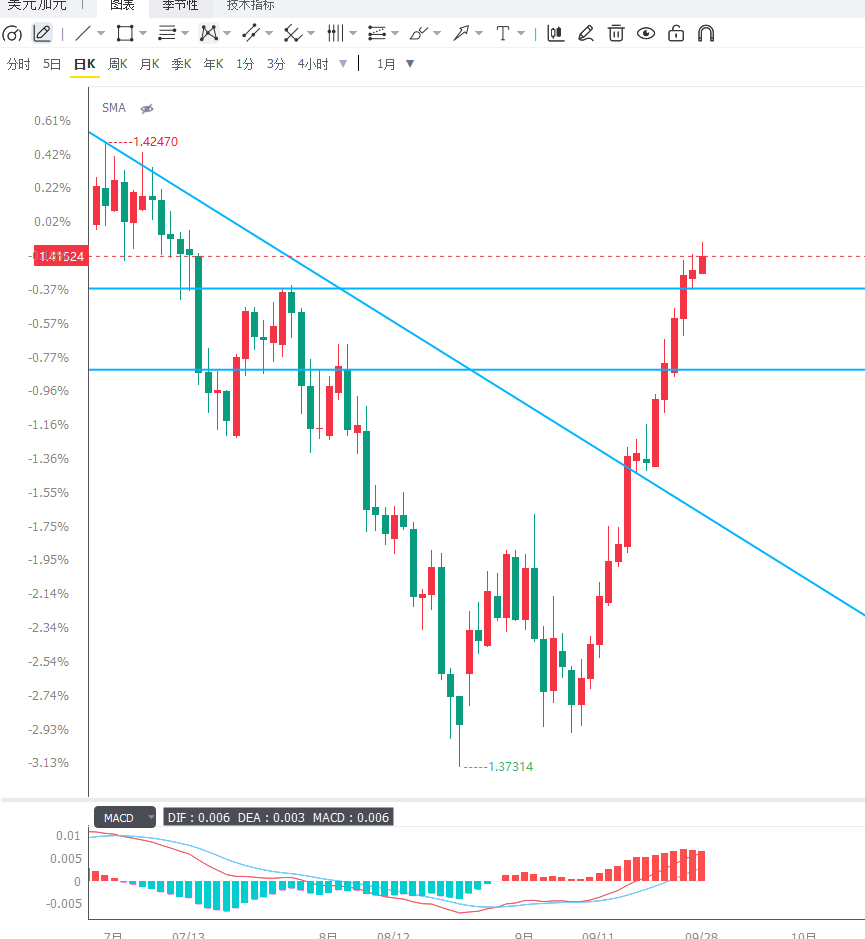 Editor's Summary: The continuous rise of the USD/CAD pair has been mainly driven by the widening interest rate differential between the US and Canada and a stronger US dollar. However, high oil prices and market expectations of a recent strong dollar are making it more difficult for the bulls to continue their upward momentum. This week's key US employment and PCE data will directly impact the Federal Reserve's October policy expectations, while the Bank of Canada's assessment of energy inflation is also worth noting. Technically, 1.4137 and 1.4246 are key resistance levels to watch, while 1.4050, 1.3990, and 1.3930 constitute important pullback areas.
Interest rate differentials have become a significant driver of the recent strength of USD/CAD. Market data shows that the probability of a Fed rate hike in October is currently around 65.9%, significantly higher than 57.6% a week ago and far higher than 9.4% a month ago. Meanwhile, the Fed raised its target range for the federal funds rate to 3.75%-4.00% in September, signaling the possibility of further policy tightening this year. However, the recent rise in USD/CAD is also beginning to be constrained by both valuation and policy expectations. Scotiabank strategists believe that the widening USD/CAD interest rate differential has been a major factor weighing on the Canadian dollar in recent weeks, but the recent weakness in the Canadian dollar has extended to some extent. The bank also points out that the market's pricing space for further Fed tightening has been limited, while there may be room for repricing in the Bank of Canada's policy expectations. Oil prices have become another important variable affecting the Canadian dollar's performance. Crude oil is a major Canadian export commodity, and generally, rising oil prices benefit the Canadian dollar. Therefore, the current situation in the Middle East is pushing oil prices high, putting some downward pressure on USD/CAD. Latest market data shows that WTI crude oil remained above $92 on Monday, with the market continuing to focus on the US-Iran situation and supply risks in the Strait of Hormuz. However, the current rise in oil prices has not provided significant support for the Canadian dollar. Previously, the rapid rise in US Treasury yields and increased expectations of a Fed rate hike significantly offset the positive impact of rising oil prices on the Canadian dollar. On September 24, USD/CAD briefly broke through 1.4100, approaching its highest level since the end of July, when both US yields and bets on a Fed rate hike strengthened significantly. This week, the market will see a series of new macroeconomic data releases. US employment data and the Fed's preferred inflation indicators will be important windows for observing the dollar and the USD/CAD interest rate differential. If employment and inflation data continue to be strong, the market may further increase its pricing in an October rate hike; conversely, if the data cools significantly, expectations of further Fed tightening may decline, thus weakening the upward momentum of USD/CAD. The US dollar index is currently trading near the 101 level, and this week's non-farm payrolls and PCE data may further amplify dollar volatility. In Canada, the market will continue to assess the impact of energy prices on inflation. The Bank of Canada remains focused on the inflation risks posed by rising energy prices, with related institutions believing that the oil price shock has increased the complexity of the October policy decision. Therefore, the subsequent movement of USD/CAD is not solely determined by the Fed's expectations, but rather by the rebalancing of the USD/CAD interest rate differential, oil prices, and economic data from both countries. USD/CAD has maintained a clear short-term upward structure recently. After previously regaining a key Fibonacci level, the price continued to rise. The 78.6% Fibonacci retracement level around 1.4137 is currently an important upside watch area; a further break above this level would target the previous cycle high around 1.4246. On the downside, the first support level to watch is around 1.4050, corresponding to the 61.8% Fibonacci retracement level; if the price falls back and breaks below this support, further attention will be paid to the 50% retracement level around 1.3990 and the 38.2% retracement level around 1.3930. Overall, while USD/CAD remains in a bullish structure, the short-term volatility has extended after the continuous rise. 1.4137 is a key technical level to watch. If it breaks through effectively, it may test 1.4246 further. If it fails to break through and falls back below 1.4050, we need to be wary of short-term profit-taking pushing the price back to 1.3990 or even 1.3930. Editor's Summary: The continuous rise of the USD/CAD pair has been mainly driven by the widening interest rate differential between the US and Canada and a stronger US dollar. However, high oil prices and market expectations of a recent strong dollar are making it more difficult for the bulls to continue their upward momentum. This week's key US employment and PCE data will directly impact the Federal Reserve's October policy expectations, while the Bank of Canada's assessment of energy inflation is also worth noting. Technically, 1.4137 and 1.4246 are key resistance levels to watch, while 1.4050, 1.3990, and 1.3930 constitute important pullback areas.
- Risk Warning and Disclaimer
- The market involves risk, and trading may not be suitable for all investors. This article is for reference only and does not constitute personal investment advice, nor does it take into account certain users’ specific investment objectives, financial situation, or other needs. Any investment decisions made based on this information are at your own risk.