The 101 level has been breached, but dollar bulls are exiting the market?
2026-09-28 15:28:16
On Monday, September 28th, the US dollar index traded above the 101 level with little intraday volatility. On the fundamental side, the Federal Reserve's meeting on September 15th-16th raised the target range for the federal funds rate by 25 basis points to 3.75% to 4.00%, marking the first rate hike since 2023. US Treasury yields rose in tandem: approximately 4.90% for the two-year maturity, 5.20% for the ten-year maturity, and 5.51% for the thirty-year maturity. Crude oil remained high, above $90 per barrel, amid unresolved tensions in the Strait of Hormuz. The preliminary reading of the S&P Global Composite Purchasing Managers' Index for September rose to 58.4. Regarding positions, data from the Commodity Futures Trading Commission for the week ending September 15th showed that non-commercial net long positions in US dollar index futures had fallen to approximately 10,600 contracts, remaining at approximately 10,300 contracts the following week. The simultaneous rise in prices and the contraction of speculative long positions is a contradiction that needs to be analyzed in detail in this round of market movements. 
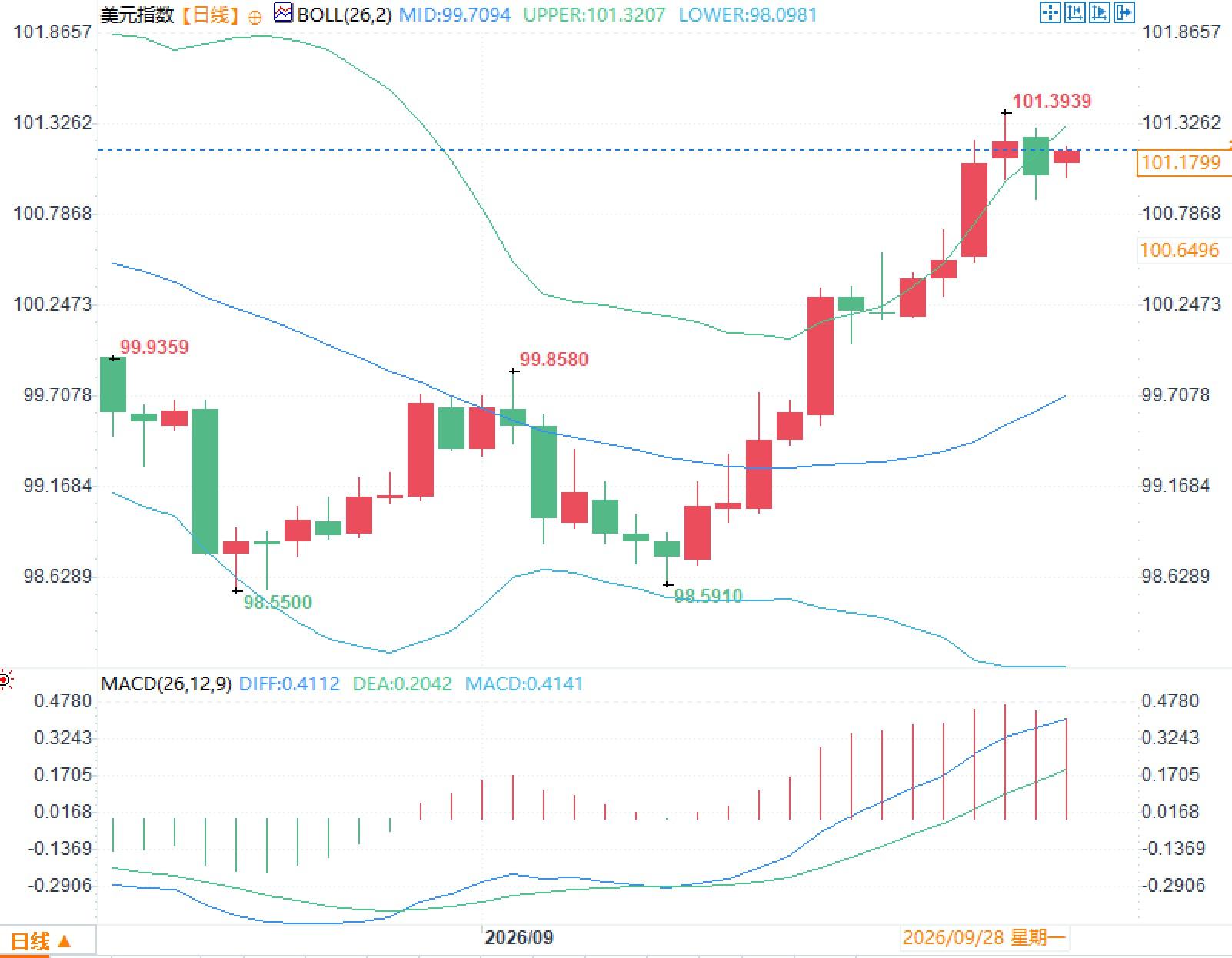 The fact that the US dollar index can continue to rise even as the open interest weakens suggests that this round of gains is driven more by interest rates, energy, and data than by the self-reinforcing nature of speculative positions. This means two things must be considered separately: first, whether the trend is still supported by macroeconomic variables; and second, whether crowding has decreased. The former determines the explanatory framework, while the latter determines who is providing liquidity when volatility increases. A series of US data releases are scheduled for September 29th: Job Openings and Labor Force Mobility Survey; September 30th: Private Sector Employment and Personal Consumption Expenditures Prices; October 1st: ISM Manufacturing Index; and October 2nd: Non-Farm Payrolls. Goolsby, Williams, Barkin, Collins, and others will still speak. The data and speeches will simultaneously examine whether the expansion of activity has spread to employment and whether price stickiness has been re-incorporated into expectations by the energy premium.
The yield curve rose in tandem with policy pricing.
The recent rebound in the US dollar index has not been directly impacted by individual exchange rate fluctuations, but rather by the overall rise in the US Treasury yield curve. The two-year yield is approaching 4.90%, reflecting the market's reassessment of the short-term policy path; the ten-year yield is around 5.20%, corresponding to the term premium and inflation compensation at the longer end; and the thirty-year yield is around 5.51%, incorporating ultra-long-term supply, risk premium, and inflation stickiness. The short end reflects policy expectations, while the long end reflects compensation requirements; the simultaneous upward shift at both ends indicates that the pricing focus has expanded from "one adjustment" to "whether the central interest rate needs to be raised further." After the Fed's September rate hike, the target range for the federal funds rate is between 3.75% and 4.00%. The dot plot shows that 16 of the 18 officials who submitted forecasts believe there is at least one more 25-basis-point increase this year, with four of them writing an additional 50-basis-point increase, bringing the year-end median interest rate to approximately 4.1%. The market is still pricing in additional tightening at the October 27-28 meeting and the December 8-9 meeting, and discussions about an additional 30 basis points this year have not disappeared from the curve.Energy premiums have brought inflation discussions back to the forefront.
West Texas Intermediate crude oil is trading above $90 per barrel, and the conflict in the Strait of Hormuz has yet to see any substantial progress that can be confirmed by the market. High energy prices will impact exchange rate pricing along two chains: one is inflation expectations, as rising gasoline, transportation, and industrial input costs make it harder for consumer prices and personal consumption expenditure prices to fall; the other is the relative position of real and nominal interest rates, as a rise in nominal interest rates in line with inflation compensation will recalculate the relative yield differential of dollar assets. US business activity data for September clarifies this chain. The preliminary composite Purchasing Managers' Index (PMI) was 58.4, higher than August's 56.0; the services sector was around 58.7, and manufacturing was around 57.0, both showing simultaneous expansion rarely seen in recent years. The survey also indicated that rising energy costs, increased supply delays, and a backlog of orders accelerated the recovery in input prices. While expanded activity itself only indicates that demand remains, it does not automatically mean that policy must be adjusted again; however, it will change the weight officials place on supply shocks when discussing them. If the shock is judged to be short-lived, policies can wait for it to subside; if the shock is judged to be recurring, waiting itself will be considered a risk.Officials stated that the September rate hike is a process, not a destination.
Following the Fed's September rate hike, officials' speeches focused not on reiterating the already implemented 25 basis point increase, but on explaining the sources of inflation. Chicago Fed President Goolsby stated that both supply and demand are pushing up prices, adding that "to bring inflation back down, we need to raise interest rates and narrow the supply-demand gap." If the main driver is confirmed to be overheated demand, the policy response will be more immediate and larger. St. Louis Fed President Musaleem believes that persistent demand and recurring supply forces are still increasing inflation risks. Without further constraints, prices are more likely to be significantly higher than the 2% target in 18 months, rather than returning to near the target. Therefore, he favors earlier and more gradual tightening rather than delaying action. New York Fed President Williams said, "Another rate hike before the end of the year would likely be appropriate." Boston Fed President Collins cited renewed Middle East conflict and sticky inflation as reasons to support the September action. Richmond Fed President Barkin likened inflation to a recurring troublemaker, suggesting that one warning may not be enough. Philadelphia Fed President Paulson stated that a slight further tightening might be necessary if conditions evolve as he sees. These statements share a common thread: they don't outline a timeline, but they remove the assumption that "supply shocks will subside on their own" from their default assumptions. Officials also emphasized that subsequent decisions will be based on data, not market sentiment or external pressures. For the market, this means that every employment, price, and business survey before the October meeting will be used to examine whether the September rate hike was a one-off adjustment or the first step in a sequence.What does the coexistence of contracting open interest and rising prices indicate?
Data from the Commodity Futures Trading Commission shows that as of the week ending September 15, non-commercial net long positions in US dollar index futures fell to approximately 10,600 contracts, a weakening four-week trend; open interest was approximately 43,800 contracts. The proportion of speculative long positions decreased from approximately 30.43% to approximately 24.44%, with the relevant percentile falling back to around 44-45, close to the neutral zone. As of the week ending September 22, net long positions remained at approximately 10,300 contracts, with open interest at approximately 46,300 contracts. The decline in net long positions, along with participation, suggests more likely long position reduction and fund exits than concentrated short position building. The fact that the US dollar index can continue to rise even as the open interest weakens suggests that this round of gains is driven more by interest rates, energy, and data than by the self-reinforcing nature of speculative positions. This means two things must be considered separately: first, whether the trend is still supported by macroeconomic variables; and second, whether crowding has decreased. The former determines the explanatory framework, while the latter determines who is providing liquidity when volatility increases. A series of US data releases are scheduled for September 29th: Job Openings and Labor Force Mobility Survey; September 30th: Private Sector Employment and Personal Consumption Expenditures Prices; October 1st: ISM Manufacturing Index; and October 2nd: Non-Farm Payrolls. Goolsby, Williams, Barkin, Collins, and others will still speak. The data and speeches will simultaneously examine whether the expansion of activity has spread to employment and whether price stickiness has been re-incorporated into expectations by the energy premium.
- Risk Warning and Disclaimer
- The market involves risk, and trading may not be suitable for all investors. This article is for reference only and does not constitute personal investment advice, nor does it take into account certain users’ specific investment objectives, financial situation, or other needs. Any investment decisions made based on this information are at your own risk.