With US-Iran negotiations expected to resume this week, what will happen to oil prices?
2026-09-28 15:10:15
WTI crude oil futures rebounded slightly in Asian trading on Monday (September 28), currently trading around $93.80 per barrel, as US President Trump rejected a peace deal with Iran. The proposal aimed to end the US-Iran conflict and reopen the Strait of Hormuz. Trump rejected Iran's proposal to reopen the Strait of Hormuz on Sunday, saying Tehran was eager for a deal, while indicating he expected negotiations with Iran to resume this week. Iran stated it was awaiting a clear response from the US regarding its seven-day proposal to reopen the strait and other demands, and would not soften its conditions. 
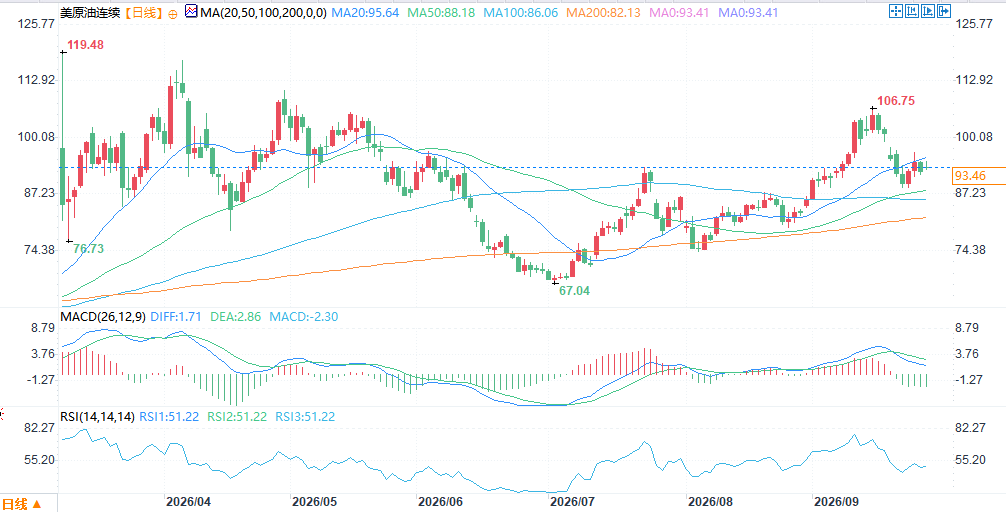 (US crude oil futures daily chart, source: FX678) At 15:08 Beijing time, US crude oil futures were trading at $93.98 per barrel.
Trump rejects Iran's proposal; negotiations expected to resume this week, but Iran remains unyielding.
On Sunday, Trump explicitly rejected Iran's proposal to reopen the Strait of Hormuz, noting Tehran's eagerness to reach an agreement. He also stated that negotiations with Iran were expected to resume this week, but Iran has not yet shown any signs of softening its conditions. Iran responded that it awaits a clear response from the US regarding its seven-day proposal to reopen the strait and other related demands, emphasizing that it will not soften its existing conditions. This standoff means that a substantial breakthrough in US-Iran diplomacy is unlikely in the short term. As a crucial passage for global oil transportation, the Strait of Hormuz continues to face risks, directly supporting the risk premium in oil prices. The market is closely watching the progress of negotiations this week; any softening of stance or further hardening of the position will quickly be transmitted to energy prices. The current stalemate has reinforced concerns about supply disruptions, keeping oil prices high due to geopolitical premiums and exerting continued pressure on global inflation expectations.Houthi rebels continue attacks on Saudi Arabia, making regional supply chains vulnerable.
The Saudi-backed coalition in Yemen stated that its air defense system successfully intercepted two drones launched by Houthi rebels towards Riyadh, as well as a ballistic missile targeting the southern border region of Khamis Mushait. ANZ analysts pointed out that geopolitical risks remain high, with continued attacks on Saudi Arabia by the Houthis and Iran making regional supply chains vulnerable. The Houthi's ongoing attacks on Saudi Arabia, and its operations along the Red Sea coast, continue to pose supply risks to two key Middle Eastern waterways—the Strait of Hormuz and the Bab el-Mandeb Strait. These two channels carry significant shares of global oil transportation, and any disruption could trigger supply shortages. Analysts believe that the combination of multiple risks is putting pressure on the regional energy supply chain, providing additional support for international oil prices. Market sensitivity to the Middle East situation has increased, and the Houthi's continued actions have become a significant variable in oil price fluctuations.The market is focused on API and EIA inventory data.
Traders are bracing for the American Petroleum Institute (API) weekly inventory data to be released later on Tuesday. A larger-than-expected drop in crude oil inventories typically indicates stronger demand, potentially pushing up WTI crude prices; conversely, a larger-than-expected increase reflects weaker demand or oversupply, potentially putting downward pressure on WTI prices. Following this, the U.S. Energy Information Administration (EIA) crude oil inventory data will be officially released on Wednesday, with the market using this data to verify the accuracy of the API data. In the current context where geopolitical risks dominate pricing, these inventory data provide crucial clues to short-term supply and demand balance. Continued inventory declines will reinforce the narrative of tight supply, further supporting oil prices; unexpected accumulations could alleviate some upward pressure. Traders will combine geopolitical dynamics with inventory changes to assess the short-term direction of oil prices. The guiding role of inventory data is particularly important in a high-risk premium environment.Institutional View: Oil Prices Add Pressure to Interest Rate and Inflation Stories
Analysts at Mitsubishi UFJ Financial Group warn that oil prices are adding another layer of pressure to the interest rate narrative, as the latest rise in crude oil prices has begun to transmit to bond market dynamics. They emphasize that renewed geopolitical risks in the Middle East, occurring against the backdrop of an already tense oil market, have triggered dual concerns about supply and inflation, thereby reinforcing the upside risks to global interest rate expectations. High oil prices push up overall inflationary pressures through the energy cost channel, causing bond yields to rise, which in turn affects the policy paths of major central banks such as the Federal Reserve. This chain reaction forms a cycle of "rising oil prices—inflation expectations rising—interest rates rising." Analysts believe that in an environment of overlapping geopolitical risks and tight supply and demand, the impact of oil prices on the macroeconomic interest rate narrative cannot be ignored. Investors need to incorporate energy price fluctuations into their framework for judging interest rates and inflation, and be wary of their additional impact on monetary policy expectations.Summarize
WTI crude oil rebounded slightly in Asian trading on Monday as Trump rejected the Iran peace deal. While US-Iran negotiations are expected to resume this week, Iran remains unyielding, and the risk to passage through the Strait of Hormuz persists. Houthi attacks continue in Saudi Arabia, weakening regional supply flows, and ANZ Bank stated that geopolitical risks remain high. The market is focused on API and EIA inventory data to assess short-term supply and demand balance. Mitsubishi UFJ warned that oil prices are adding pressure to interest rates and inflation, with Middle East geopolitical risks occurring against an already tense oil market backdrop, reinforcing the upward risk to global interest rate expectations. Future developments will depend on the progress of US-Iran negotiations, whether Houthi attacks escalate, changes in inventory data, and the transmission of high oil prices to inflation and central bank policy. Given the coexistence of supply risks and geopolitical tensions, the risk premium in oil prices is unlikely to dissipate, limiting downside potential. (US crude oil futures daily chart, source: FX678) At 15:08 Beijing time, US crude oil futures were trading at $93.98 per barrel.
- Risk Warning and Disclaimer
- The market involves risk, and trading may not be suitable for all investors. This article is for reference only and does not constitute personal investment advice, nor does it take into account certain users’ specific investment objectives, financial situation, or other needs. Any investment decisions made based on this information are at your own risk.