Rising oil prices are putting pressure on the Indian rupee. How long can the Reserve Bank of India's intervention last?
2026-09-28 15:54:16
The dollar rose 0.15% against the Indian rupee to around 95.95 due to higher oil prices. The MCX crude oil contract expiring on October 19th rose 1.7% to nearly 9,000 rupees. Currencies of economies like India that heavily rely on oil imports to meet their energy needs often underperform in environments with high oil prices. Meanwhile, the Reserve Bank of India continued to support the rupee through intervention in the spot and non-deliverable forward markets. 
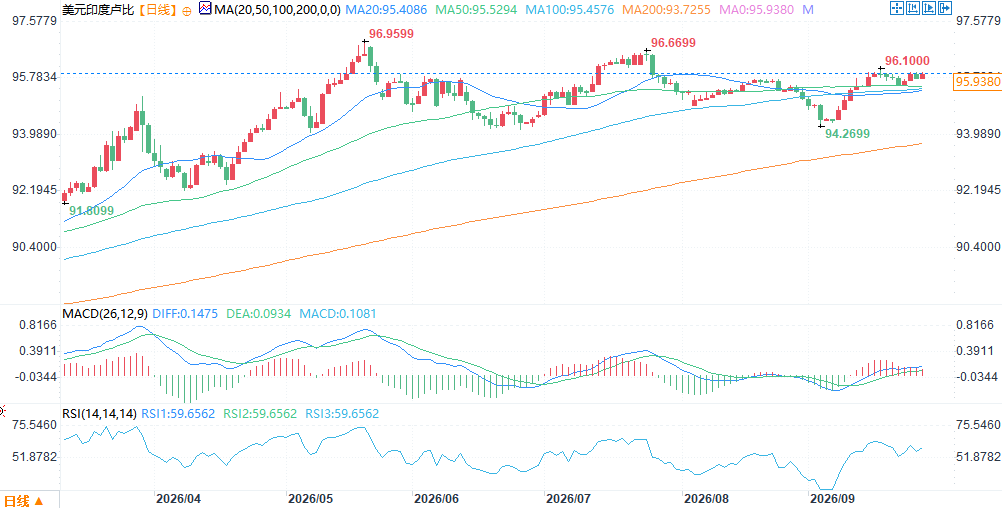 (USD/INR daily chart, source: FX678) At 15:48 Beijing time, the USD/INR exchange rate was 95.94/95.
Trump postpones diplomatic hopes; oil prices rise over the weekend.
Oil prices attracted heavy buying over the weekend as US President Trump postponed hopes for diplomacy with Iran, adding that additional military strikes were possible before the midterm elections. Trump expressed confidence that Washington would soon win the conflict, stating, "Once we win, oil prices will fall, drop significantly back to pre-conflict levels." Meanwhile, Iranian Foreign Minister Araqchi stated that Iran was open to "real diplomacy," but was prepared for a "doomsday war" should the US attack again. This standoff exacerbated geopolitical uncertainty in the Middle East, directly pushing up oil prices and putting pressure on the Indian rupee.High US Treasury yields put pressure on risk assets.
U.S. Treasury yields remained high due to strong market expectations of another Federal Reserve rate hike this year, continuing to be a key concern for risk assets. The 10-year Treasury yield held near 5.23%, a 19-year high reached last Friday. OCBC strategists noted that recent resilient U.S. data and sticky inflation have translated into stronger expectations of further Fed action. "Market pricing currently suggests a roughly 70% probability of another 25 basis point rate hike in October, highlighting the market's growing belief that the Fed's inflation battle is not over." High U.S. Treasury yields are attracting funds to dollar assets, suppressing emerging market currencies, including the Indian rupee.The Reserve Bank of India's continued intervention provides a floor for the rupee.
The Reserve Bank of India (RBI) continued to support the rupee through intervention in the spot and non-deliverable forward (NDF) markets. Traders said, "We're seeing some level of intervention almost daily, which suggests the RBI wants to maintain a firm floor for the rupee for the time being." This intervention provided short-term support for the rupee, limiting the upside potential of the USD/IRR pair. However, the effectiveness of the intervention depends on oil prices and the dollar's performance; if oil prices remain high and US Treasury yields remain high, downward pressure on the rupee will persist.Divergent opinions among institutions: Will the Reserve Bank of India remain on hold or raise interest rates by 50 basis points?
Commerzbank analysts emphasize that although year-to-date CPI inflation has averaged 3.8%, lower than the Reserve Bank of India's (RBI) forecast of 5.0% for fiscal year 2026-2027, the underlying price backdrop remains a concern. They believe that "persistent cost pressures suggest policymakers are likely to maintain a cautious stance," reinforcing the view that the RBI will remain in "wait-and-see mode." In Commerzbank's view, "evidence of higher global oil prices and second-round effects continues to pose upside risks to the inflation outlook," keeping the central bank vigilant. Contrary to Commerzbank's view, MUFG strategists believe that robust domestic growth and signs of widening core pressures are strengthening the case for a 50 basis point rate hike in the second half of fiscal year 2027, making the October meeting a "suspenseful" one.Summarize
The Indian rupee opened lower due to rising oil prices, with the USD/IRR pair rising to around 95.95. Trump's postponement of diplomatic hopes with Iran and reservations about the possibility of military strikes pushed up oil prices; US Treasury yields remained near a 19-year high of 5.23%, with the market pricing in a roughly 70% probability of a Fed rate hike in October, suppressing risk assets. The Reserve Bank of India's (RBI) continued intervention provided a floor for the rupee. Commerzbank believes the RBI will remain on the sidelines, as cost pressures and oil prices pose upside risks to inflation; Mitsubishi UFJ believes robust growth and increasing core pressures strengthen the case for a 50 basis point rate hike, leaving the October meeting uncertain. Going forward, attention should be paid to oil price movements, US Treasury yields, Indian inflation data, and the RBI's policy statements. If oil prices remain high and US Treasury yields remain high, the rupee may continue to be under pressure; if the RBI raises rates or oil prices fall, the rupee may find some respite. (USD/INR daily chart, source: FX678) At 15:48 Beijing time, the USD/INR exchange rate was 95.94/95.
- Risk Warning and Disclaimer
- The market involves risk, and trading may not be suitable for all investors. This article is for reference only and does not constitute personal investment advice, nor does it take into account certain users’ specific investment objectives, financial situation, or other needs. Any investment decisions made based on this information are at your own risk.