The weight of the Hormuz index has decreased, the US has adjusted its narrative on Iran, and the high oil price stalemate continues.
2026-09-28 16:26:14
As of September 28, 2026, the nearly seven-month-long US-Iran standoff in the Middle East has not cooled down, with both countries maintaining a diplomatic stance of "deterrence while negotiations." However, there are some differences compared to before. Previously, the US believed that the Strait of Hormuz was the entirety of oil supply, but currently, a large part of the rise in refined oil prices is due to the Russia-Ukraine conflict. Trump blamed the diesel supply shortage on Ukraine's attack on Russian oil refineries, while some oil supply also depends on the Houthis and Saudi Arabia. The relative importance of the Strait of Hormuz is decreasing, so logically, the US can take a tough stance against Iran because Trump's logic is that a US-Iran war has not excessively affected international oil prices. On the contrary, a tough stance against Iran can be packaged as ensuring the removal of the nuclear threat, controlling some of Iran's oil in the future, and selling more of its own shale gas at higher prices. Trump publicly rejected the seven-day passage plan to Iran and retained the option of launching a new round of military strikes before the midterm elections, but he did not sever diplomatic channels and still plans to continue contact with Iran this week. This state of "neither complete breakdown nor substantial easing" has kept the crude oil market at a high risk premium, but it is difficult to break out of the trend of unilateral rise or fall. 
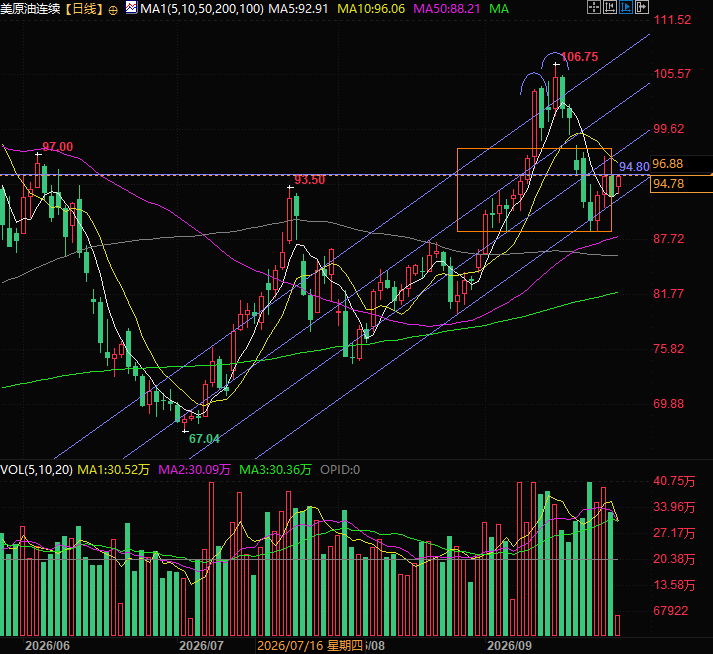 (WTI crude oil futures main contract daily chart, source: EasyTrade) Beijing time WTI crude oil futures main contract is currently trading at $94.87 per barrel.
Iran's seven-day plan: A rapid replication of the June collapse agreement
The seven-day step-by-step plan proposed by Iran is not a completely new framework, but rather a compressed and upgraded version of the interim agreement reached in June, and also the core theme of this geopolitical game. Iran demands that the US first lift the port blockade, resume oil exports, unfreeze overseas assets, and promote de-escalation of the situation in Lebanon; the US would reopen the Strait of Hormuz on the sixth day after completing these preliminary measures, and initiate final negotiations on the nuclear program on the seventh day. In June of this year, the US and Iran reached a 60-day interim ceasefire agreement, but it quickly and completely collapsed. The root cause of the breakdown lay in the disagreement over waterway control—Iran refused the US's unilateral establishment of alternative routes bypassing Iranian control and resumed attacks on ships; the US subsequently reinstated the blockade and revoked oil waivers, shattering bilateral trust. This seven-day short-term plan is Iran's way of learning from the lessons of the June agreement's collapse, using a phased implementation design to reduce the risk of the other side defaulting midway.The fundamental deadlock: The demands of the US and Iran are completely misaligned, leaving no room for compatibility.
The structural opposition to the core bottom lines of both sides is the root cause of the difficulty in making progress in negotiations. Iran's demands are all focused on economic relief and lifting of the blockade, while insisting that all negotiations must be premised on concessions from the US. The US's core demands focus on nuclear capability constraints, requiring Iran to limit its high-enriched uranium and enrichment production capacity, accept strict inspections, and refuse to let the issue of shipping routes dictate the pace of negotiations. At the same time, US decision-making is deeply tied to the domestic political cycle: with the midterm elections approaching in November, high oil prices continue to erode the purchasing power of American voters, the Republican Party is under significant pressure, and Trump continues to waver between "military hardline" and "oil price inflationary pressures," further amplifying the uncertainty of the situation.Latest update: Risks associated with the two shipping routes in the Middle East + Saudi Arabia's complete reversal of its stance
The current energy risks are no longer limited to the Strait of Hormuz, but rather the Persian Gulf and the Red Sea are simultaneously under pressure. Saudi Arabia's stance has shifted from "supporting negotiations" in the summer to deep skepticism, primarily due to the double blow to supply: First, the Houthi rebels in Yemen control the Red Sea coast, bringing shipping through the Bab el-Mandeb Strait to a near standstill and completely cutting off the Middle Eastern crude oil export route via the Red Sea; second, the attack on Saudi Arabia's main east-west oil pipeline in September, with a daily capacity of 2.6-4 million barrels (4% of global supply), and a repair period of three to five weeks, completely eliminating Saudi Arabia's export redundancy by bypassing the Strait of Hormuz. Furthermore, the Gulf Straits governance conference, originally scheduled to be hosted by Oman, was canceled due to irreconcilable differences between Saudi Arabia and Iran, exposing a deep division in the Gulf states' policies towards Iran and significantly reducing the controllability of the regional situation. Moreover, Iran's current negotiating proposal only covers a ceasefire in Lebanon, deliberately preserving leverage for the Houthi rebels in Yemen and continuing to pressure the United States.Iran's internal divisions: the biggest hidden risk of its collapse
The market has largely overlooked the uncertainty arising from internal factional divisions within Iran. Iran is currently characterized by a clear binary opposition: the moderate reformists, represented by the president and foreign minister, advocate for diplomatic solutions and the lifting of sanctions; while the hardline conservatives, represented by the Revolutionary Guard and high-ranking clerics, resolutely oppose compromise with the US, stating that "resistance is the only option." The Iranian parliament speaker's rare public acknowledgment of internal divisions, coupled with this tug-of-war, suggests a very high risk that even if a US-Iran agreement is reached, it could be internally rejected and torn up again. The nearly seven-month-long joint US-Israeli strikes have already resulted in over 5,000 casualties in Iran, damage to numerous power plants, bridges, and desalination facilities, and a simultaneous increase in domestic economic and livelihood pressures alongside a hardline military stance.Real supply chain disruptions: shipping disruptions + spread of global energy inflation
While cargo flows through the Taiwan Strait haven't completely collapsed, shipping controls continue to tighten. As of September 25, the US blockade had forced 122 merchant ships to divert, and Iran simultaneously banned unauthorized shipping lanes, keeping market risk aversion high. The inflationary transmission from the conflict has fully materialized: since the start of the conflict, gasoline prices in the US have risen by nearly 45%, and diesel by 66%, while diesel prices in emerging markets have surged by as much as 80%–92%. Persistently high energy inflation may force global central banks to adjust their interest rate paths. Regional spillover risks are also spreading simultaneously; the UAE has indefinitely suspended flights operated by Iranian airlines since September 24, further increasing the risk of non-compliance in regional energy logistics and maintenance supply chains.Summary and Technical Analysis:
The US is currently altering its narrative regarding the Iraq War. The partial resumption of shipping capacity in the Strait of Hormuz allows it to directly blame Russia and Ukraine for rising oil prices. A tough stance against Iran helps stabilize the base of MAGA supporters, while supporting AI and securing agricultural and coal contracts boosts its midterm election votes. Regarding negotiations, even if Iran proposes reconciliation first, the potential internal divisions within Iran mean that a viable agreement is unlikely unless the Revolutionary Guard approves. Therefore, oil prices may remain high until either the US or Iran surrenders. Furthermore, some analyses suggest that high oil prices and interest rates will not immediately impact the AI industry, as the returns on AI investments can be amplified by oligarchs. Going forward, besides monitoring whether the aforementioned narrative is validated, three key variables can be directly observed: first, whether Qatar's mediation can bridge the differences in pre-existing conditions between the two sides. Second, will the US escalate military action before the midterm elections? Third, will the shipping conditions along the Red Sea and Persian Gulf routes, including the progress of Saudi pipeline repairs, remain uncertain? Until there are clear signs of easing or escalation in the situation, oil prices will continue to fluctuate widely and volatilely. Technically, WTI crude oil futures are still in an upward channel, and oil prices are likely to continue to rebound. The current resistance level is around 94.80, the 0.618 Fibonacci retracement level. (WTI crude oil futures main contract daily chart, source: EasyTrade) Beijing time WTI crude oil futures main contract is currently trading at $94.87 per barrel.
- Risk Warning and Disclaimer
- The market involves risk, and trading may not be suitable for all investors. This article is for reference only and does not constitute personal investment advice, nor does it take into account certain users’ specific investment objectives, financial situation, or other needs. Any investment decisions made based on this information are at your own risk.