From shelf prices to energy shocks: These are the variables that sterling traders should really be watching, not the BRC.
2026-09-29 10:24:13
On Tuesday (September 29) during Asian trading hours, the pound traded in a narrow range against the dollar, currently hovering around 1.3250. Newly released UK shop price data provided new insights for the market to assess the inflation path and the central bank's policy outlook. Data from the British Retail Consortium (BRC) showed that the annual shop price inflation rate in the UK slowed to 1.4% in September from 1.5% in August, slightly above the three-month average of 1.3%. Food inflation slowed to 2.5% from 2.8%, while non-food inflation slowed to 0.8% from 0.9%. The BRC called on the Chancellor of the Exchequer to cut business taxes in the October 28 budget, due to rising cost pressures from the conflict with Iran. 
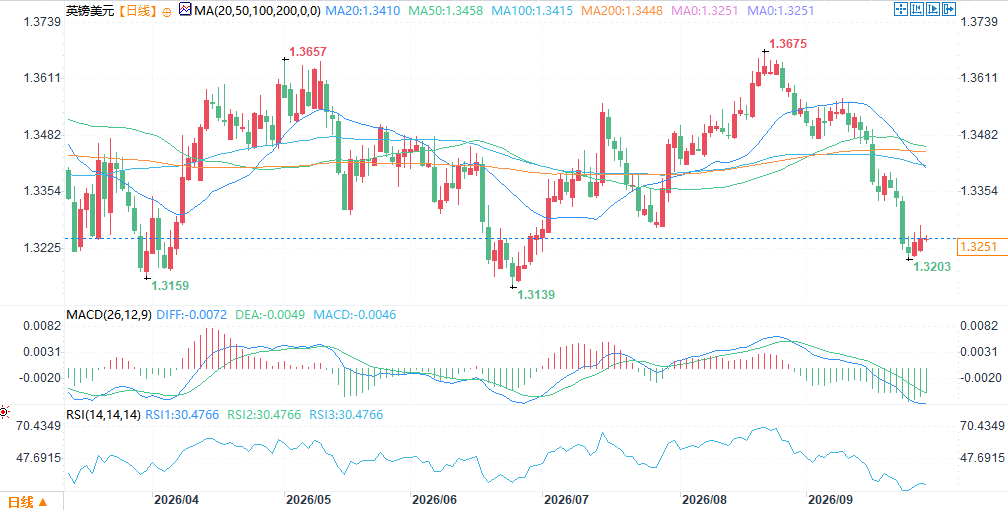 (GBP/USD daily chart, source: FX678) At 10:21 Beijing time, GBP/USD was trading at 1.3253/54.
Inflation in both food and non-food sectors has slowed, primarily due to promotions and discounts.
Food prices drove most of the changes. Food inflation slowed to 2.5% from 2.8% as promotions lowered meat and dairy prices. This easing was partially offset by poor harvests in Europe pushing up fruit prices, while high commodity prices kept chocolate and confectionery expensive. Non-food inflation also slowed to 0.8% from 0.9%, as heavy discounts lowered the prices of back-to-school essentials. Overall, store price inflation slowed slightly, but the reading remained just above the three-month average of 1.3%.Retailers say they have absorbed multiple rounds of cost increases and are nearing their limit.
BRC CEO Helen Dickinson stated that retailers have absorbed a range of additional costs, but businesses have limited capacity to absorb them. She cited the higher business tax expiring in April, coupled with rising employment costs, energy bills, and packaging taxes, describing the upcoming budget as a critical moment for the industry. The BRC hopes Chancellor John Healy will use his October 28th tax and spending plan to help retailers reduce business taxes, believing this will help keep prices down. Retailers say they are nearing their limits with conflict-driven costs rising and the budget approaching.There is a gap between store prices and official inflation, and the energy shock has not yet been fully transmitted.
The softer shop price readings contrast with the broader inflation picture. The UK's broader official consumer price index rose to 3.1% in August and is projected to climb above 4% by early 2027 due to energy price shocks related to the conflict with Iran. This gap suggests that the pressures described by retailers have not yet fully translated into shelf prices, even though promotions and discounts have temporarily suppressed retail indicators. Energy is a swing factor: oil and gas prices related to the conflict with Iran directly impact retail costs and affect the inflation outlook, so diplomatic headlines can quickly influence UK interest rates and expectations for the pound.The market is focused on official inflation data and budgets, with energy costs being key.
Markets may be less concerned about a slight decline in store prices, focusing instead on the official inflation path, which is expected to rise above 4% next year. The BRC indicator is a narrow, retrospective snapshot, so markets are more focused on the broader official inflation path. A budget with business tax cuts will provide some relief for retailers, but it won't eliminate broader energy-driven cost pressures. Attention now turns to the next official inflation reading, whether energy costs will continue to rise as the conflict with Iran continues, and what the October 28th budget offers retailers in terms of business taxes.Slowing shop prices are unlikely to change the pound's direction; energy and budget are the key variables.
Shop price inflation slowed to 1.4% from 1.5%, with both food and non-food prices declining. This superficially signals easing inflationary pressures and could theoretically reduce the urgency of a Bank of England rate hike, putting a slight negative on the pound. However, the market is likely to take this reading less seriously – the BRC indicator is a narrow, retrospective snapshot with limited coverage and a significant gap from the official inflation path. The UK's official CPI rose to 3.1% in August, and the energy shock from the conflict with Iran is projected to exceed 4% by early 2027, meaning that the cost pressures described by retailers have not yet been fully passed on to shelf prices. For the pound, the real variables are energy prices and fiscal policy. Oil and gas prices related to the conflict with Iran directly impact retailer costs and the overall inflation outlook. Any diplomatic developments or headlines about an escalation of the conflict could quickly change market pricing in the Bank of England's interest rate path, thus affecting the pound. Furthermore, the BRC's call for the Chancellor to cut business taxes in the October 28th budget, while potentially easing cost pressures on retailers if the budget provides substantial relief, will not eliminate broader energy-driven inflation. Therefore, the current exchange rate of pound sterling against the dollar is more driven by the dollar's performance, the interest rate differential between the US and the UK, and energy prices. Store price data alone is unlikely to change the direction of the exchange rate unless subsequent official inflation data confirms a significant easing or intensification of inflationary pressures.Summarize
UK shop price inflation slowed to 1.4% in September, with food inflation falling to 2.5% and non-food inflation to 0.8%, as promotions and discounts pushed prices down, but poor harvests in Europe pushed up fruit prices. The BRC warned retailers were nearing their breaking point and called on the Chancellor to cut business tax in the October 28th budget. The softer shop price reading contrasts with official inflation: the official CPI was 3.1% in August and is projected to rise above 4% by early 2027 due to the energy shock from the conflict with Iran. This gap suggests that retailer pressures have not yet fully translated to shelf space. Energy is a volatile factor, and diplomatic headlines can quickly influence UK interest rates and pound expectations. Going forward, attention will be focused on the next official inflation reading, whether energy costs continue to rise, and the business tax arrangements in the October 28th budget. A business tax cut would provide relief for retailers but would not eliminate energy-driven cost pressures. (GBP/USD daily chart, source: FX678) At 10:21 Beijing time, GBP/USD was trading at 1.3253/54.
- Risk Warning and Disclaimer
- The market involves risk, and trading may not be suitable for all investors. This article is for reference only and does not constitute personal investment advice, nor does it take into account certain users’ specific investment objectives, financial situation, or other needs. Any investment decisions made based on this information are at your own risk.