The dollar's strength, coupled with hawkish expectations from the Federal Reserve, has led to a continued volatile rebound against the yen.
2026-09-29 13:22:16
The USD/JPY pair maintained a slightly stronger trend in Asian trading on Tuesday, trading around 157.40, continuing its recent rebound. The US dollar remained strong overall, supported by expectations of hawkish Federal Reserve policy and rising US Treasury yields. However, the yen's depreciation has drawn continued attention from both Japanese and US officials, and the closer the pair approaches the 160 level, the more sensitive the market becomes to potential policy intervention.  Japanese Finance Minister Katsunobu Kato stated that she and U.S. Treasury Secretary Scott Bessant have strengthened communication regarding the weakening yen and believe that the yen's undervaluation is problematic. Jun Mimura, Japan's top foreign exchange official, previously stated that the market should take seriously the clear signals from both Japan and the U.S. regarding the yen's weakness. Japan also emphasized that it will continue to maintain close communication with the U.S. Treasury to ensure the orderly operation of the foreign exchange market. These statements have reignited market concerns about the risks of currency intervention. Japan had previously stated that the basic principles followed in the coordinated intervention by Japan and the U.S. at the end of July remain valid, meaning that the market is still watching the policy response space should the yen depreciate too quickly and disorderly. However, from the perspective of interest rate differentials, the USD/JPY exchange rate still has strong fundamental support. The yield on the 10-year U.S. Treasury note recently rose to its highest level since 2007, while the dollar index remained near a two-month high of around 101.2. The market currently expects a greater than 70% probability of another Fed rate hike in October, meaning that the expected interest rate differential between the U.S. and Japan remains favorable for the dollar. The Bank of Japan had previously raised its policy rate to 1.25%, but the yen did not strengthen as a result. The market still believes that as long as US yields remain high and the pace of further policy tightening in Japan is relatively limited, the USD/JPY exchange rate is unlikely to reverse its trend solely due to the Bank of Japan's rate hikes. The core contradiction in USD/JPY currently lies in the direct interplay between the US interest rate advantage and the risk of Japanese policy intervention. Energy prices are also a significant variable in the recent foreign exchange market. Middle East supply risks have driven oil prices back up, and Japan's high dependence on energy imports means that higher energy costs will further increase import inflation pressure from yen depreciation. At the same time, rising oil prices may strengthen US inflation expectations and push up US Treasury yields, further supporting the dollar and creating a complex two-way transmission effect on USD/JPY. From a market sentiment perspective, investors have not completely abandoned their dollar bullish positions, but they are also unwilling to ignore policy risks and continue chasing the price higher in the 157-160 range. Especially after Japanese officials repeatedly warned about yen valuation and market order, USD/JPY may face greater volatility if it continues to rise at higher levels. Therefore, the current upward logic for USD/JPY remains intact, but the policy risks at higher levels are clearly increasing. This week's US economic data will be a key catalyst for the next phase of market movements. The market will focus on PCE inflation, employment data, and speeches by Federal Reserve officials. If US data continues to be strong and US Treasury yields remain high, the US dollar may continue to receive support; if the data cools significantly, interest rate expectations may decline, pushing USD/JPY into a technical correction. From a daily chart perspective, USD/JPY has rebounded from its recent lows and climbed back above the Bollinger Band middle line around 156.15, but it is currently still below the 100-day moving average at 159.55 and the upper Bollinger Band at 159.50, indicating that the short-term rebound is still limited by medium-term technical pressure. The 14-day RSI is around 50, having recovered from oversold territory to a neutral level, and currently shows no obvious overbought signal. The area between 159.50 and 159.55 forms a dense resistance zone; a successful break above this level would signify a further correction of the short-term weak structure; otherwise, the high-level consolidation pattern may continue. From the 4-hour chart, USD/JPY maintains its rebound structure, but the 157.50 to 158.00 area has become a short-term battleground between bulls and bears. If the price can hold above 158.00, it may further test the 159.00 and 159.50 areas. If it rallies but is rejected and falls below 156.15, the short-term downward pressure will increase significantly, and the next target can be the lower Bollinger Band around 152.85. Since the exchange rate is already close to the policy-sensitive 159.50-160.00 area, technical breakouts and policy risks may amplify simultaneously, and short-term volatility is expected to remain high.
 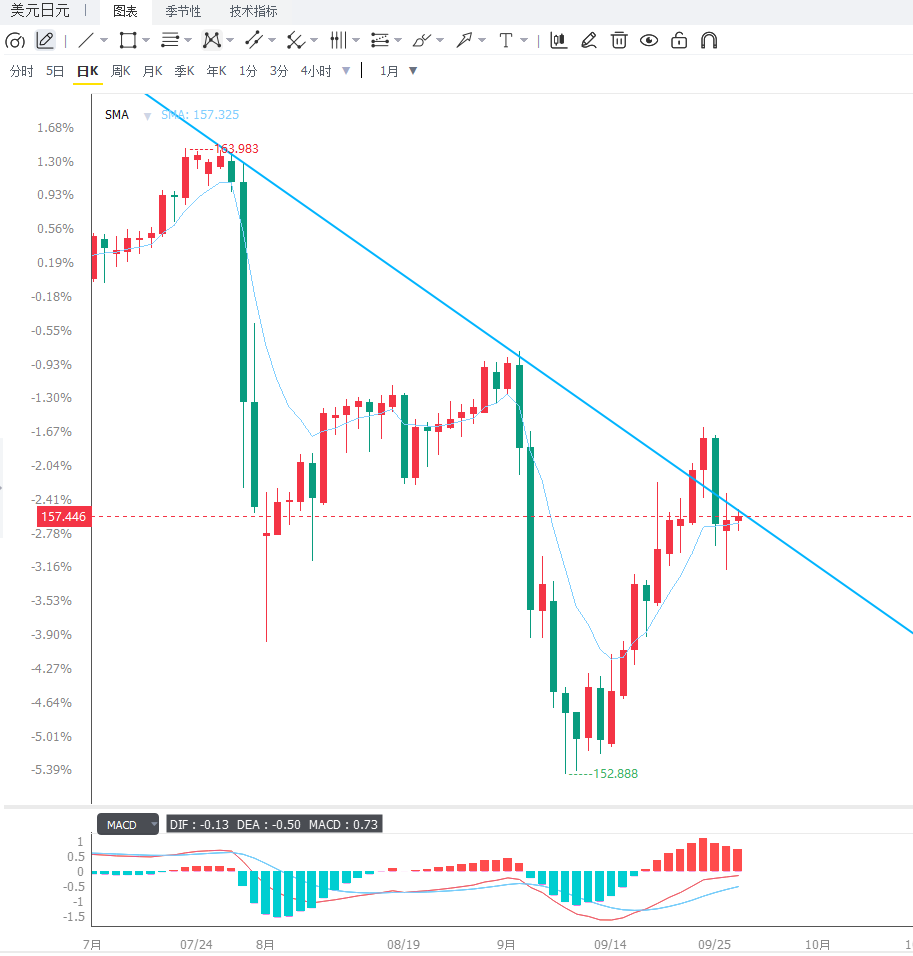 Editor's Summary: The USD/JPY pair remains supported by the USD/JPY interest rate differential and a strong US dollar. However, continued statements from Japanese and US officials regarding the yen's depreciation make the risk of policy intervention a significant factor limiting further upside for the exchange rate. Future market movements will continue to revolve around two main themes: rising US yields and the risk of Japanese policy intervention. In the short term, 156.15 is a key support level, 159.50-159.55 is a crucial resistance zone, and 160.00 is a psychologically important level that the market is closely watching. If US economic data continues to reinforce hawkish expectations from the Federal Reserve, USD/JPY may remain at high levels; however, if yields fall or Japanese policy signals become more hawkish, the exchange rate may experience a significant pullback from its highs.
Japanese Finance Minister Katsunobu Kato stated that she and U.S. Treasury Secretary Scott Bessant have strengthened communication regarding the weakening yen and believe that the yen's undervaluation is problematic. Jun Mimura, Japan's top foreign exchange official, previously stated that the market should take seriously the clear signals from both Japan and the U.S. regarding the yen's weakness. Japan also emphasized that it will continue to maintain close communication with the U.S. Treasury to ensure the orderly operation of the foreign exchange market. These statements have reignited market concerns about the risks of currency intervention. Japan had previously stated that the basic principles followed in the coordinated intervention by Japan and the U.S. at the end of July remain valid, meaning that the market is still watching the policy response space should the yen depreciate too quickly and disorderly. However, from the perspective of interest rate differentials, the USD/JPY exchange rate still has strong fundamental support. The yield on the 10-year U.S. Treasury note recently rose to its highest level since 2007, while the dollar index remained near a two-month high of around 101.2. The market currently expects a greater than 70% probability of another Fed rate hike in October, meaning that the expected interest rate differential between the U.S. and Japan remains favorable for the dollar. The Bank of Japan had previously raised its policy rate to 1.25%, but the yen did not strengthen as a result. The market still believes that as long as US yields remain high and the pace of further policy tightening in Japan is relatively limited, the USD/JPY exchange rate is unlikely to reverse its trend solely due to the Bank of Japan's rate hikes. The core contradiction in USD/JPY currently lies in the direct interplay between the US interest rate advantage and the risk of Japanese policy intervention. Energy prices are also a significant variable in the recent foreign exchange market. Middle East supply risks have driven oil prices back up, and Japan's high dependence on energy imports means that higher energy costs will further increase import inflation pressure from yen depreciation. At the same time, rising oil prices may strengthen US inflation expectations and push up US Treasury yields, further supporting the dollar and creating a complex two-way transmission effect on USD/JPY. From a market sentiment perspective, investors have not completely abandoned their dollar bullish positions, but they are also unwilling to ignore policy risks and continue chasing the price higher in the 157-160 range. Especially after Japanese officials repeatedly warned about yen valuation and market order, USD/JPY may face greater volatility if it continues to rise at higher levels. Therefore, the current upward logic for USD/JPY remains intact, but the policy risks at higher levels are clearly increasing. This week's US economic data will be a key catalyst for the next phase of market movements. The market will focus on PCE inflation, employment data, and speeches by Federal Reserve officials. If US data continues to be strong and US Treasury yields remain high, the US dollar may continue to receive support; if the data cools significantly, interest rate expectations may decline, pushing USD/JPY into a technical correction. From a daily chart perspective, USD/JPY has rebounded from its recent lows and climbed back above the Bollinger Band middle line around 156.15, but it is currently still below the 100-day moving average at 159.55 and the upper Bollinger Band at 159.50, indicating that the short-term rebound is still limited by medium-term technical pressure. The 14-day RSI is around 50, having recovered from oversold territory to a neutral level, and currently shows no obvious overbought signal. The area between 159.50 and 159.55 forms a dense resistance zone; a successful break above this level would signify a further correction of the short-term weak structure; otherwise, the high-level consolidation pattern may continue. From the 4-hour chart, USD/JPY maintains its rebound structure, but the 157.50 to 158.00 area has become a short-term battleground between bulls and bears. If the price can hold above 158.00, it may further test the 159.00 and 159.50 areas. If it rallies but is rejected and falls below 156.15, the short-term downward pressure will increase significantly, and the next target can be the lower Bollinger Band around 152.85. Since the exchange rate is already close to the policy-sensitive 159.50-160.00 area, technical breakouts and policy risks may amplify simultaneously, and short-term volatility is expected to remain high. Editor's Summary: The USD/JPY pair remains supported by the USD/JPY interest rate differential and a strong US dollar. However, continued statements from Japanese and US officials regarding the yen's depreciation make the risk of policy intervention a significant factor limiting further upside for the exchange rate. Future market movements will continue to revolve around two main themes: rising US yields and the risk of Japanese policy intervention. In the short term, 156.15 is a key support level, 159.50-159.55 is a crucial resistance zone, and 160.00 is a psychologically important level that the market is closely watching. If US economic data continues to reinforce hawkish expectations from the Federal Reserve, USD/JPY may remain at high levels; however, if yields fall or Japanese policy signals become more hawkish, the exchange rate may experience a significant pullback from its highs.
- Risk Warning and Disclaimer
- The market involves risk, and trading may not be suitable for all investors. This article is for reference only and does not constitute personal investment advice, nor does it take into account certain users’ specific investment objectives, financial situation, or other needs. Any investment decisions made based on this information are at your own risk.