Stalled US-Iran negotiations fueled oil prices and inflation concerns, pushing the dollar index up to around 101.20 for the second consecutive day.
2026-09-29 14:44:15
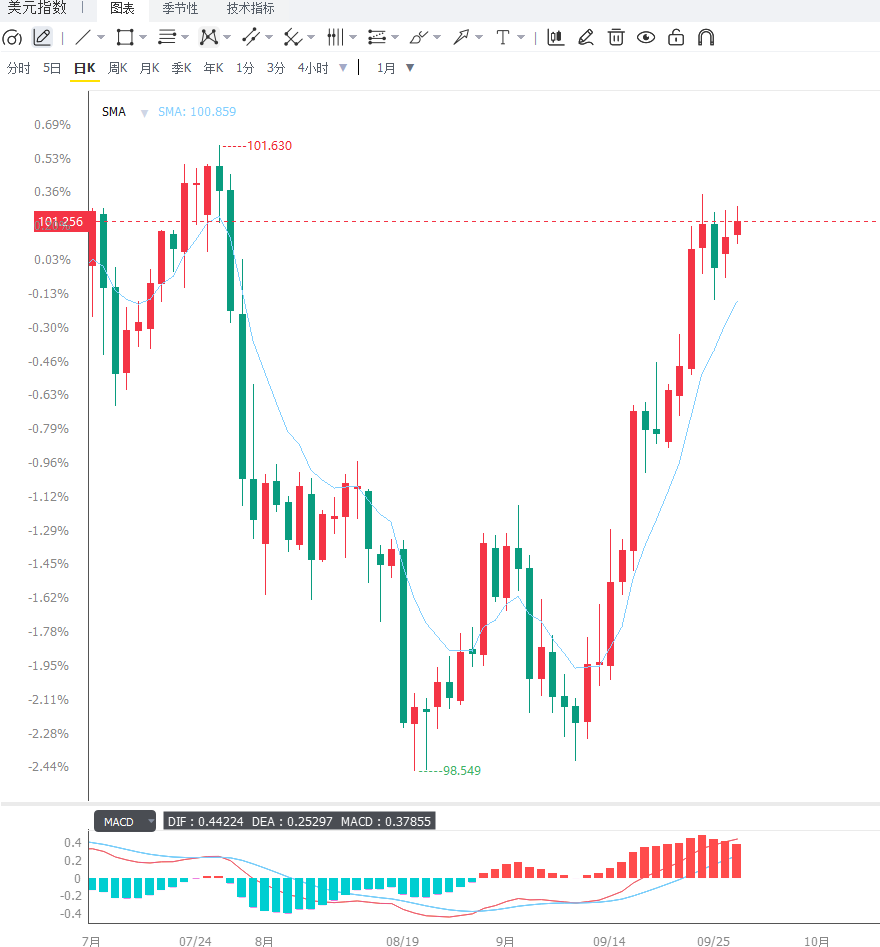
The US dollar index extended its gains in Asian trading on Tuesday, trading around 101.20, marking its second consecutive day of increases. The dollar has recently regained support from both interest rate expectations and safe-haven demand, particularly after the Middle East situation kept energy prices high, leading to renewed market concerns about US inflationary pressures and further strengthening expectations of further monetary tightening by the Federal Reserve.  One of the core drivers of the current dollar strength comes from the energy market. Negotiations between the US and Iran remain stalled, and market expectations for the restoration of supplies through the Strait of Hormuz and a de-escalation of regional tensions have cooled. Iran has recently adopted a cautious stance on reaching an agreement before the US midterm elections, and the US's previous rejection of Iranian proposals has added further uncertainty to the diplomatic process. Against this backdrop, oil prices have strengthened again, further transmitting to inflation expectations. Rising energy costs not only directly increase consumer and business spending but may also amplify price pressures through transportation and manufacturing. The current rise in oil prices is influencing dollar pricing again through inflation expectations and has become a significant factor driving up US Treasury yields. Changes in the US Treasury market further reinforce this logic. Yields on both 10-year and 30-year US Treasury bonds have risen to multi-year highs above 5%, indicating that the market is reassessing future inflation and monetary policy paths. Higher bond yields increase the relative attractiveness of dollar assets while increasing the opportunity cost of holding other low-yield currencies. Regarding monetary policy, the market has begun to increase expectations for further interest rate hikes by the Federal Reserve. The Federal Reserve recently raised interest rates for the first time in over three years, and current market pricing data using interest rate futures indicate a roughly 70% probability of another 25 basis point rate hike in October. If energy prices remain high and drive up inflation expectations, the likelihood of the Fed shifting towards a tighter policy stance will continue to be a significant support for the dollar. However, dollar long positions have not shown significant out-of-control behavior. Rabobank analysis shows limited overall change in speculative net long positions in the dollar, with both long and short positions increasing, indicating that market participants are readjusting their positions rather than forming one-sided bets. This means that while the recent dollar rally is supported by fundamentals, investors still have some disagreement about the future policy direction. The market's focus will shift to US macroeconomic data in the next phase. The Personal Consumption Expenditures Price Index (PCE) released this Wednesday and the non-farm payroll report on Friday will directly influence market judgments on the Fed's future policy path. If the PCE shows renewed acceleration in inflationary pressures while the job market remains resilient, the dollar may receive further support from interest rate expectations; if inflation and employment data show a significant cooling, US Treasury yields may fall, weakening the dollar's recent upward momentum. Furthermore, oil prices remain an important external variable for the dollar's performance. If negotiations between the US and Iran remain stalled, energy supply risks could continue to push up oil prices, thereby reinforcing inflation and interest rate expectations. Conversely, if diplomatic communication progresses and energy supplies recover, the oil price risk premium could decline, potentially weakening some of the recent interest rate support for the US dollar. Therefore, the short-term trend of the US dollar is actually influenced by three main factors simultaneously: oil prices, yields, and US macroeconomic data. Looking at the daily chart, the US dollar index has risen for the second consecutive day, currently standing above the 101.00 level, with an overall short-term bullish structure. After a previous correction, the dollar has regained upward momentum. If it can continue to stabilize above 101.00, it is expected to further test 101.50 and the previous high area. At the same time, it is necessary to pay attention to whether momentum indicators such as the RSI enter overbought territory to determine whether there is technical correction pressure after the continuous rise of the dollar. If the price falls below 100.70 again, the short-term bullish structure may weaken. Looking at the 4-hour chart, the US dollar index maintains an upward oscillating structure, with price highs and lows gradually rising, indicating that the bulls still hold a certain advantage in the short term. The area around 101.20 is a key level to watch. A decisive break above 101.50 could extend the short-term uptrend further; conversely, a failure to break higher and a drop below 100.70 could lead to a consolidation phase at higher levels. Further support is seen around 100.30. Overall, the US dollar remains relatively strong in the short term, but with the PCE and non-farm payroll data approaching this week, market positioning may occur before the release of key data, potentially leading to increased volatility.
  Editor's Summary: The US dollar index is currently supported by a combination of factors, including interest rate expectations, energy prices, and safe-haven demand. Rising US Treasury yields to multi-year highs and market expectations of another rate hike in October provide strong fundamental support for the dollar. However, overall speculative positioning in the dollar remains relatively balanced, indicating that bullish positions have not become extremely crowded. In the short term, 101.00 is a key psychological support level for the dollar index, while 101.50 is a resistance area to watch for further upward movement. Subsequent PCE inflation and non-farm payroll data will be key catalysts for market movements. If inflation and employment remain strong, the dollar's strength may continue; if the data shows a significant cooling, both yields and the dollar may face pressure for a period of correction.
One of the core drivers of the current dollar strength comes from the energy market. Negotiations between the US and Iran remain stalled, and market expectations for the restoration of supplies through the Strait of Hormuz and a de-escalation of regional tensions have cooled. Iran has recently adopted a cautious stance on reaching an agreement before the US midterm elections, and the US's previous rejection of Iranian proposals has added further uncertainty to the diplomatic process. Against this backdrop, oil prices have strengthened again, further transmitting to inflation expectations. Rising energy costs not only directly increase consumer and business spending but may also amplify price pressures through transportation and manufacturing. The current rise in oil prices is influencing dollar pricing again through inflation expectations and has become a significant factor driving up US Treasury yields. Changes in the US Treasury market further reinforce this logic. Yields on both 10-year and 30-year US Treasury bonds have risen to multi-year highs above 5%, indicating that the market is reassessing future inflation and monetary policy paths. Higher bond yields increase the relative attractiveness of dollar assets while increasing the opportunity cost of holding other low-yield currencies. Regarding monetary policy, the market has begun to increase expectations for further interest rate hikes by the Federal Reserve. The Federal Reserve recently raised interest rates for the first time in over three years, and current market pricing data using interest rate futures indicate a roughly 70% probability of another 25 basis point rate hike in October. If energy prices remain high and drive up inflation expectations, the likelihood of the Fed shifting towards a tighter policy stance will continue to be a significant support for the dollar. However, dollar long positions have not shown significant out-of-control behavior. Rabobank analysis shows limited overall change in speculative net long positions in the dollar, with both long and short positions increasing, indicating that market participants are readjusting their positions rather than forming one-sided bets. This means that while the recent dollar rally is supported by fundamentals, investors still have some disagreement about the future policy direction. The market's focus will shift to US macroeconomic data in the next phase. The Personal Consumption Expenditures Price Index (PCE) released this Wednesday and the non-farm payroll report on Friday will directly influence market judgments on the Fed's future policy path. If the PCE shows renewed acceleration in inflationary pressures while the job market remains resilient, the dollar may receive further support from interest rate expectations; if inflation and employment data show a significant cooling, US Treasury yields may fall, weakening the dollar's recent upward momentum. Furthermore, oil prices remain an important external variable for the dollar's performance. If negotiations between the US and Iran remain stalled, energy supply risks could continue to push up oil prices, thereby reinforcing inflation and interest rate expectations. Conversely, if diplomatic communication progresses and energy supplies recover, the oil price risk premium could decline, potentially weakening some of the recent interest rate support for the US dollar. Therefore, the short-term trend of the US dollar is actually influenced by three main factors simultaneously: oil prices, yields, and US macroeconomic data. Looking at the daily chart, the US dollar index has risen for the second consecutive day, currently standing above the 101.00 level, with an overall short-term bullish structure. After a previous correction, the dollar has regained upward momentum. If it can continue to stabilize above 101.00, it is expected to further test 101.50 and the previous high area. At the same time, it is necessary to pay attention to whether momentum indicators such as the RSI enter overbought territory to determine whether there is technical correction pressure after the continuous rise of the dollar. If the price falls below 100.70 again, the short-term bullish structure may weaken. Looking at the 4-hour chart, the US dollar index maintains an upward oscillating structure, with price highs and lows gradually rising, indicating that the bulls still hold a certain advantage in the short term. The area around 101.20 is a key level to watch. A decisive break above 101.50 could extend the short-term uptrend further; conversely, a failure to break higher and a drop below 100.70 could lead to a consolidation phase at higher levels. Further support is seen around 100.30. Overall, the US dollar remains relatively strong in the short term, but with the PCE and non-farm payroll data approaching this week, market positioning may occur before the release of key data, potentially leading to increased volatility. Editor's Summary: The US dollar index is currently supported by a combination of factors, including interest rate expectations, energy prices, and safe-haven demand. Rising US Treasury yields to multi-year highs and market expectations of another rate hike in October provide strong fundamental support for the dollar. However, overall speculative positioning in the dollar remains relatively balanced, indicating that bullish positions have not become extremely crowded. In the short term, 101.00 is a key psychological support level for the dollar index, while 101.50 is a resistance area to watch for further upward movement. Subsequent PCE inflation and non-farm payroll data will be key catalysts for market movements. If inflation and employment remain strong, the dollar's strength may continue; if the data shows a significant cooling, both yields and the dollar may face pressure for a period of correction.
- Risk Warning and Disclaimer
- The market involves risk, and trading may not be suitable for all investors. This article is for reference only and does not constitute personal investment advice, nor does it take into account certain users’ specific investment objectives, financial situation, or other needs. Any investment decisions made based on this information are at your own risk.