Rising oil prices and expectations of a Federal Reserve rate hike put pressure on silver, causing spot silver to decline for several consecutive days.
2026-09-29 14:38:15
Spot silver continued its decline in Asian trading on Tuesday, with XAG/USD trading around $60.90, after falling more than 5% in the previous session. Silver has recently faced significant selling pressure, primarily due to rising energy prices reigniting inflation expectations, while US Treasury yields have risen to multi-year highs, further increasing market expectations for further tightening of monetary policy by the Federal Reserve.  Negotiations between the US and Iran remain stalled, impacting market expectations for a recovery in energy supplies and causing crude oil prices to rebound. Iran has recently adopted a cautious stance on reaching an agreement before the US midterm elections, and previous US rejections of Iranian proposals have also stalled the diplomatic process. Rising oil prices are reinforcing market concerns about persistent inflation and putting pressure on non-interest-bearing silver through interest rate expectations. Increased energy costs can be passed on to overall prices through multiple stages, including transportation, manufacturing, and consumption. If oil prices remain high, the Federal Reserve may need to maintain a tight policy stance for a longer period to curb potential inflationary pressures. The market currently estimates a 70% probability of another 25 basis point rate hike in October, indicating that investors still have strong expectations for future monetary policy tightening. Changes in US Treasury yields are particularly important for silver. As a non-interest-bearing asset, silver faces a higher opportunity cost in an environment of rapidly rising yields. When US Treasury yields continue to rise, dollar assets become more attractive, and precious metals like silver are more susceptible to the impact of capital reallocation. The core logic behind the current decline in silver prices is the negative combination of rising oil prices, rising inflation expectations, and rising US Treasury yields. Interest rate pricing also indicates that investors have not completely abandoned expectations of further policy tightening. Market analysts believe that the OIS yield curve still reflects expectations of multiple rate hikes over the next year and a half. This means that even though the Fed has already completed a 25-basis-point rate hike, the market's assessment of the tightening cycle has not significantly reversed. Silver itself also has industrial attributes, so its price is not only affected by the US dollar and real yields, but also easily influenced by global economic growth expectations and changes in industrial demand. With energy costs continuing to rise, if corporate production costs increase further while economic growth momentum is suppressed, expectations for industrial demand for silver may also come under pressure, thus amplifying short-term volatility in the precious metals market. However, silver has shown some oversold characteristics after its rapid decline, and a technical rebound in the short term cannot be ruled out. The market will next focus on US PCE inflation data and the non-farm payroll report. If inflation and employment data are lower than expected, US Treasury yields and the US dollar may fall, thus providing room for silver to recover; conversely, if the data continues to show that inflation is resilient, the market may further increase expectations for Fed rate hikes, and silver will still face downward pressure. From the daily chart, silver's short-term structure has clearly weakened after a single-day drop of over 5%, with prices rapidly moving away from previous highs. The market now needs to closely observe the support level at the $60 mark. If buying support emerges in this area, a short-term oversold rebound is possible; however, if $60 is effectively breached, it means that bearish momentum remains dominant, and further support levels may be sought. Due to the recent significant decline, momentum indicators such as the RSI may gradually enter oversold territory, so shorting should be approached with caution regarding the risk of a technical pullback. From the 4-hour chart, XAG/USD remains in a clear downward oscillation structure, with rebound highs consistently moving lower, and the short-term trend has not yet shown a clear reversal. The first resistance level to watch is around $62.00, followed by the $64.00 area. If the price can regain $64 and stabilize, the short-term weakness may be alleviated; if the rebound continues to be resisted and falls below $60 again, further downward movement should be anticipated. Current market volatility is high, and rapid two-way price movements may occur around the release of PCE and non-farm payroll data.
 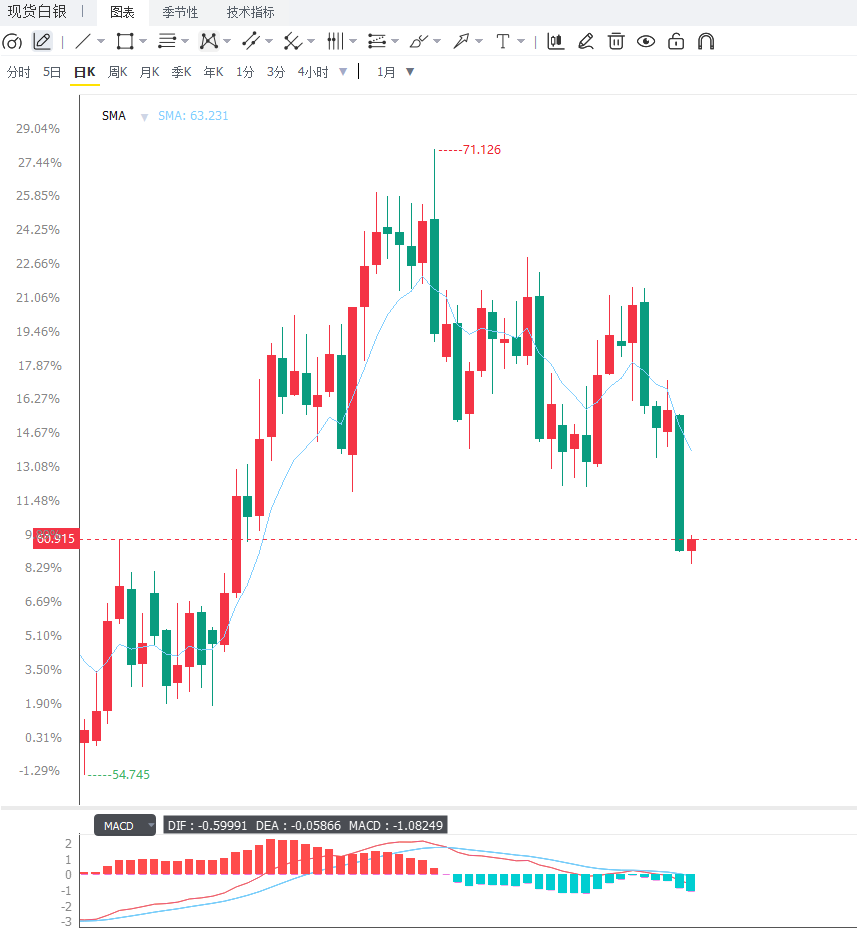 Editor's Summary: Silver is currently under pressure from US Treasury yields, a strong dollar, energy inflation, and expectations of further tightening by the Federal Reserve. Profit-taking after the previous rapid rise has also amplified the current correction. As silver possesses both precious and industrial metal attributes, its future performance will also be influenced by changes in global economic growth expectations. In the short term, $60 is a key psychological support level; whether it can hold will determine whether silver experiences a technical correction. The $62 and $64 levels are resistance areas to watch during any rebound. Subsequent US PCE inflation and non-farm payroll data will be important catalysts, and the direction of the dollar and US Treasury yields remain key variables in determining silver's short-term trend.
Negotiations between the US and Iran remain stalled, impacting market expectations for a recovery in energy supplies and causing crude oil prices to rebound. Iran has recently adopted a cautious stance on reaching an agreement before the US midterm elections, and previous US rejections of Iranian proposals have also stalled the diplomatic process. Rising oil prices are reinforcing market concerns about persistent inflation and putting pressure on non-interest-bearing silver through interest rate expectations. Increased energy costs can be passed on to overall prices through multiple stages, including transportation, manufacturing, and consumption. If oil prices remain high, the Federal Reserve may need to maintain a tight policy stance for a longer period to curb potential inflationary pressures. The market currently estimates a 70% probability of another 25 basis point rate hike in October, indicating that investors still have strong expectations for future monetary policy tightening. Changes in US Treasury yields are particularly important for silver. As a non-interest-bearing asset, silver faces a higher opportunity cost in an environment of rapidly rising yields. When US Treasury yields continue to rise, dollar assets become more attractive, and precious metals like silver are more susceptible to the impact of capital reallocation. The core logic behind the current decline in silver prices is the negative combination of rising oil prices, rising inflation expectations, and rising US Treasury yields. Interest rate pricing also indicates that investors have not completely abandoned expectations of further policy tightening. Market analysts believe that the OIS yield curve still reflects expectations of multiple rate hikes over the next year and a half. This means that even though the Fed has already completed a 25-basis-point rate hike, the market's assessment of the tightening cycle has not significantly reversed. Silver itself also has industrial attributes, so its price is not only affected by the US dollar and real yields, but also easily influenced by global economic growth expectations and changes in industrial demand. With energy costs continuing to rise, if corporate production costs increase further while economic growth momentum is suppressed, expectations for industrial demand for silver may also come under pressure, thus amplifying short-term volatility in the precious metals market. However, silver has shown some oversold characteristics after its rapid decline, and a technical rebound in the short term cannot be ruled out. The market will next focus on US PCE inflation data and the non-farm payroll report. If inflation and employment data are lower than expected, US Treasury yields and the US dollar may fall, thus providing room for silver to recover; conversely, if the data continues to show that inflation is resilient, the market may further increase expectations for Fed rate hikes, and silver will still face downward pressure. From the daily chart, silver's short-term structure has clearly weakened after a single-day drop of over 5%, with prices rapidly moving away from previous highs. The market now needs to closely observe the support level at the $60 mark. If buying support emerges in this area, a short-term oversold rebound is possible; however, if $60 is effectively breached, it means that bearish momentum remains dominant, and further support levels may be sought. Due to the recent significant decline, momentum indicators such as the RSI may gradually enter oversold territory, so shorting should be approached with caution regarding the risk of a technical pullback. From the 4-hour chart, XAG/USD remains in a clear downward oscillation structure, with rebound highs consistently moving lower, and the short-term trend has not yet shown a clear reversal. The first resistance level to watch is around $62.00, followed by the $64.00 area. If the price can regain $64 and stabilize, the short-term weakness may be alleviated; if the rebound continues to be resisted and falls below $60 again, further downward movement should be anticipated. Current market volatility is high, and rapid two-way price movements may occur around the release of PCE and non-farm payroll data. Editor's Summary: Silver is currently under pressure from US Treasury yields, a strong dollar, energy inflation, and expectations of further tightening by the Federal Reserve. Profit-taking after the previous rapid rise has also amplified the current correction. As silver possesses both precious and industrial metal attributes, its future performance will also be influenced by changes in global economic growth expectations. In the short term, $60 is a key psychological support level; whether it can hold will determine whether silver experiences a technical correction. The $62 and $64 levels are resistance areas to watch during any rebound. Subsequent US PCE inflation and non-farm payroll data will be important catalysts, and the direction of the dollar and US Treasury yields remain key variables in determining silver's short-term trend.
- Risk Warning and Disclaimer
- The market involves risk, and trading may not be suitable for all investors. This article is for reference only and does not constitute personal investment advice, nor does it take into account certain users’ specific investment objectives, financial situation, or other needs. Any investment decisions made based on this information are at your own risk.