Standard Chartered warns: CTA bullish funds have reached their limit in pushing up oil prices; only a physical supply shock will bring new upward momentum.
2026-09-29 15:22:23
Diplomatic negotiations yielded limited results, with confrontational rhetoric from both the US and Iran fueling market concerns about escalating conflict, leading to a rebound in international oil prices after previous declines. Last Wednesday, Iranian President Masoud Pezeshkian delivered a hardline speech at the United Nations, accusing the US of instigating war and disrupting global stability, and declaring that Iran would never yield. He stated that Iran was willing to initiate dialogue, but set seven preconditions for restarting negotiations, including unfreezing frozen funds and a comprehensive ceasefire. Just one day before the Iranian president's speech, US President Trump stated that he was considering a devastating strike against Iran, but reiterated that an agreement was expected after the US midterm elections. Mojtaba Khamenei, advisor to Iran's Supreme Leader, subsequently warned that if Iran were attacked again, the conflict would escalate to the Indian Ocean. Standard Chartered Bank commodity analysts pointed out that currently, crowded long positions in crude oil held by fund managers are limiting the upside potential of oil prices; only a deep disruption to the physical crude oil supply chain from war will give this round of oil price increases renewed upward momentum.
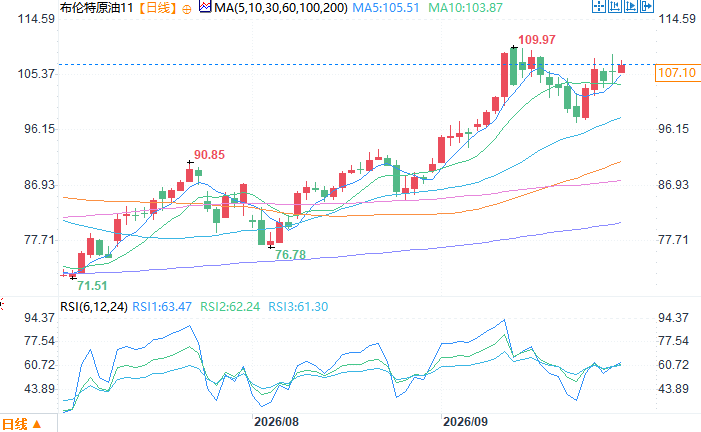 The daily chart for Brent crude oil for November delivery shows that at 15:04 Beijing time on September 29, Brent crude oil for November delivery was trading at $107.10 per barrel.
The bullish trend has reached its peak, and the logic behind rising oil prices has shifted.
Programmed trend-following funds (CTAs), relying on algorithmic models for trading, have established the largest long positions in Brent crude, WTI crude, and major refined product markets . Standard Chartered Bank stated that such extreme positioning structures have only occurred a handful of times in the past decade. The room for further additions to the programmed buying that previously drove up crude oil prices has been largely exhausted. For oil prices to continue rising, it cannot rely on trend-following funds chasing the rally; it requires the entry of autonomous decision-making funds or physical buyers. Standard Chartered analysts believe that once crude oil transportation in the Strait of Hormuz returns to normal, or Saudi crude oil exports further recover, the crude oil market could easily enter a consolidation phase, or even experience a rapid decline due to large-scale long position liquidation. However, the bank believes that this vulnerability in positioning does not necessarily indicate a long-term bearish outlook for crude oil. Institutions break down crude oil price risks into two paths: downside risk comes from concentrated liquidation of crowded long positions by funds; while a new round of price increases must rely on new physical supply shocks, such as renewed damage to oil and gas infrastructure, continued restrictions on crude oil transportation through the Strait of Hormuz, or the inability of existing alternative transportation solutions to sustain crude oil exports. The initial rise in oil prices was driven by fund holdings; for prices to reach new highs in the future, they will need to be impacted by supply shocks in the physical market.US refined oil prices surge, and Russian refining capacity recovery unlikely in the short term.
US retail diesel prices have surpassed $6.50 per gallon, a year-to-date increase of 83%, and nearly $1 higher than last month. Gasoline prices have risen less than diesel, but are approaching $4.50 per gallon, a year-to-date increase of 58%. Meanwhile, CTA long positions in refined oil products are also at historical highs , coupled with tight physical supply, making the refined oil market extremely risky. This month, Trump twice attributed the surge in refined oil prices to the impact on Russia's refining system, first calling on Ukraine to stop attacking Russian energy infrastructure, and then stating that the war has caused Russia to lose control of its diesel industry. Standard Chartered believes that even if Ukraine immediately stops its attacks, it will still take months to repair the damaged Russian refining capacity. Standard Chartered emphasizes that the risks to crude oil, refining, and logistics chains all depend on the direction of negotiations between the US and Iran. Until a clear solution is reached, the entire energy system continues to face the risk of supply disruptions. Currently, the global energy market has almost no buffer inventory to absorb new sudden shocks; if the conflict escalates again, supply could tighten within days. Conversely, a de-escalation of the situation could take weeks or even months, requiring a genuine recovery in crude oil production, refining, and export flows before the supply and demand fundamentals truly ease. Standard Chartered's long-term forecasts indicate that both crude oil and refined product prices still have upward potential, ultimately depending on the credibility and speed of the geopolitical solution's implementation.European natural gas prices rebounded after a decline, with continued inventory gaps providing support at the bottom.
Uncertainty surrounding the Middle East situation persists, and European natural gas prices rebounded from a three-week low, stabilizing at €74.26 per megawatt-hour on Monday. Last week, unverified rumors circulated that Iran might reopen the Strait of Hormuz within a week if the US met its demands, pushing prices down to around €70 per megawatt-hour. Standard Chartered stated that this decline was premature, as neither the US nor Iran confirmed any agreement or timetable for reopening the strait, and the fundamentals of European natural gas have not fundamentally changed. Over the past week, heating demand in Northwest Europe increased, and gas injection into storage facilities remained stable. Milder temperature forecasts before early October are expected to reduce heating consumption, allowing for a further increase in gas injections. However, European gas storage levels still fall significantly below normal years, and Standard Chartered expects this gap to continue providing a floor for European natural gas prices.Conclusion
In summary, the stalemate in US-Iran diplomatic negotiations and the tough statements from both sides have increased geopolitical risk premiums, driving a rebound in Brent and WTI crude oil prices. However, the current extremely crowded CTA long positions have limited the upside potential for oil prices, and the market driver has shifted from speculative trading to physical supply shocks. US diesel and gasoline retail prices have risen sharply, and the Russian refining capacity recovery cycle is lengthy, putting continued pressure on the refined oil market. Global energy market buffer inventories are low; escalating conflict could quickly tighten supply, while a de-escalation would require a longer period to repair the supply chain. European natural gas prices have rebounded from low levels, with storage gaps supporting the price floor. Going forward, it is necessary to continuously monitor the progress of US-Iran diplomatic negotiations, the navigation status of the Strait of Hormuz, and changes in CTA fund positions to determine the direction of energy market fluctuations. The daily chart for Brent crude oil for November delivery shows that at 15:04 Beijing time on September 29, Brent crude oil for November delivery was trading at $107.10 per barrel.
- Risk Warning and Disclaimer
- The market involves risk, and trading may not be suitable for all investors. This article is for reference only and does not constitute personal investment advice, nor does it take into account certain users’ specific investment objectives, financial situation, or other needs. Any investment decisions made based on this information are at your own risk.