Debt-driven hype, AI attracting investment, and traditional assets like gold bearing the liquidity costs.
2026-09-29 18:22:16
Previously, the core variables suppressing assets and dominating Federal Reserve policy were runaway inflation and expectations of interest rate hikes. However, with the Fed's continued hawkish stance and global inflation expectations gradually anchoring, the inflation-driven market cycle has ended. The core logic currently dominating long-term interest rates, reshaping asset pricing, and continuously suppressing gold prices is the structurally high interest rate environment jointly created by the US's medium- to long-term debt repayment pressure and the massive capital demands of AI. This is also the underlying reason for the continued pressure on gold and its fluctuating valuations in this round. 
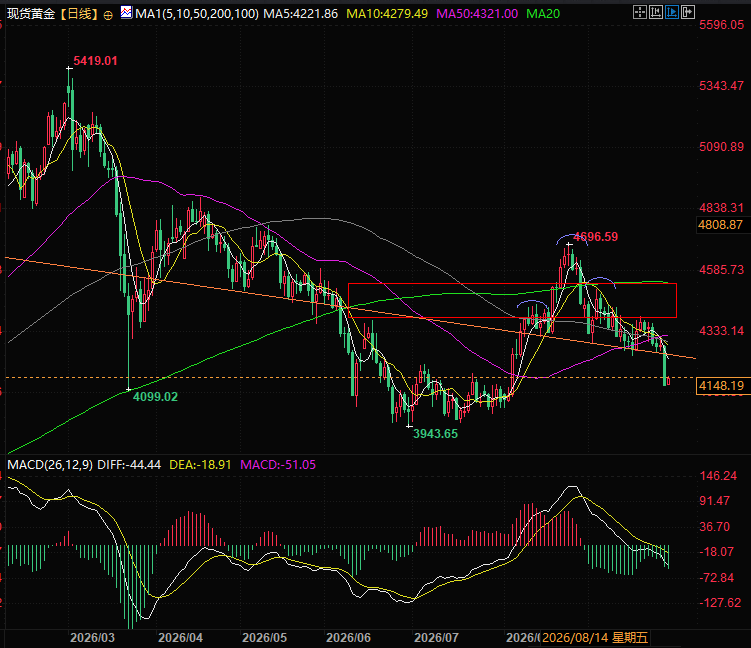 (Spot gold daily chart, source: EasyTrade) At 18:20 Beijing time, spot gold is currently trading at $4148 per ounce.
Market Theme Shifts: Inflation Recedes, Debt and Capital Demand Take Over Pricing
The core objective of this round of Fed rate hikes is to suppress runaway inflation expectations. After several rounds of intensive hawkish operations, current market inflation expectations have significantly converged, and the probability of a short-term inflation rebound or continued exceeding expectations has been greatly reduced. The bad news of inflation-driven rate hikes and negative impacts on gold has essentially ended. The new market theme is the structural risks of the US debt swap and the reshaping of long-term capital pricing. However, our view is that this part of the pricing in interest rates is inflated, but the inflated prices cannot be removed in the short term. The total US debt is $40 trillion, with a debt structure of $25 trillion in domestic debt and $15 trillion in foreign debt. This structure determines that there is almost no substantial risk of default on US sovereign debt: over 60% of the debt is held by domestic institutions and residents, representing a redistribution of domestic wealth, which can be continuously absorbed through domestic rollovers, liquidity adjustments, and fiscal buffers; the structure of only $15 trillion in foreign debt significantly reduces the tail risk of concentrated overseas capital sell-offs and a debt crisis. The period from 2026 to 2028 marks the peak of the replacement of low-interest, medium- to long-term US Treasury bonds during the pandemic. A massive amount of existing low-interest debt will be replaced by high-interest new debt, continuously raising the debt servicing costs of the US federal government. The rigid increase in government interest payments and the continued amplification of fiscal pressure are forcing the market to demand a higher risk premium, ultimately driving up long-term US Treasury yields. This explains why the current 10-year US Treasury yield has broken through 5.2% and the 30-year yield has exceeded 5.5%, reaching multi-year highs. However, this capital has overestimated the risk of a US debt default. This excessive caution has provided many long-term funds with excellent entry points for US Treasuries. Similar logic exists, for example, Japanese funds have begun buying 40-year Japanese government bonds at bargain prices, and US institutions are also looking for opportunities to buy US Treasuries at bargain prices. This is because the returns on US Treasuries and junk bonds are currently too high. This excessive worry naturally leads to a decline in the price of long-term assets, such as gold.AI Capital Siphoning: The Core Driver of This Round of High Interest Rates, Independent of Monetary Policy
Simple debt swap pressures are insufficient to support the current extremely high interest rate environment. The key driver of this round of sustained long-term interest rate increases comes from the intense capital competition and rigid investment demand in the AI industry, which is also the most unique structural characteristic of the current macro market. In traditional macroeconomic logic, interest rate hikes, which increase funding costs, would suppress corporate investment and inhibit industrial expansion. However, the AI oligopoly completely breaks this rule. Market consensus and industry practice confirm that the technological iteration, computing power deployment, and ecosystem dominance of leading AI companies have almost unlimited long-term return expectations. The extremely high potential rate of return makes AI giants completely unconstrained by high interest rates. Even with a significant increase in funding costs, leading companies such as Nvidia, Microsoft, and Meta continue to increase capital expenditures and launch stock buyback plans worth hundreds of billions of dollars, and the enthusiasm for industry investment continues to rise. For global allocation institutions, the current risk-free long-term bond yield is at a multi-year extreme, representing a once-in-a-decade opportunity for stable allocation. A large amount of overseas funds and long-term asset management institutions continue to sell risky assets and increase holdings of US and Japanese bonds, further tightening market liquidity and consolidating the high interest rate environment. Under this environment, the disadvantages of gold are magnified infinitely. As a non-interest-bearing general equivalent, gold's core pricing anchor is the real interest rate and opportunity cost. The combined effect of AI-driven increases in industrial capital returns and rising interest rate premiums due to US debt risk has led to a significant increase in real interest rates. This has caused gold's holding costs to soar and its investment value to decline continuously, ultimately resulting in a structural divergence: "rising debt risk benefits gold's hedging properties, but high interest rates completely suppress gold prices." In short, the expectation of excess returns from the AI industry and the rigid premium of US debt have jointly created artificially high market interest rates, resulting in a situation where US debt creates hype, the AI industry generates revenue, and gold, traditional real economy industries, and consumer sectors ultimately pay the price for this liquidity premium—a situation where the eagle cries, the tiger responds, and in the end, the pig pays the bill.Geopolitical and electoral buffers: short-term stability, but no change in interest rate trends.
Multiple fundamental variables have further solidified the market's stability and the high-interest-rate environment. Geopolitically, ongoing US-Iran negotiations, a resurgence of navigation in the Strait of Hormuz, and Iran's agreement to suspend uranium enrichment in exchange for easing US sanctions have led to a marginal easing of regional conflicts and a gradual decline in the geopolitical premium for oil prices. This has further reduced the risk of imported inflation, effectively locking in the old logic of a renewed runaway inflation. Meanwhile, Iraq's resumption of shipping routes to Iran and the recovery of regional trade have further eased uncertainty in the Middle East. Politically, Polymarket data shows a 91% probability of the Democrats winning the House of Representatives in November, essentially resolving the suspense of the US midterm elections. While the market has priced in expectations of a subsequent split between the executive and legislative branches and policy deadlock, the predominantly domestic debt structure has prevented extreme debt risks, only bringing expectations of long-term fiscal maneuvering, which cannot offset the current pressure of high interest rates on gold.Gold Market Outlook: The Turning Point Lies Not in Interest Rate Hikes, but in the Decline of AI and Cooling Employment Markets
In the short term, the inflated interest rate environment in the market will continue, making a sustained upward trend in gold prices unlikely. The trend of global institutions increasing their long-term allocation to long-term bonds has just begun, and the momentum for interest rate declines is insufficient, meaning the high opportunity cost pressure on gold will persist. However, as buying of ultra-long-term bonds continues, the upward space for market interest rates has gradually narrowed, and long-term yields are expected to gradually correct, restoring the inflated premium. Whether gold can experience a sustained upward trend depends not on the Fed's policy, but on two key turning points: First, the marginal decline of the AI industry boom. When expectations of AI excess returns cool and capital expenditure growth slows, market demand for funds decreases, and the central interest rate will naturally decline, significantly easing the opportunity cost pressure on gold; Second, a cooling US labor market. Weaker employment data will end the fundamental support for high interest rates, and coupled with the gradual implementation of debt swap pressures from 2026-2028, market pricing will shift from "capital scarcity" to "debt risk and economic weakness," and gold's hedging and safe-haven attributes will once again dominate pricing.Key takeaways:
The biggest headwind for gold right now isn't inflation or interest rate hikes, but rather the structurally inflated interest rates fueled by the combined effects of AI's massive capital demands and the US Treasury bond servicing premium. The low-default-risk structure of the US domestic debt makes a debt crisis difficult to resolve and prevents gold's safe-haven value from being realized. The investment frenzy among AI giants, unconstrained by interest rates, continues to drain market liquidity and raise the cost of holding gold. In the short term, gold prices will remain under pressure and fluctuate, awaiting the correction of the interest rate premium. However, a clear turning point is expected in the medium to long term: the waning AI hype and a cooling labor market will be the two core signals for gold to break free from high interest rate pressure and begin a trend-driven market. (Spot gold daily chart, source: EasyTrade) At 18:20 Beijing time, spot gold is currently trading at $4148 per ounce.
- Risk Warning and Disclaimer
- The market involves risk, and trading may not be suitable for all investors. This article is for reference only and does not constitute personal investment advice, nor does it take into account certain users’ specific investment objectives, financial situation, or other needs. Any investment decisions made based on this information are at your own risk.