Canadian dollar retreats more than 2%: Is the slow pace of interest rate hikes followed by a potentially faster and more aggressive move?
2026-09-29 21:32:17
On Tuesday, September 29th, Statistics Canada released the final July GDP figure and the preliminary August estimate based on industry-specific methods. After a 3.3% annualized growth rate in the second quarter, real output was flat in July, while June's growth was revised upward from 0.3% to 0.4%, and the preliminary August estimate showed a 0.2% month-on-month increase. Following the data release, the Canadian dollar maintained its recent weakness, with the USD/CAD pair trading around 1.418. So far in September, the Canadian dollar has fallen by more than 2%, approaching its weak range since early July. The Bank of Canada's policy rate remains at 2.25%, and with the October 28th policy meeting approaching, overnight swaps are pricing in a roughly 50% rate hike. Slowing growth, increased tariffs, and energy prices pushing up overall inflation constitute the core background for the current exchange rate pricing. 
The third quarter started weakly, with monthly output showing industry-wide divergence.
Industry-specific data shows that goods and services production almost simultaneously stalled in July, indicating that the decline was not caused by a single sector. Construction grew 1.3% month-over-month, expanding for the fourth consecutive month, driven by non-residential construction boosted by Ontario hospital projects; utilities grew 1.7%, with high temperatures in many areas driving up electricity consumption. On the other hand, manufacturing declined 0.9%, the first drop in four months, with petroleum and coal products manufacturing falling 5.7%, primarily due to an unplanned shutdown of a refinery in Southwestern Ontario. Mining, quarrying, and oil and gas extraction declined 0.5%, with weakening oil and gas extraction (excluding oil sands) leading to a decline in exports of both categories. Retail sales fell 1.0%, with most sub-categories declining except for building materials and gardening. Preliminary estimates for August project a 0.2% month-over-month increase, with mining and quarrying recovering, while oil and gas extraction continues to offset this. Charles St. Arno, chief economist at Servus Credit Union, noted that overall figures show the economy remained resilient during the summer, but weaker growth may begin to emerge from September following the recent escalation of trade tensions between the US and Canada. In the second quarter, the annualized rate of increase was 3.3% using the expenditure approach, and the quarter-on-quarter increase was 0.8%, with exports, household spending, and business capital expenditures being the main contributors. The third quarter started significantly slower than this pace, and the figures for August were still preliminary, so there is considerable room for revision.Tariffs and energy shocks overlap in the same policy window
Bank of Canada Governor Tiff Macklem warned last week that if the new tariffs remain in place, fourth-quarter growth could be roughly halved to below 1%. The affected goods account for about 5% of goods exports to the US. Meanwhile, the conflict involving Iran has pushed up global oil prices and refinery profits, with Canada's overall inflation hovering around 3% in recent months, about 2.2% excluding gasoline, and core inflation still close to 2%. Macklem stated that 3% is too high and emphasized that if energy prices remain high, they cannot be allowed to spread into a broader and more persistent price increase. Another constraint on policy statements is equally direct. Macklem pointed out that if interest rate hikes are too slow, they often need to be adjusted more quickly and significantly afterwards. The September 2nd policy meeting kept the policy rate at 2.25%, acknowledging increased upside risks to inflation and that tariffs make the growth outlook more uncertain. Andrew Grantham, senior economist at CIBC, believes that the current GDP figures largely reflect activity before the trade escalation and are somewhat outdated. Before the policy meeting in late October, employment, consumer prices, and the central bank's business outlook survey will have a higher weighting.The USD/CAD exchange rate reflects the dual uncertainty of interest rates and growth.
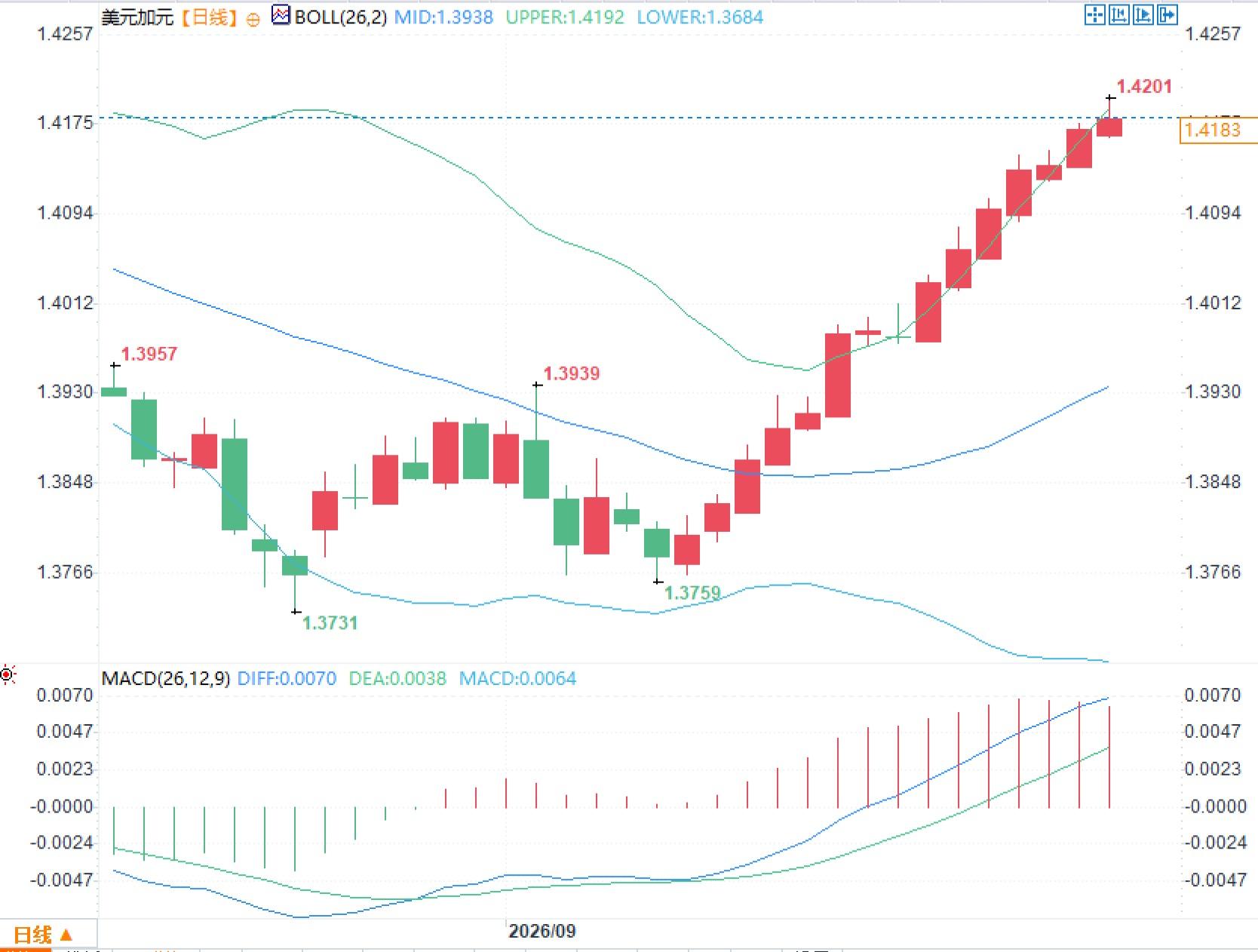
The exchange rate is an immediate reflection of the aforementioned tensions. Second-quarter growth exceeded the Bank of Canada's July forecast of 2.5%, which could have supported expectations for Canadian dollar interest rates. However, after tariffs and import restrictions were tightened in September, the growth path was repriced, and the Canadian dollar fell by more than 2% cumulatively in September. On the day the data was released, the Canadian dollar remained slightly weaker, while Canadian bonds remained generally stable, indicating that the market viewed this monthly output data more as confirmation of a slowdown in the third quarter than as a new shock rewriting the policy function. On the daily chart, the USD/CAD pair has rebounded from its lows in early September and is trading above the Bollinger Band's middle band, near the upper band, with the MACD fast and slow lines and histogram both above the zero line. The cross-market logic is clearer: on one hand, there is the lagged drag of tariffs on exports and investment; on the other hand, there is the immediate increase in overall inflation due to energy prices. Both ends are entering the October monetary policy report window, thus resulting in higher exchange rate volatility than in the summer.Employment, prices, and business surveys will be more important than this lagging output.
The value of monthly industry GDP lies in breaking down the supply side, rather than providing a point estimate for the fourth quarter. The strength in construction and utilities indicates that domestic demand is still influenced by projects and weather factors; the weakness in manufacturing, oil and gas, and retail suggests that cracks have appeared in the export chain and household consumption. The Bank of Canada's October policy meeting will, for the first time, use a new forecasting model as the main model for its monetary policy report to distinguish between one-off price shocks and a more persistent inflationary process. The market's use of overnight swaps to indicate a roughly 50% probability of an October rate hike itself reflects the coexistence of two risks: if energy price increases spread to other components, policy discussions will focus more on price sustainability; if tariffs begin to reshape exports and investment, policy discussions will focus more on the output gap. This GDP report records summer resilience and leaves autumn constraints for subsequent data.Frequently Asked Questions
Question 1: Why is the flat July figure and the preliminary August figure of 0.2% still considered a weak third quarter? Answer: The second quarter grew at an annualized rate of 3.3%, raising the base already. Goods and services output almost simultaneously stalled in July, with manufacturing, retail, and oil and gas extraction all declining. The 0.2% August figure is only a preliminary estimate using the industry-specific approach; the recovery in mining was still offset by oil and gas extraction. Looking at the revised 0.4% in June, the flat July figure, and the preliminary August figure together, the third quarter started significantly slower than the second quarter, confirming a shift in pace rather than just monthly noise. Question 2: Why do some economists say this GDP figure is outdated? Answer: Most of the activity in July and August occurred before the renewed escalation of the US-Canada trade friction. The impact of tariffs and import restrictions on exports, investment, and hiring typically takes one to two months to fully impact industry output. Therefore, before the October 28th interest rate decision, employment, consumer prices, and the central bank's business outlook survey are more likely to reflect the immediate constraints within the policy window. Question 3: Why are discussions about a potential halving of growth and interest rate hikes occurring simultaneously? A: If the US-Canada tariffs remain in place, Canada's fourth-quarter growth rate could be suppressed to below 1%. The conflict involving Iran, however, will keep overall inflation at around 3% through oil prices. With downside risks to output and upside risks to prices overlapping at the same interest rate level, and the Canadian policy rate still at 2.25%, overnight swaps pricing in about 50% of an October rate hike, reflects the coexistence of constraints, rather than a single path being locked in by data.- Risk Warning and Disclaimer
- The market involves risk, and trading may not be suitable for all investors. This article is for reference only and does not constitute personal investment advice, nor does it take into account certain users’ specific investment objectives, financial situation, or other needs. Any investment decisions made based on this information are at your own risk.