How a global debt crisis erupted
2026-09-29 22:04:14
Regarding the rising yields on long-term government bonds, many commentaries have focused on various technical details. I have also written articles discussing related topics such as the aftereffects of global debt, the global debt crisis, and the global debt backlog. One view holds that the current rise in yields is simply a normalization process of returning to historical levels; another view suggests that the higher yields are merely the market pricing in a more hawkish central bank policy, while risk premiums and term premiums remain within a controllable range. These arguments have a "boiling frog" feel to them. Long-term yield trends in some regions already show signs of crisis, with the situation in France and Italy being particularly prominent.  In debt-related discussions, the sophistry of using other cases to divert attention completely ignores the numerous crisis warnings released by high-frequency data. This year has already seen several rounds of small-scale financial turmoil: In January, Japanese Prime Minister Sanae Takaichi stated that fiscal austerity was meaningless, followed by a sharp rise in Japanese long-term government bond yields—this was the first wave of turmoil. After the Federal Reserve meeting released dovish signals, the US yield curve steepened further; simultaneously, the US Treasury unexpectedly announced a bond buyback, causing a sharp drop in the dollar and a surge in precious metal prices—this was another round of turmoil. The latest upheaval is that the already high yields on French and Italian long-term government bonds surged again yesterday. Over the past year, the global bond sell-off has constantly shifted its targets, rising and falling in waves. However, in recent months, the market has focused its attention on France and Italy, identifying them as the most vulnerable and risky sectors, and now both countries are standing on the verge of a full-blown crisis.
 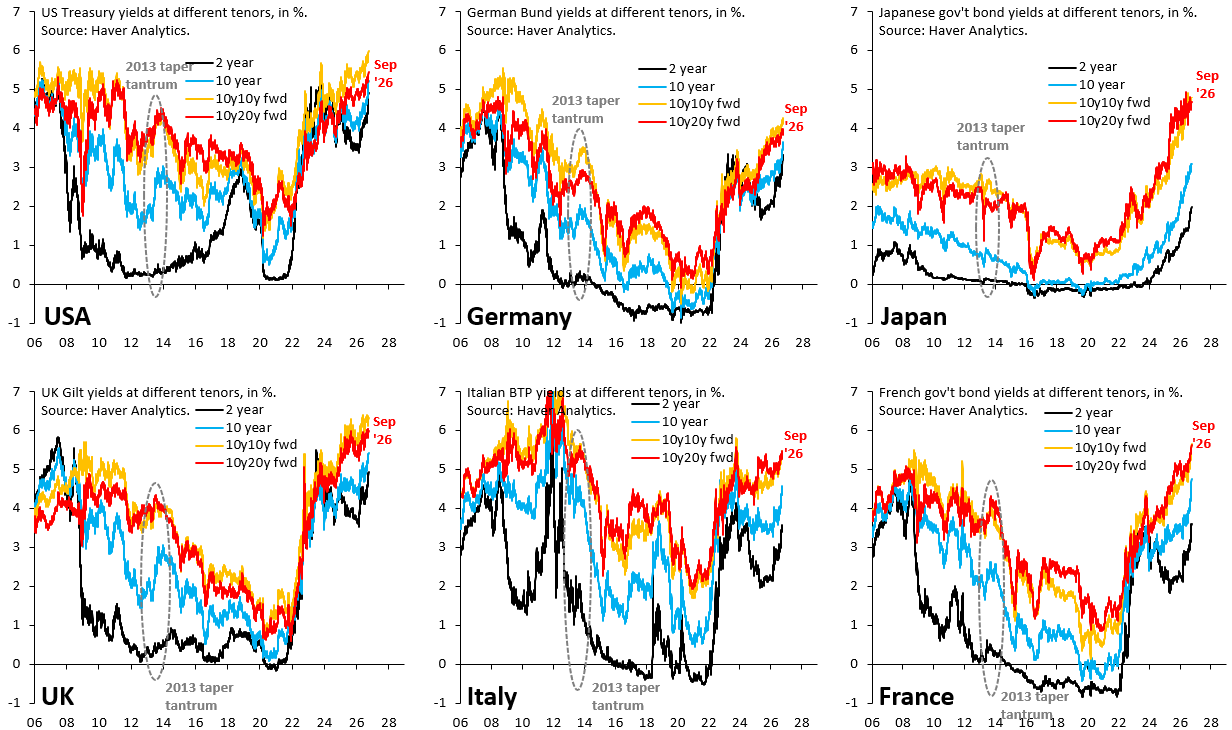 The chart above shows the yields of government bonds in various countries: top left is the US, top center is Germany, top right is Japan, bottom left is the UK, bottom center is Italy, and bottom right is France. In each chart, the black line represents the two-year yield, reflecting market expectations for monetary policy; the blue line is the ten-year yield; the orange and red lines are the 10-year forward 10-year yield and the 10-year forward 20-year yield, respectively, calculated from the 10-year, 20-year, and 30-year yields. Compared to the 20-year yield, the 10-year forward 10-year yield has the advantage of eliminating the influence of the yield over the previous 10 years, thus it is less affected by short-term monetary policy expectations; the same applies to the 10-year forward 20-year yield. Several points are worth noting. First, driven by market expectations that central banks will maintain a hawkish policy for a longer period, long-term yields have generally risen globally. If the market judges that geopolitical instability will push up oil prices and that this situation will persist for a long time, even after removing disturbances at the front of the yield curve, the market will still price higher long-term yields. Second, this round of long-term yield increases is by no means a normal market correction. The 10-year forward yields in almost all countries have far exceeded their historical highs since 2006. There are only two exceptions: Germany, which still possesses safe-haven asset characteristics; and Italy, which was deeply mired in a debt crisis fifteen years ago. Third, yesterday, the 10-year forward yields in France and Italy both rose by 11 basis points. Given that yields were already high, this represents a dramatic fluctuation of several standard deviations. For reference, the US and UK saw this indicator rise by only 5 basis points yesterday, and the fiscal discipline of both countries is hardly prudent. An obvious question is: why is the market targeting France and Italy? One reason is that the spread between Eurozone sovereign bonds and German bonds remains low, thus restricting the European Central Bank's actions. "Financial fragmentation" is a concept concocted by the ECB to justify its de facto yield cap policy—a policy that essentially subsidizes highly indebted countries within the Eurozone. Currently, interest rate spreads haven't widened significantly, so the European Central Bank (ECB) cannot intervene on the grounds of "financial fragmentation." A substantial further widening of spreads would be necessary for the ECB to take action, and the situation seems to be moving in that direction. The market has exploited this loophole in the ECB's policy toolbox. While academics can engage in discussions about interpreting rising yields, they must not ignore the various unsettling short-term warning signs. Crises always erupt in the most vulnerable areas and then spread outwards; this is currently unfolding.
In debt-related discussions, the sophistry of using other cases to divert attention completely ignores the numerous crisis warnings released by high-frequency data. This year has already seen several rounds of small-scale financial turmoil: In January, Japanese Prime Minister Sanae Takaichi stated that fiscal austerity was meaningless, followed by a sharp rise in Japanese long-term government bond yields—this was the first wave of turmoil. After the Federal Reserve meeting released dovish signals, the US yield curve steepened further; simultaneously, the US Treasury unexpectedly announced a bond buyback, causing a sharp drop in the dollar and a surge in precious metal prices—this was another round of turmoil. The latest upheaval is that the already high yields on French and Italian long-term government bonds surged again yesterday. Over the past year, the global bond sell-off has constantly shifted its targets, rising and falling in waves. However, in recent months, the market has focused its attention on France and Italy, identifying them as the most vulnerable and risky sectors, and now both countries are standing on the verge of a full-blown crisis. The chart above shows the yields of government bonds in various countries: top left is the US, top center is Germany, top right is Japan, bottom left is the UK, bottom center is Italy, and bottom right is France. In each chart, the black line represents the two-year yield, reflecting market expectations for monetary policy; the blue line is the ten-year yield; the orange and red lines are the 10-year forward 10-year yield and the 10-year forward 20-year yield, respectively, calculated from the 10-year, 20-year, and 30-year yields. Compared to the 20-year yield, the 10-year forward 10-year yield has the advantage of eliminating the influence of the yield over the previous 10 years, thus it is less affected by short-term monetary policy expectations; the same applies to the 10-year forward 20-year yield. Several points are worth noting. First, driven by market expectations that central banks will maintain a hawkish policy for a longer period, long-term yields have generally risen globally. If the market judges that geopolitical instability will push up oil prices and that this situation will persist for a long time, even after removing disturbances at the front of the yield curve, the market will still price higher long-term yields. Second, this round of long-term yield increases is by no means a normal market correction. The 10-year forward yields in almost all countries have far exceeded their historical highs since 2006. There are only two exceptions: Germany, which still possesses safe-haven asset characteristics; and Italy, which was deeply mired in a debt crisis fifteen years ago. Third, yesterday, the 10-year forward yields in France and Italy both rose by 11 basis points. Given that yields were already high, this represents a dramatic fluctuation of several standard deviations. For reference, the US and UK saw this indicator rise by only 5 basis points yesterday, and the fiscal discipline of both countries is hardly prudent. An obvious question is: why is the market targeting France and Italy? One reason is that the spread between Eurozone sovereign bonds and German bonds remains low, thus restricting the European Central Bank's actions. "Financial fragmentation" is a concept concocted by the ECB to justify its de facto yield cap policy—a policy that essentially subsidizes highly indebted countries within the Eurozone. Currently, interest rate spreads haven't widened significantly, so the European Central Bank (ECB) cannot intervene on the grounds of "financial fragmentation." A substantial further widening of spreads would be necessary for the ECB to take action, and the situation seems to be moving in that direction. The market has exploited this loophole in the ECB's policy toolbox. While academics can engage in discussions about interpreting rising yields, they must not ignore the various unsettling short-term warning signs. Crises always erupt in the most vulnerable areas and then spread outwards; this is currently unfolding.
- Risk Warning and Disclaimer
- The market involves risk, and trading may not be suitable for all investors. This article is for reference only and does not constitute personal investment advice, nor does it take into account certain users’ specific investment objectives, financial situation, or other needs. Any investment decisions made based on this information are at your own risk.