Inflation diverges between Europe and the US amid energy shocks; PCE may signal an inflation turning point.
2026-09-29 21:52:22
Both the European Central Bank (ECB) and the US economy are in a similar interest rate hike cycle and facing energy disruptions caused by the Middle East conflict. The ECB's perspective can be used to observe the US economy. Compared to the US, the Eurozone's economic fundamentals and energy vulnerability are weaker. Therefore, if the Eurozone is optimistic, the US should be even more so. ECB President Lagarde recently stated that Eurozone inflation will be driven up by the energy crisis, but there are currently no signs of energy price increases being passed on to wages; the ECB maintains a "middle-of-the-road" monetary policy. Comparative analysis shows that the US economy is significantly more resilient than the Eurozone. If tomorrow's PCE data is better than expected, coupled with the assumptions of easing tensions between the US and Iran and AI's long-term boost to productivity while suppressing inflation, the inflation inflection point may have already quietly arrived. Current market panic about inflation may have peaked, and the pricing logic of the US dollar index will shift. Today, ECB President Lagarde spoke at the European Parliament, stating that the Eurozone's inflation expectations have further increased due to rising energy prices caused by the Iranian conflict. The ECB updated its forecasts in September, raising its inflation targets for 2027 and 2028 to 2.5% and 2.1%, respectively. However, Lagarde emphasized that there is currently no evidence that energy price increases are being passed on to wages. This round of energy shocks is a one-off supply disruption and has not yet formed a vicious cycle of "energy → wages → prices." At the policy level, the ECB has chosen to balance inflation control and economic growth pressures, taking a "middle road." Lagarde mentioned that the rise in long-term interest rates in the Eurozone has exceeded previous model predictions, which will suppress economic growth and weaken the transmission of energy prices to end-product prices. She also suggested that AI has the long-term potential to improve corporate productivity and reduce costs, and can alleviate inflationary pressures in the long run, but its short-term impact on the economy and inflation remains uncertain. 
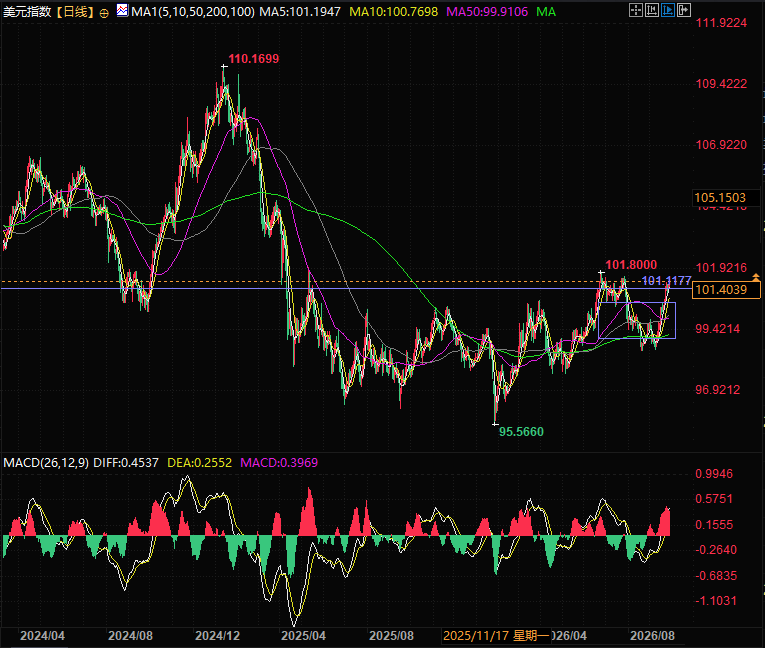 (US Dollar Index Daily Chart, Source: FX678) At 21:48 Beijing time, the US Dollar Index is currently at 101.37.
Comparison of inflation and economic resilience in Europe and the United States
While the US and Europe raised interest rates simultaneously, the damage from the energy shock to these two economies was on completely different scales. The Eurozone, heavily reliant on external energy imports, saw its oil price increases due to geopolitical conflicts directly impacting consumer spending and manufacturing costs. This represents a typical case of passive supply-side pressure, weakening its economic foundation and amplifying the side effects of interest rate hikes. Lagarde's optimistic predictions focused on the fact that the energy shock had not yet transmitted to wages and that rising long-term bond yields would automatically suppress inflation transmission. Even if both of these optimistic assumptions materialized, the Eurozone could only avoid stagflation, unlikely to achieve robust growth. In contrast, the US has a higher degree of domestic energy self-sufficiency, and the transmission of energy prices to overall CPI and core PCE is far weaker than in the Eurozone. The underlying environment for this round of US interest rate hikes is stronger domestic demand, a healthier labor market, and continued AI capital expenditure driving aggregate supply, allowing the economy to withstand higher interest rates without a deep recession. This constitutes the biggest divergence between the US and Europe: the Eurozone's growth is dragged down by the energy shock; the US economy remains resilient despite interest rate hikes and energy disruptions. From the perspective of the inflation transmission chain, the Eurozone needs to be wary of the lagged effect of sustained energy price increases on service sector wages; in contrast, the endogenous driving force behind US wage growth comes from a tight labor market balance, with limited indirect impact of energy on wages. In other words, Eurozone inflation is mainly driven by external energy inputs, while US inflation is more dominated by endogenous demand and service prices. Once external energy pressures ease, the resistance to a decline in US inflation will be significantly less than in the Eurozone.Tomorrow's PCE data: a window for verifying the inflection point of inflation, directly affecting the US dollar index.
Market attention will be focused on tomorrow's US PCE price index—the Fed's most valued inflation indicator and a key catalyst for the short-term dollar index. If the PCE is better than expected (with core PCE continuing to decline): Under the combined assumptions of easing tensions between the US and Iran, declining oil prices, and AI's long-term productivity gains suppressing inflation, the market will begin trading the arrival of an inflation inflection point. Current market concerns about inflation are likely at their peak. Declining inflation expectations will lower long-term US Treasury yields, leading to an earlier correction in interest rate cut expectations and putting short-term downward pressure on the dollar index. If the PCE is higher than expected, and inflation stickiness exceeds expectations: the market will reprice the Fed's "higher interest rates for longer," causing US Treasury yields to rebound, the interest rate differential to widen again, and the dollar index to rebound and strengthen. Looking at the underlying logic of the dollar index in the medium to long term: the dollar index is essentially the pricing of the economic and monetary policy interest rate differential between the US and a basket of economies such as the euro and yen. The upper limit for the Eurozone is "avoiding stagflation," while the US has the opportunity to achieve a soft landing. Once the inflection point of US inflation is confirmed, the Federal Reserve's policy cycle will shift first, while the ECB will need more time to address the tail risks of energy-related inflation. This will narrow the gap in monetary policy cycles between the US and Europe, suppressing the medium- to long-term upside potential of the US dollar index. However, there are significant risk constraints: a renewed escalation of the US-Iran conflict and a sharp resurgence in oil prices could reignite global inflation expectations, overturning the current "inflation inflection point" assumption. This would reignite global inflation concerns, strengthening the US dollar as a safe-haven asset. The AI-related benefits mentioned by Lagarde are long-term, slow-moving variables and cannot offset the energy shocks from geopolitical conflicts in the short term.Summarize:
From the current perspective, the underlying contradictions of inflation in Europe and the US are clear: the Eurozone passively bears the external energy shocks, with its upper limit being the avoidance of stagflation; the US economy has stronger endogenous resilience and has the opportunity for a soft landing. Tomorrow's PCE data is the most important short-term verification point. If the PCE data shows marginal improvement, coupled with the positive energy news from the easing of tensions between the US and Iran, the market will gradually confirm the inflation inflection point, and the previously brewing inflation panic will have peaked. In the short term, the US dollar will weaken due to the expectation of interest rate cuts; however, if the situation in the Middle East fluctuates and oil prices rebound, the inflation narrative will reverse again, and the US dollar will regain support. (US Dollar Index Daily Chart, Source: FX678) At 21:48 Beijing time, the US Dollar Index is currently at 101.37.
- Risk Warning and Disclaimer
- The market involves risk, and trading may not be suitable for all investors. This article is for reference only and does not constitute personal investment advice, nor does it take into account certain users’ specific investment objectives, financial situation, or other needs. Any investment decisions made based on this information are at your own risk.