A chart shows that freight rates for large vessels have weakened significantly, with the Baltic Dry Index falling to a near one-month low.
2026-09-29 23:20:14
Latest data shows that the Baltic Dry Index (BDI) closed at 3178 points on September 29, 2026, a new low since September 1, 2026, down 2.75% from the previous day, marking the third consecutive day of decline (including zero growth). Looking at the short-term charts, the BDI has seen positive growth 5 times, negative growth 6 times, and zero growth in the last 11 BDI data points. Specifically, the Panamax Freight Index (BPI) closed at 2390 points, down 0.50% from the previous day; the Capesize Freight Index (BCI) closed at 5103 points, down 4.63%; and the Supramax Freight Index (BSI) closed at 1797 points, up 0.39%. For detailed charts of the Baltic Dry Index and its three main sub-indices, including the latest 720-day and 10-year trends, please refer to the charts specially created by FX678. 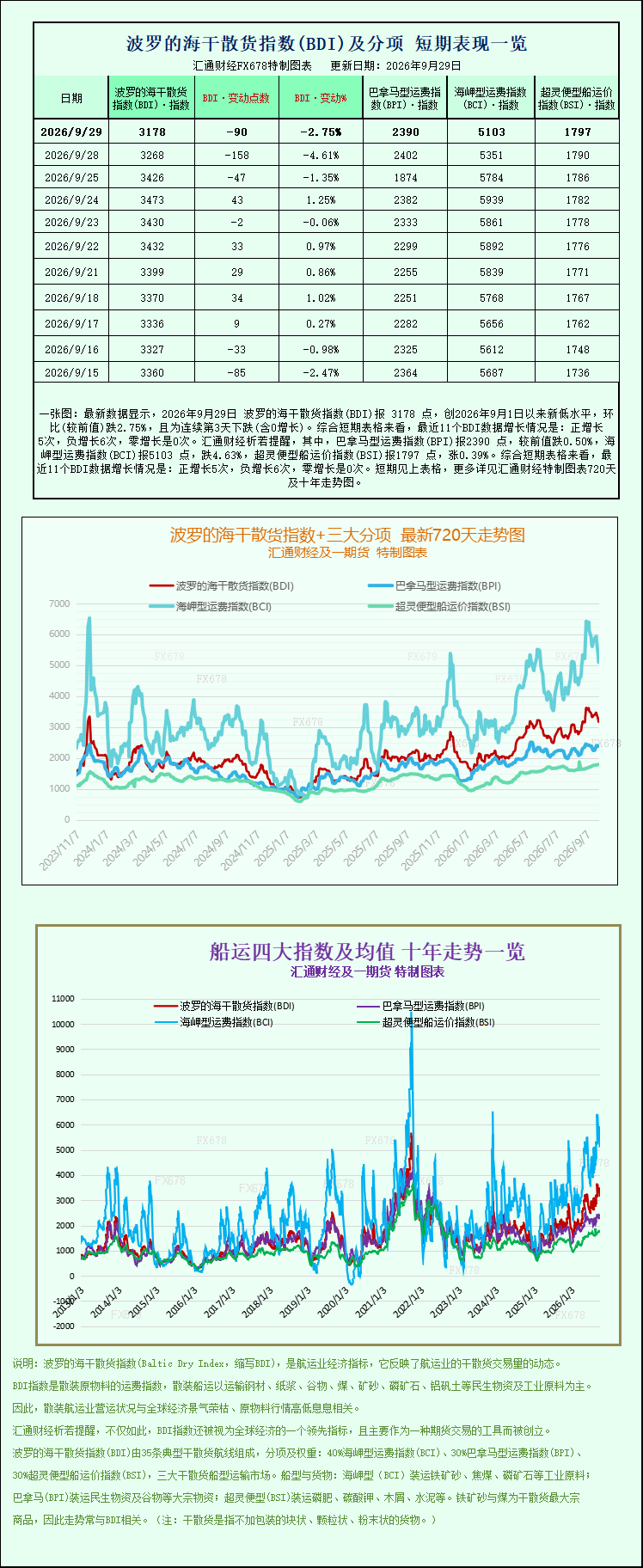 On September 29, 2026, the latest shipping market data showed that the Baltic Dry Index (BADI) fell sharply on Tuesday, reaching its lowest point in nearly a month since September 1, dragged down by a significant decline in freight rates for large dry bulk vessels. The international dry bulk shipping market exhibited a clear structural divergence, with cooling demand for large vessels and stronger performance for smaller vessels, reflecting a phased adjustment in global demand for bulk raw materials. Data showed that the core Baltic Dry Index fell sharply by 90 points, a drop of 2.75%, closing at 3178 points, completely ending the upward trend since mid-September and marking the largest single-day drop and lowest closing point in nearly a month. This index comprehensively tracks the freight rate trends of the three major dry bulk vessel types: Capesize, Panamax, and Supramax, and is a core indicator of the global commodity shipping market's health. Its sharp decline also signifies a short-term downturn in the international dry bulk market's health. The core drag on this sharp index decline came from the Capesize vessel market, which has the highest weighting. Data shows that the Capesize Index (BACI) plummeted 248 points in a single day, a drop of 4.63%, closing at 5103 points, a near one-month low since August 26th, leading the decline across all vessel types. Capesize vessels, as the mainstay large vessel type in the dry bulk shipping market, primarily carry core industrial raw materials such as iron ore and thermal coal at the 150,000-ton level. They are the core carriers of the global heavy industry supply chain's maritime transport, and their freight rate fluctuations have a decisive impact on the overall index trend. In terms of profitability, the Capesize vessel market's profit level also shrank significantly. On that day, the average daily revenue of Capesize vessels decreased by $2249 to $42775, a significant drop compared to the previous day. Industry analysts pointed out that the core cause of the sharp decline in Capesize freight rates was the continued weakness in global iron ore trade demand, coupled with the pre-holiday stockpiling effect due to the approaching Chinese National Day holiday, directly impacting the chartering demand for large mining vessels. Iron ore futures prices have declined for three consecutive trading days recently, while port arrivals of iron ore have continued to climb, resulting in a relatively ample market supply. Meanwhile, domestic steel industry end-user demand remains weak, steel mills are facing inventory buildup and narrowing profit margins, leading to a significant decline in production enthusiasm and a proactive reduction in iron ore restocking. This has directly resulted in a substantial reduction in ocean-going iron ore cargo volume, shifting the supply-demand balance for large vessels to a more relaxed state. Following the trend of Capesize vessels, the medium-sized Panamax vessel market also continued its weak performance. Data shows that the Panamax Index (BPNI) fell 12 points, or 0.50%, to close at 2390 points, continuing its downward trend in freight rates. Panamax vessels primarily carry 60,000 to 70,000 tons of bulk cargo such as coal, grain, and agricultural supplies, while also transporting industrial raw materials and agricultural products, making their applications more diverse. Their average daily revenue decreased by $113 to $21,507, although the decline was much smaller than that of Capesize vessels, the overall weak market demand is evident. On the one hand, global demand for thermal coal trade is gradually cooling down as the peak industrial season in many countries comes to an end; on the other hand, the pace of international grain seaborne trade is stable, lacking the support of concentrated shipments, causing Panamax freight rates to remain weak and volatile. In stark contrast to the collective weakness of large and medium-sized vessels, the small Supramax vessel market has bucked the trend and strengthened, showing an independent upward trend. On the same day, the Supramax Vessel Index (BSIS) rose slightly by 7 points, an increase of 0.39%, closing at 1797 points, a new four-year high since August 2022, becoming the only positive growth point in the current dry bulk market. The structural differentiation of the market is becoming increasingly obvious. Industry insiders interpret the rise of Supramax vessels against the trend as being mainly due to their vessel type advantages and the support of niche market demand. These vessels are smaller in tonnage and have higher route flexibility, suitable for short-distance, small-batch, multi-category bulk cargo transportation, covering niche categories such as building materials, agricultural materials, grains, and niche minerals, and are minimally affected by fluctuations in demand for bulk industrial raw materials such as iron ore and coal. The current increase in global regional trade activity and the continued release of demand for small- and medium-volume bulk cargo transportation, coupled with limited new capacity deployment for small vessels and a tight market supply and demand, have supported the continued rise in freight rates, resulting in a long-term upward trend. In summary, the recent correction in the Baltic Dry Index is the result of the combined effects of short-term demand cycles, seasonal factors, and the supply and demand structure of shipping capacity. The market has already fully digested the pre-holiday restocking benefits, resulting in a short-term ample supply of large vessels. This, combined with the off-season effect in the domestic steel industry, has suppressed freight rates for large vessels. Meanwhile, small vessels, relying on their flexible transportation advantages, continue to benefit from stable demand in their niche market and maintain a strong upward trend. Market analysts believe that in the short term, with the approach of China's National Day holiday, the pace of domestic industrial production and raw material procurement will continue to slow down, and the demand for seaborne transportation of bulk raw materials such as iron ore and coal may further weaken. Freight rates for large dry bulk vessels are likely to remain in a volatile and weak pattern. However, Supramax vessels, thanks to the resilience of their niche market, are expected to continue their high freight rate trend. In the medium to long term, the key focus will be on the pace of resumption of work and production after the holidays in China, the recovery of demand in the steel industry, and changes in the global trade flow of bulk raw materials, which will dominate the overall trend of the dry bulk shipping market in the fourth quarter.
On September 29, 2026, the latest shipping market data showed that the Baltic Dry Index (BADI) fell sharply on Tuesday, reaching its lowest point in nearly a month since September 1, dragged down by a significant decline in freight rates for large dry bulk vessels. The international dry bulk shipping market exhibited a clear structural divergence, with cooling demand for large vessels and stronger performance for smaller vessels, reflecting a phased adjustment in global demand for bulk raw materials. Data showed that the core Baltic Dry Index fell sharply by 90 points, a drop of 2.75%, closing at 3178 points, completely ending the upward trend since mid-September and marking the largest single-day drop and lowest closing point in nearly a month. This index comprehensively tracks the freight rate trends of the three major dry bulk vessel types: Capesize, Panamax, and Supramax, and is a core indicator of the global commodity shipping market's health. Its sharp decline also signifies a short-term downturn in the international dry bulk market's health. The core drag on this sharp index decline came from the Capesize vessel market, which has the highest weighting. Data shows that the Capesize Index (BACI) plummeted 248 points in a single day, a drop of 4.63%, closing at 5103 points, a near one-month low since August 26th, leading the decline across all vessel types. Capesize vessels, as the mainstay large vessel type in the dry bulk shipping market, primarily carry core industrial raw materials such as iron ore and thermal coal at the 150,000-ton level. They are the core carriers of the global heavy industry supply chain's maritime transport, and their freight rate fluctuations have a decisive impact on the overall index trend. In terms of profitability, the Capesize vessel market's profit level also shrank significantly. On that day, the average daily revenue of Capesize vessels decreased by $2249 to $42775, a significant drop compared to the previous day. Industry analysts pointed out that the core cause of the sharp decline in Capesize freight rates was the continued weakness in global iron ore trade demand, coupled with the pre-holiday stockpiling effect due to the approaching Chinese National Day holiday, directly impacting the chartering demand for large mining vessels. Iron ore futures prices have declined for three consecutive trading days recently, while port arrivals of iron ore have continued to climb, resulting in a relatively ample market supply. Meanwhile, domestic steel industry end-user demand remains weak, steel mills are facing inventory buildup and narrowing profit margins, leading to a significant decline in production enthusiasm and a proactive reduction in iron ore restocking. This has directly resulted in a substantial reduction in ocean-going iron ore cargo volume, shifting the supply-demand balance for large vessels to a more relaxed state. Following the trend of Capesize vessels, the medium-sized Panamax vessel market also continued its weak performance. Data shows that the Panamax Index (BPNI) fell 12 points, or 0.50%, to close at 2390 points, continuing its downward trend in freight rates. Panamax vessels primarily carry 60,000 to 70,000 tons of bulk cargo such as coal, grain, and agricultural supplies, while also transporting industrial raw materials and agricultural products, making their applications more diverse. Their average daily revenue decreased by $113 to $21,507, although the decline was much smaller than that of Capesize vessels, the overall weak market demand is evident. On the one hand, global demand for thermal coal trade is gradually cooling down as the peak industrial season in many countries comes to an end; on the other hand, the pace of international grain seaborne trade is stable, lacking the support of concentrated shipments, causing Panamax freight rates to remain weak and volatile. In stark contrast to the collective weakness of large and medium-sized vessels, the small Supramax vessel market has bucked the trend and strengthened, showing an independent upward trend. On the same day, the Supramax Vessel Index (BSIS) rose slightly by 7 points, an increase of 0.39%, closing at 1797 points, a new four-year high since August 2022, becoming the only positive growth point in the current dry bulk market. The structural differentiation of the market is becoming increasingly obvious. Industry insiders interpret the rise of Supramax vessels against the trend as being mainly due to their vessel type advantages and the support of niche market demand. These vessels are smaller in tonnage and have higher route flexibility, suitable for short-distance, small-batch, multi-category bulk cargo transportation, covering niche categories such as building materials, agricultural materials, grains, and niche minerals, and are minimally affected by fluctuations in demand for bulk industrial raw materials such as iron ore and coal. The current increase in global regional trade activity and the continued release of demand for small- and medium-volume bulk cargo transportation, coupled with limited new capacity deployment for small vessels and a tight market supply and demand, have supported the continued rise in freight rates, resulting in a long-term upward trend. In summary, the recent correction in the Baltic Dry Index is the result of the combined effects of short-term demand cycles, seasonal factors, and the supply and demand structure of shipping capacity. The market has already fully digested the pre-holiday restocking benefits, resulting in a short-term ample supply of large vessels. This, combined with the off-season effect in the domestic steel industry, has suppressed freight rates for large vessels. Meanwhile, small vessels, relying on their flexible transportation advantages, continue to benefit from stable demand in their niche market and maintain a strong upward trend. Market analysts believe that in the short term, with the approach of China's National Day holiday, the pace of domestic industrial production and raw material procurement will continue to slow down, and the demand for seaborne transportation of bulk raw materials such as iron ore and coal may further weaken. Freight rates for large dry bulk vessels are likely to remain in a volatile and weak pattern. However, Supramax vessels, thanks to the resilience of their niche market, are expected to continue their high freight rate trend. In the medium to long term, the key focus will be on the pace of resumption of work and production after the holidays in China, the recovery of demand in the steel industry, and changes in the global trade flow of bulk raw materials, which will dominate the overall trend of the dry bulk shipping market in the fourth quarter.
- Risk Warning and Disclaimer
- The market involves risk, and trading may not be suitable for all investors. This article is for reference only and does not constitute personal investment advice, nor does it take into account certain users’ specific investment objectives, financial situation, or other needs. Any investment decisions made based on this information are at your own risk.