The Reserve Bank of Australia just raised interest rates on Tuesday, but Wednesday's data came in below expectations. Will it follow suit in November?
2026-09-30 10:44:15
Australia's August consumer price index (CPI) rose less than market expectations, with the overall CPI increasing by 0.4% month-on-month and the core cutoff mean rising by only 0.2%, both below forecasts. This data eased pressure for further interest rate hikes in the short term, but the year-on-year increase accelerated from 3.5% to 4.0%, indicating that the absolute level of inflation is still rising. Following the data release, the Australian dollar weakened, falling from around 0.6990 to around 0.6960 against the US dollar. 
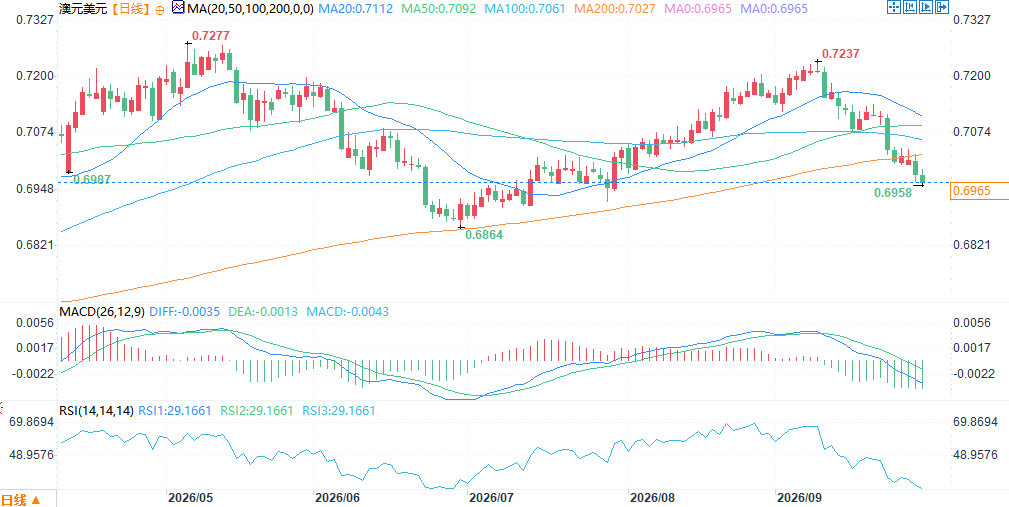 (Australian dollar against US dollar daily chart, source: EasyForex) At 10:43 Beijing time, the Australian dollar was trading at 0.6964/65 against the US dollar.
Overall data: Month-on-month growth was below expectations, but year-on-year growth accelerated.
The Australian Bureau of Statistics (ABS) released its August Consumer Price Index (CPI) data on Wednesday, showing a 0.4% month-on-month increase, a significant slowdown from July's 1.0% rise and slightly below market expectations of 0.5%. Meanwhile, the year-on-year increase accelerated to 4.0% from 3.5% in July, reaching a new high in recent months. This coexistence of a month-on-month slowdown and a year-on-year acceleration primarily reflects the lingering base effect from the past year, rather than a comprehensive strengthening of new price increases in the current month. Housing and transportation were the main contributors to year-on-year inflation, with housing rising 5.7% year-on-year and transportation rising 5.6% year-on-year, driven by fuel prices. Fuel prices surged 14.8% in August alone, influenced by global oil prices and the complete withdrawal of the government's fuel consumption tax relief measures. Overall, the data indicates that the absolute level of inflation remains above the Reserve Bank of Australia's (RBA) target range of 2%-3%, but the slowdown in monthly momentum provides breathing room for policy observation. Previous market concerns about a potential further year-on-year increase were partially validated, but the lower-than-expected month-on-month increase eased immediate tightening pressures.Core inflation: Cut-off mean lower than expected, pressure eases marginally.
The cutoff mean of core inflation rose 0.2% month-on-month in August, lower than the market expectation of 0.3%; its year-on-year increase remained stable at 3.6%, marking the third consecutive month of stability. This result is the most policy-significant signal in this data release. The cutoff mean, after excluding highly volatile items such as fuel, clothing, and tourism, more clearly reflects potential price pressures. The month-on-month increase being lower than expected means that, after excluding short-term shocks, overall inflation momentum has not worsened further, but rather shows signs of marginal easing. While the year-on-year increase of 3.6% is still significantly higher than the target level, its stable performance indicates that core pressures have not accelerated. This provides the Reserve Bank of Australia with an important reference for assessing the effectiveness of its "precautionary rate hikes." After the data release, market expectations for further aggressive tightening in the short term cooled somewhat, and the resilience and controllability of core indicators became key to observing the subsequent policy path. Overall, the moderate performance of core inflation helps to balance concerns about the spillover effects of energy shocks.Breakdown: Fuel price increases were offset by declines in clothing and tourism.
The structural characteristics of inflation in August were quite clear: the sharp rise in fuel prices was partially offset by declines in clothing and travel expenses. The transportation sub-category saw a significant month-on-month increase driven by automobile fuel prices, becoming the main upward force for the month; while clothing and footwear fell by about 0.9% month-on-month, and leisure and culture (including tourism-related) fell by about 1.0% month-on-month, forming a offset. This offsetting relationship indicates that the inflation driver in August was not a comprehensive demand-pull, but rather the result of localized cost shocks and localized demand declines offsetting each other. The fuel price increase was strongly exogenous, related to the situation in the Middle East and global energy prices; the price declines in clothing and travel reflected weakness in some discretionary consumption sectors, possibly related to cautious household spending in a high-interest-rate environment. The housing sub-category saw a moderate month-on-month increase, but year-on-year growth was still supported by the cost of new housing construction and electricity prices. The sub-category structure shows that inflationary pressures are differentiated rather than broadly widespread, helping policymakers distinguish between temporary shocks and persistent factors.Policy implications: Pressure to raise interest rates has eased temporarily, but the central bank retains room for maneuver.
The Reserve Bank of Australia (RBA) raised the cash rate by 25 basis points to 4.6% on Tuesday, based on expectations of potentially higher inflation data, and left clear room for further monetary tightening if necessary. The August CPI actually fell short of market expectations, particularly the moderate performance of the core cutoff mean, indicating that the central bank's previous "precautionary rate hike" had already priced in some inflation risks. This reduced the urgency for further rate hikes in the short term, and market expectations for follow-up action at the November meeting have been adjusted. However, the rebound in year-on-year inflation to 4.0% and the continued impact of energy prices still keep the RBA on its toes. The statement retaining flexibility for further action indicates that policy options are not closed, and subsequent decisions will be highly dependent on data developments, including the next phase of core inflation trends, changes in the labor market, and whether the energy shock will spill over. Overall, the data provides the RBA with a window of opportunity, but the high absolute level of inflation and external uncertainties still require policy caution.Summarize
Australia's August CPI showed a combination of "lower-than-expected month-on-month growth, accelerated year-on-year increase, and marginal easing of core inflation pressures." Fuel price increases were offset by price reductions in clothing and tourism, resulting in overall inflation not being as strong as expected. The Reserve Bank of Australia (RBA) had already raised interest rates on Tuesday, and this data release eased the pressure for further rate hikes in the short term. However, the year-on-year CPI of 4.0% remains above the target range, leaving the RBA with room for further tightening. Going forward, attention should be paid to the sustainability of fuel price increases and whether core inflation can continue its downward trend. (Australian dollar against US dollar daily chart, source: EasyForex) At 10:43 Beijing time, the Australian dollar was trading at 0.6964/65 against the US dollar.
- Risk Warning and Disclaimer
- The market involves risk, and trading may not be suitable for all investors. This article is for reference only and does not constitute personal investment advice, nor does it take into account certain users’ specific investment objectives, financial situation, or other needs. Any investment decisions made based on this information are at your own risk.