The agency stated that oil prices and gold prices are negatively correlated, and gave a difference of $1,750 in their high and low gold price forecasts.
2026-09-30 11:34:17
International gold prices are facing significant uncertainty due to a confluence of macroeconomic variables. Rising oil prices, sticky inflation, and a high-interest-rate environment continue to weigh on precious metals prices. A recent gold research report from Natixis points out that the evolving situation around the Strait of Hormuz will be a key variable determining gold price movements, with vastly different geopolitical scenarios leading to divergent price outlooks. The bank's precious metals analysts have developed three scenario predictions, with gold prices potentially falling as low as $3,500 per ounce and reaching $5,250 per ounce in an optimistic scenario.
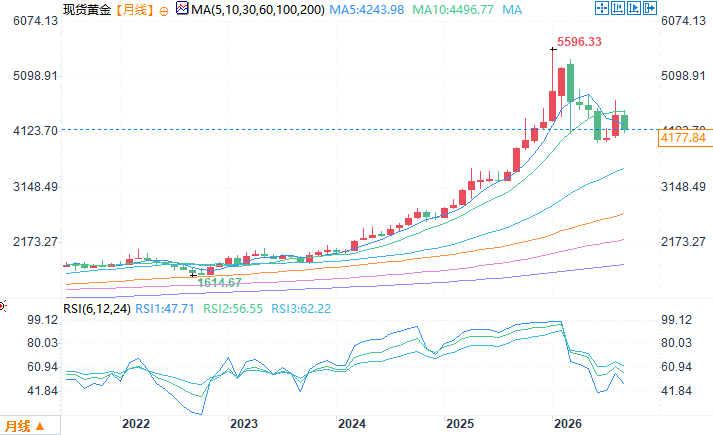 Spot gold monthly chart source: FX678. At 11:32 AM Beijing time on September 30th, spot gold was trading at $4177.84 per ounce.
The macroeconomic environment has reversed, and oil and gold prices have once again shown a negative correlation.
In his latest report, Bernard Dahdah, a precious metals analyst at Natixis, updated his assessment of the gold market, a significant shift from his forecast at the end of August. In late August, Dahdah raised his year-end gold price target to $5,000 per ounce. At that time, the US debt crisis and turmoil in the US Treasury market fueled safe-haven buying, supporting gold prices. Concerns about fiscal sustainability and expectations of currency devaluation helped gold withstand pressure from high opportunity costs. However, the macroeconomic environment has changed rapidly over the past month, with the bank observing a renewed negative correlation between crude oil and gold. Rising international crude oil prices exacerbate market inflation concerns, pushing up expectations of further interest rate hikes by the Federal Reserve. Since gold itself does not generate interest, rising interest rates increase the opportunity cost of holding gold, thus suppressing its price. Dahdah stated that this correlation first appeared during the conflict between the US and Israel and Iran. After a diplomatic breakthrough in June, this correlation temporarily disappeared. However, geopolitical tensions escalated again at the end of August, coupled with the US rejection of Iran's latest proposal following the UN General Assembly, causing this negative price correlation to reappear and strengthen. Meanwhile, gold investors are highly sensitive to changes in expectations regarding the Federal Reserve's monetary policy. Charts in the report show that gold prices weaken when market expectations for additional interest rate hikes rise. Rising US Treasury yields and a stronger dollar further amplify downward pressure on gold prices. Since the end of August, gold and the US 10-year Treasury yield have re-established a correlation, and the correlation between gold's performance and the US dollar index has been the most stable this year.A battle between bulls and bears is underway, with ETFs and central bank gold purchases providing support, but uncertainties remain.
Despite the decline in gold prices, bullish forces still exist in the market. Natixis observed that even as gold prices fell, holdings in physical gold ETFs continued to increase, with funds flowing into ETFs during the price drop—a rare historical divergence between market sentiment and liquidity. The report stated that some investors are taking advantage of the price decline to buy gold ETFs, but this structural buying is insufficient to offset the pressure on gold prices from interest rate expectations adjustments. Central bank gold purchases have historically been a significant support for gold prices, with continued buying pushing prices higher amid rising US Treasury yields. However, the bank also raised risks: if oil prices remain high and the US dollar strengthens, central banks may shift their policy focus to combating domestic inflation and maintaining currency stability, thus slowing or even halting gold reserve purchases, potentially weakening the support from central bank gold purchases.Three scenarios suggest that geopolitical dynamics will ultimately determine the direction of gold prices.
In the baseline scenario, gold prices will remain under pressure for the remainder of 2026, with the market anticipating a possible rate hike by the Federal Reserve in December, potentially pushing prices down to $4,100 per ounce by the end of the year. The bank assumes the Fed will maintain interest rates in 2027, and with the progress of de-dollarization, a recovery in investor demand, and continued central bank gold purchases, gold prices could rebound to $4,750 per ounce by the end of 2027. In the pessimistic scenario, escalating conflict in the Middle East disrupts shipping in the Strait of Hormuz, further surging international oil prices and keeping inflation high for an extended period, requiring the Fed to maintain high interest rates for a longer time. If many central banks shift from net gold purchases to net sales, using reserves to defend their currencies, the combined negative factors could push gold prices down to as low as $3,500 per ounce. The optimistic scenario is based on a de-escalation of tensions in the Strait of Hormuz, a significant drop in oil prices, a rapid cooling of inflation, and the Fed gaining room to shift its policy and halt its tightening cycle. In this scenario, gold prices are expected to stabilize above $5,250 per ounce.Conclusion
The gold market is currently at a critical juncture, with interest rate expectations, the strength of the US dollar, oil prices, and geopolitical risks all intertwined. Natixis's scenario forecast clearly demonstrates that geopolitical risks in the Strait of Hormuz are the core variable influencing gold prices. In the short term, high inflation fuels expectations of interest rate hikes, making it difficult to quickly eliminate downward pressure on gold prices; however, once geopolitical conflicts ease, inflation rapidly declines, and the Federal Reserve shifts its policy, gold will experience a strong surge. Subsequent oil prices, statements from Federal Reserve officials, and changes in the Middle East situation will continue to dominate gold price fluctuations. Spot gold monthly chart source: FX678. At 11:32 AM Beijing time on September 30th, spot gold was trading at $4177.84 per ounce.
- Risk Warning and Disclaimer
- The market involves risk, and trading may not be suitable for all investors. This article is for reference only and does not constitute personal investment advice, nor does it take into account certain users’ specific investment objectives, financial situation, or other needs. Any investment decisions made based on this information are at your own risk.