Mid-year fund flows pushed the yen to a one-week high, but how long can this rally last?
2026-09-30 12:06:15
The dollar fell as low as 156.35 against the yen in Asian trading on Wednesday (September 30), hitting a one-week low, a decline of about 0.7%. This move was mainly attributed to fund flows related to Japan's fiscal half-year closing on September 30, with Japanese investors repatriating funds and exporters selling foreign currency. Comments from Japanese and US officials also helped limit the pair's upside. Federal Reserve's Williams said on Tuesday that there was no need to rush into another rate hike, although he indicated that another increase might be appropriate later this year if the economy develops as predicted. 
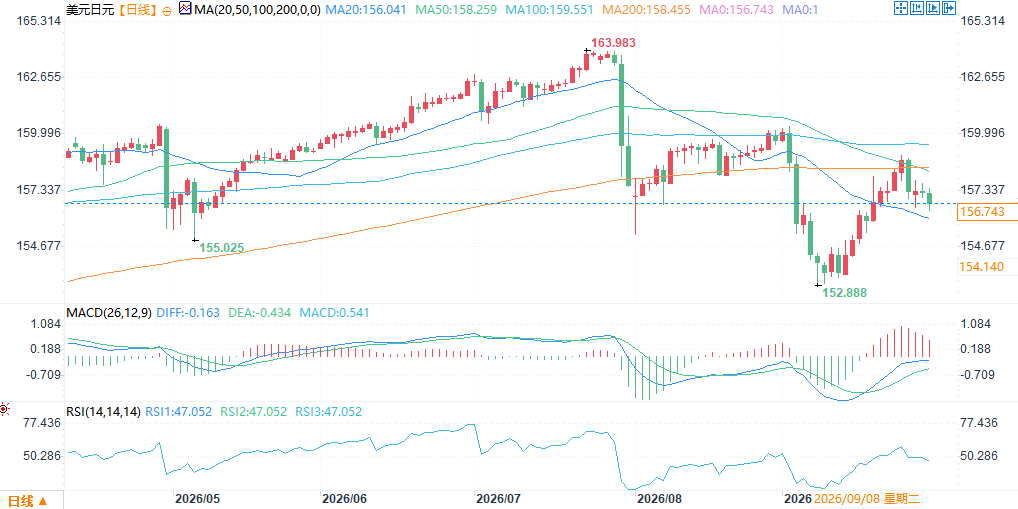 (USD/JPY daily chart, source: EasyForex) At 12:05 Beijing time, USD/JPY was trading at 156.82/83.
Mid-year cash flow is the main driver; the yen's appreciation may be unsustainable.
The USD/JPY pair fell from around 157.5 to around 156.4 in Asian trading on Wednesday, a drop of about 0.7%, with other yen crosses also declining. This move was mainly attributed to fund flows related to the end of Japan's fiscal six-month period on September 30, as Japanese investors repatriated funds and exporters sold foreign currency. Selling continued after the Tokyo fixing, the daily reference rate set mid-morning and historically a focal point for corporate fund flows. Six-month-end fund flows are the dominant driver, and such seasonal trends often reverse quickly after the start of a new fiscal six-month period; therefore, the yen's gains may not be as sustained as the apparent decline suggests. Traders are generally focused on the pair's performance after the start of the new fiscal six-month period on Thursday, as the repatriation flows are likely to subside quickly and market liquidity will return to normal. Historical experience suggests that the six-month-end effect is usually short-lived, and if fundamentals do not change fundamentally, USD/JPY is expected to strengthen again after the fund flows subside. Overall, the current yen appreciation is more of a combination of technical and seasonal factors than a clear signal of a trend reversal.Comments from US and Japanese officials limit the upside potential of the dollar against the yen.
Official comments also helped limit the upside potential of the USD/JPY pair. Market commentary pointed to statements made by Japanese and US officials late last week and earlier this week, with reports of Trump's concerns about the yen's weakness fueling speculation of another coordinated US-Japan intervention. Japanese Finance Ministry officials emphasized vigilance against excessive exchange rate volatility, and the US also signaled its concern. The USD/JPY pair consolidated around 157.5 on Tuesday after rebounding from a one-week low, supported by hawkish expectations from the Bank of Japan. These official statements made traders cautious about pushing the USD/JPY higher, as the pair had been at the upper end of its recent range before the decline. The increased risk of intervention significantly raised the cost of short positions, and the market's sensitivity to the 160 level has noticeably increased. Overall, policy communication has become a significant short-term constraint, limiting further sharp gains in the dollar while providing additional support for the yen. Traders are more inclined to adopt a wait-and-see approach or reduce positions on rallies near key resistance levels.Williams said there was no need to rush, but other Fed officials were more hawkish.
Comments from Federal Reserve officials added to the dollar's weakness. New York Fed President Williams said on Tuesday that there was no need for urgency following the central bank's September rate hike, although he added that another rate hike might be appropriate later this year if the economy evolves as he predicts. This statement was described as dovish and reportedly pushed the dollar index slightly lower, although the index still closed higher for the day. Other Fed officials were more hawkish, with Governor Barr suggesting further rate hikes might be necessary, and the money market still sees a rate hike at the October meeting as the most likely outcome. Williams's statement about "no need for urgency" removed some support for the dollar, but Treasury yields remain high and overall expectations for rate hikes remain firm. This internal divergence in stance makes the dollar's trajectory more complex: pressured in the short term by dovish voices, but supported in the medium term by hawkish signals and the interest rate advantage. The market will continue to weigh the weight of different officials' comments and the confirmation effect of subsequent data on the policy path.The yen's appreciation ignores weak domestic data; it is driven by capital flows rather than fundamentals.
The yen's appreciation ignored weak domestic data. Japanese industrial production fell 1.7% month-on-month in August, compared to an expected increase of 1.7%; retail sales rose 2.7% year-on-year, below the expected 3.3%. These results typically weaken the yen by complicating the rationale for tightening policy, suggesting that capital flows rather than fundamentals are driving this move. The Bank of Japan raised its policy rate to 1.25% in September, the highest since 1995, and a former BOJ executive director set the probability of another rate hike in October at 20% to 30%. The BOJ's own path is another swing factor, with markets debating whether it will act again in October. (USD/JPY daily chart, source: EasyForex) At 12:05 Beijing time, USD/JPY was trading at 156.82/83.
- Risk Warning and Disclaimer
- The market involves risk, and trading may not be suitable for all investors. This article is for reference only and does not constitute personal investment advice, nor does it take into account certain users’ specific investment objectives, financial situation, or other needs. Any investment decisions made based on this information are at your own risk.