Short-term liquidity needs outweigh long-term safe-haven demand, severely testing gold's resilience.
2026-09-30 12:08:15
In a precious metals analysis report, Ole Hansen, head of commodities strategy at Saxo Bank, pointed out that international gold prices broke below the key support level of $4,230. Coupled with soaring US Treasury yields and a stronger dollar, the market has once again entered a sell-off phase. Currently, inflows into gold ETFs are the only core hedging force supporting gold prices. Under the continued pressure of high real interest rates, gold's resilience is facing an extremely rigorous test, and the market is showing a set of contradictory signals: long-term debt risks are beneficial to gold's safe-haven properties, but short-term liquidity crises could trigger a gold sell-off.
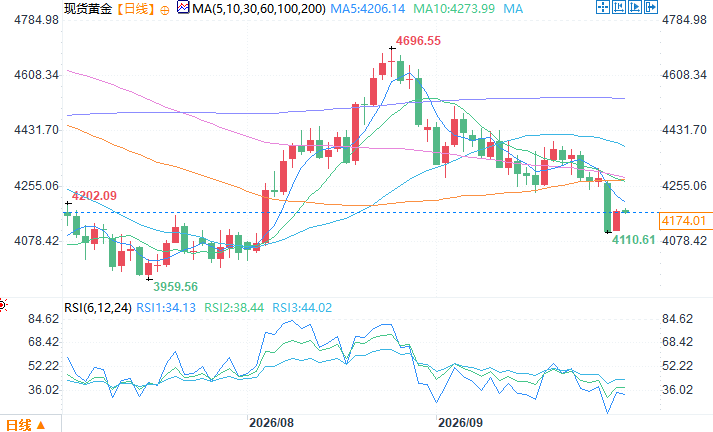 Spot gold daily chart source: FX678. As of 12:07 PM Beijing time on September 30th, spot gold was trading at $4174.01 per ounce.
Multiple negative factors combined to push gold prices below key support level.
Ole Hansen stated that gold's price action at the beginning of this week illustrates that its ability to maintain investment buying pressure is facing increasingly severe challenges in an environment of continuously rising bond yields. He wrote that the weakening gold price is the result of multiple factors: rising US Treasury yields, a stronger dollar, technical selling pressure triggered by the break of support levels, and profit-taking by investors in major Asian countries before the Golden Week holiday, further amplifying the decline. The pressure from interest rates is now undeniable; the US 10-year real yield has climbed to an 18-year high, approaching 2.85%, and the short-term interest rate market is even pricing in three more 25-basis-point rate hikes by the Federal Reserve by April next year. Hansen mentioned that historically, a rapid increase in the opportunity cost of holding non-interest-bearing assets like gold usually creates a strong negative factor. Gold itself does not generate interest, and when real bond yields rise, funds tend to shift from gold to bonds, which is the core logic suppressing gold prices under the traditional framework. However, the current market shows a clear divergence; even with the continued rise in real yields, gold ETF holdings are still recovering, which is the most noteworthy phenomenon in the current market. The core question is whether this buying momentum can continue. The market needs to continuously track ETF fund flows. These funds are less sensitive to interest rate fluctuations and are mostly allocating to gold out of concern about the financial risks brought about by long-term high borrowing costs.High yields create a dual effect, with conflicting logic between short-term and long-term strategies.
He analyzed that high yields would suppress gold prices through traditional valuation channels, but at the same time, high interest rates would increase government fiscal pressure and debt interest costs, pushing up sovereign debt risk, which would actually enhance gold's long-term value as a risk hedging tool. However, the pressure on cash flow would turn into a negative factor in the short term. As interest rates rise, corporate refinancing risks increase, and weaker entities in the US corporate credit market are already showing pressure. The spread of CCC-rated corporate bonds has widened significantly, and the spread between them and B-rated bonds has reached levels only seen during major economic slowdowns in the past. From the overall market perspective, the spread between US high-yield corporate bonds and US Treasuries widened again by 12 basis points last Friday, reaching 294 basis points, the highest level since April. Rising credit market risks have sown the seeds of tightening liquidity. Hansen warned that if this pressure continues to intensify, investors will sell their most liquid assets for cash to meet margin calls and other liquidity needs. The gold market has ample depth and good liquidity, making it highly likely to be liquidated in such a scenario. This creates a unique short-term paradox in the gold market: the fiscal and financial pressures brought about by high yields enhance the long-term value of gold as an investment; however, once a severe liquidity shortage occurs, the market will sell gold first, directly depressing the price of gold.Conclusion
In summary, the sharp rise in US real yields coupled with a technical breakdown means that gold's resilience is undergoing its most difficult test to date. ETF inflows are currently the only bulwark for the bulls, but whether this buying can withstand the dual impact of interest rates and the dollar remains uncertain. The gold market is currently experiencing a mix of bullish and bearish factors; long-term sovereign debt risks are bullish for gold, while short-term liquidity crises could bring selling pressure. Going forward, changes in US Treasury real yields, the dollar index, and credit spreads will continue to dominate gold price fluctuations. The sustainability of ETF inflows is a key indicator for judging whether gold prices can hold their support level. Spot gold daily chart source: FX678. As of 12:07 PM Beijing time on September 30th, spot gold was trading at $4174.01 per ounce.
- Risk Warning and Disclaimer
- The market involves risk, and trading may not be suitable for all investors. This article is for reference only and does not constitute personal investment advice, nor does it take into account certain users’ specific investment objectives, financial situation, or other needs. Any investment decisions made based on this information are at your own risk.