Feedback from US-Iran negotiations, coupled with a rapid recovery in supply and demand, led to a swift clearing of the crude oil premium.
2026-09-30 16:38:16
On Wednesday, September 30th, during the Asian and European sessions, oil prices continued their weakness, failing to rebound significantly and maintaining an overall volatile and weak trend. Meanwhile, international oil prices experienced their largest single-day drop in over a week on Tuesday evening, with Brent and WTI crude benchmark prices falling sharply. This was attributed to a substantial recovery in Middle Eastern oil supply, hedging by US energy policy, and a significant reduction in the US-Iran geopolitical risk premium. Furthermore, the ambiguous stalemate in US-Iran negotiations and cautious market risk appetite further suppressed the potential for an oil price rebound. An Iranian government spokesperson stated via the X platform that Iranian Foreign Minister Araqchi had informed the cabinet of receiving the US proposal. 
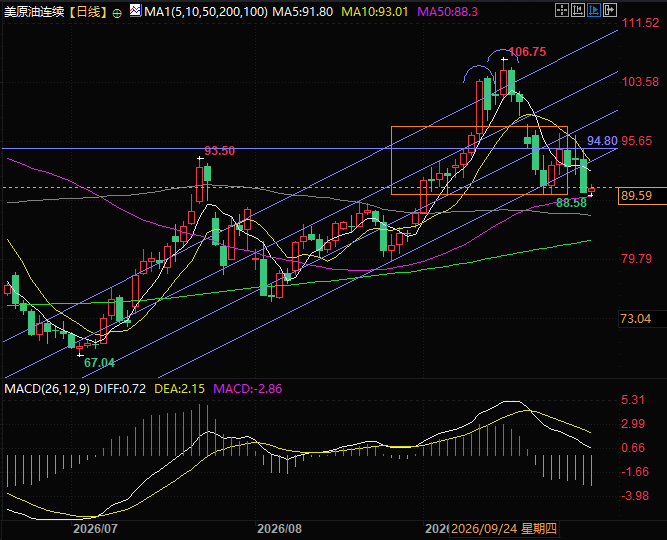 (WTI crude oil futures main contract daily chart, source: EasyTrade) At 16:36 Beijing time, WTI crude oil futures main contract was trading at $89.57 per barrel.
Geopolitical de-escalation: US-Iran negotiations continue, risk premiums retreat significantly.
The core geopolitical logic that previously supported high oil prices—the permanent blockade of the Strait of Hormuz and the full-scale escalation of the US-Iran conflict—has loosened with continued diplomatic efforts, leading to a significant reduction in geopolitical risk premiums. This was the core sentiment driving Tuesday's sharp drop in oil prices. Currently, the US-Iran standoff is stable, characterized by "no escalation of military confrontation and no interruption of diplomatic negotiations." Iranian Foreign Minister Araqchi clearly stated that the only focus of the negotiations is the issue of navigation in the Strait of Hormuz, and Iran's position remains unchanged; there will be no compromise on its nuclear program. Iran previously proposed a "seven-day navigation plan," demanding that the US lift the blockade of Iranian ports, waive oil sanctions, unfreeze Iranian assets, and implement the ceasefire agreement in Lebanon. If these conditions are met, the Strait of Hormuz will be fully reopened for shipping within seven days. Although Trump has publicly stated that he "will not make any concessions to Iran or provide any sanctions waivers," the two sides are still maintaining an indirect mediation channel through Qatar. On Tuesday evening, Araqchi met with Qatari mediators in Doha and formally received written feedback from the US regarding the seven-day proposal. A high-level meeting will be held in Tehran on Wednesday to assess the response. The Iranian government spokesperson stated via the X platform that Iranian Foreign Minister Araqchi has informed the cabinet of the proposal received from the United States.Key negative factor for oil prices: Middle East supply fully restored, alleviating fears of supply disruptions in the Straits.
The most fundamental support for this round of oil price plunge is the significant easing of the previously extreme market concern over the supply crisis in the Strait of Hormuz. Middle Eastern crude oil exports have nearly returned to pre-war levels, breaking through the previously high geopolitical risk premium. Data shows that last week, the average daily flow of crude oil and refined products through the Strait of Hormuz reached 13.1 million barrels, recovering to 80% of the level before the US-Israel joint airstrikes on Iran in February. Currently, shipping through the strait continues to operate under emergency modes such as US military escort, tankers turning off AIS for covert navigation, and ship-to-ship transfers. Although not fully back to normal, there is no longer a risk of large-scale supply disruptions. Coupled with a significant rebound in Gulf crude oil exports in September, Goldman Sachs data shows that the average daily crude oil exports from the Gulf region, including "shadow exports," rose to 19 million barrels, 8% higher than the average of previous years. Total refined product exports rebounded to 23.3 million barrels per day, completely erasing the supply gap from the early stages of the war. September exports nearly doubled compared to previous months. At the same time, Saudi Arabia's core alternative shipping lanes have fully resumed operation, further diverting supply pressure from the Strait of Hormuz. The Saudi transcontinental oil pipeline, shut down after a drone attack, has resumed operation, currently transporting a stable 3.5 million barrels per day, half of its total capacity, and is expected to return to full capacity within weeks. This pipeline allows Saudi crude oil to be directly exported to the Red Sea port of Yanbu, bypassing the Strait of Hormuz. On Sunday alone, Yanbu port and surrounding terminals loaded 12.5 million barrels of oil. With multiple supply channels working together, global crude oil supply and demand have returned to a general balance. JPMorgan data shows that since the outbreak of the conflict, global crude oil and refined product inventories have decreased by 5.55 million barrels, but recent supply recovery has halted the trend of continued inventory reduction, dispelling market expectations of extreme shortages.Policy countermeasures ease oil price concerns: US reserve release further suppresses upside potential for oil prices.
With supply-side recovery underway, the US energy reserve release policy became a direct catalyst for suppressing oil prices. The US Department of Energy officially announced the release of up to 40 million barrels of strategic petroleum reserves, the final batch of the 172 million barrel release plan since the outbreak of the conflict in February. Although the market clearly understands that this 40 million barrel release is a swap arrangement, requiring future return, and that its volume is unlikely to significantly alter the fundamentals in the long term compared to the daily flow of tens of millions of barrels across the Strait, in a short-term market driven by sentiment, this move sends a clear signal that the US is stabilizing oil prices and hedging against the energy crisis, effectively suppressing speculative bullish sentiment. Coupled with the EU's collaboration with the International Energy Agency to launch a new round of consultations on reserve releases, global energy regulation policies have formed a united front, further compressing the premium for rising oil prices. However, it is worth noting that the US's regular strategic reserve release authority is nearing the legal limit of 252.4 million barrels, after which non-emergency sales/swaps are prohibited, leaving no room for large-scale releases. However, the short-term policy benefits have already been fully priced into the market.Sanctions continue to weaken Iran's confrontational potential
The United States continues to escalate sanctions against Iran, adding 10 related entities and individuals in Iran and Pakistan, precisely targeting Iran's military supply chain and further intensifying regional confrontation. Meanwhile, Iran's economy faces difficulties, with the rial hitting a new low, where one US dollar can be exchanged for over 2.5 million rials. Under this economic pressure, the voice of hardliners within Iran may be affected , but extreme conditions could lead to further escalation, posing a hidden risk to oil prices. For example, the current Middle East shipping system is highly vulnerable, relying on US military escorts, covert navigation, and alternative pipelines; an attack could easily disrupt supply chains again.Summary and Technical Analysis:
Currently, Iran faces numerous hard constraints, including economic challenges, aviation sanctions, and a backlog of crude oil production, highlighting the resilience of its domestic economy. This has led to a greater inclination towards negotiations. Meanwhile, the US, burdened by rising domestic oil prices, is forced to release its remaining crude oil reserves. Both sides currently have a need for dialogue. Observing oil prices, the US currently holds the upper hand. Previous articles have indicated that oil prices may continue to decline. However, it's important to note that if oil prices continue to fall, Iran's bargaining chips will diminish. At this point, Iran may begin to seek ways to stimulate oil prices. For example, Iranian Parliament Speaker Gharibaf recently stated that if Iran cannot sell oil, no country in the region should sell oil; and if Iran lacks security guarantees, then regional infrastructure will also be insecure. Technically, the WTI crude oil futures main contract price has broken below the upward channel and returned to near the bottom of the range. We should observe whether oil prices can stabilize near this support level; if not, they may break below the range. (WTI crude oil futures main contract daily chart, source: EasyTrade) At 16:36 Beijing time, WTI crude oil futures main contract was trading at $89.57 per barrel.
- Risk Warning and Disclaimer
- The market involves risk, and trading may not be suitable for all investors. This article is for reference only and does not constitute personal investment advice, nor does it take into account certain users’ specific investment objectives, financial situation, or other needs. Any investment decisions made based on this information are at your own risk.