A chart shows the Baltic Dry Index falling to a more than one-month low, with freight rates for large vessels weakening significantly.
2026-09-30 23:50:28
The latest data shows that the Baltic Dry Index (BDI) closed at 3113 points on September 30, 2026, a new low since August 27, 2026, down 2.05% month-on-month, marking the fourth consecutive day of decline (including zero growth). Looking at the short-term charts, the BDI has seen positive growth 5 times, negative growth 6 times, and zero growth in the last 11 BDI data points. Specifically, the Panamax Freight Index (BPI) closed at 2384 points, down 0.25% from the previous value; the Capesize Freight Index (BCI) closed at 4928 points, down 3.43%; and the Supramax Freight Index (BSI) closed at 1797 points, unchanged. For detailed charts of the latest 720-day and 10-year trends of the Baltic Dry Index and its three main sub-indices, please refer to the charts specially created by FX678. 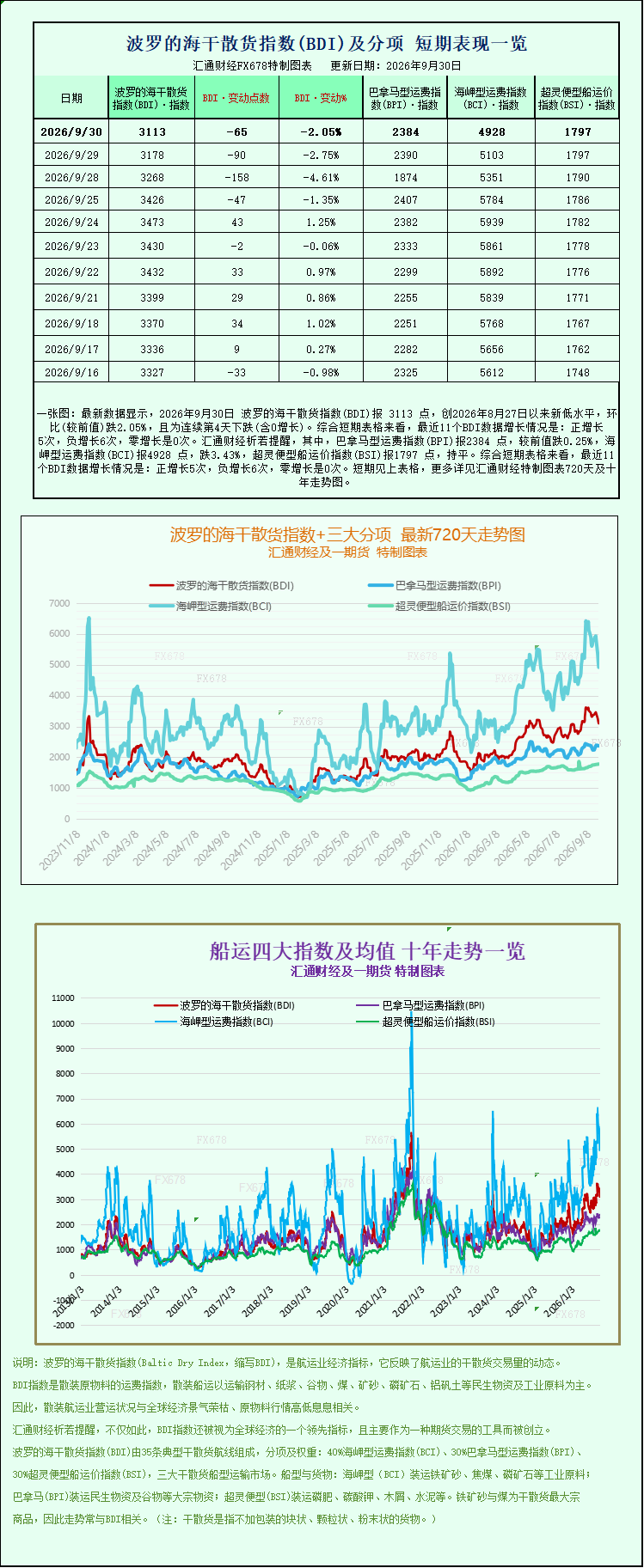 At 21:29 on September 30, 2026, news broke that the international dry bulk shipping market experienced a significant correction on Wednesday, with the Baltic Dry Index (BADI) falling sharply to a more than one-month low. This decline was primarily driven by a plunge in Capesize freight rates, while Panamax rates also weakened slightly. Only Supramax rates remained firm, indicating a significant divergence in ship types, reflecting the structural differences in global commodity shipping demand. Data shows that the Baltic Dry Index (BADI), which tracks freight rates for the three major dry bulk vessel types (Capesize, Panamax, and Supramax), fell 65 points, a drop of 2.05%, closing at 3113 points, its lowest level since August 27th. This ended the previous period of consolidation and indicates a significant decline in short-term shipping market sentiment. Looking at the sub-ship type indices, the market differentiation is particularly pronounced. Large vessels carrying bulk industrial raw materials are facing significant pressure on freight rates, while small and medium-sized vessels continue their strong performance. Capesize vessels, the main carriers of core industrial raw materials such as iron ore and coal, have seen the most significant price drop. The Baltic Capesize Index (BACI) plummeted 175 points in a single day, a drop of 3.43%, closing at 4928 points, a one-month low since August 25th. Specific operating revenue data shows that the average daily earnings of Capesize vessels with a deadweight tonnage of 150,000 tons, mainly carrying bulk commodities such as iron ore and thermal coal, have shrunk dramatically, decreasing by $1584 per day to a latest average daily earnings of $41191. The profit margins for large mining vessels continue to narrow. Industry analysts point out that the sharp decline in Capesize freight rates is the result of a mismatch between supply and demand and a temporary cooling of demand. Recently, domestic steel industry end-user demand has remained generally stable. To control production costs and mitigate market volatility risks, steel mills have maintained a just-in-time restocking pace, without any concentrated stockpiling, resulting in insufficient incremental demand for iron ore in ocean shipping. Meanwhile, previous restocking demand has been fully released, and with the National Day holiday approaching, upstream and downstream enterprises have slowed down their procurement and transportation pace, further dragging down the growth of large bulk carrier charter orders. Coupled with relatively ample short-term shipping capacity, this has directly driven a rapid correction in large vessel freight rates. It is worth noting that while the shipping market is weakening, the domestic industrial economy is showing signs of recovery, creating a counterbalancing effect. The latest data on China's manufacturing activity in September shows that factory production has returned to growth, and the manufacturing sector's prosperity is steadily recovering. At the same time, the implementation of a new round of economic stimulus policies has effectively boosted overall sentiment in the commodity market, driving a slight increase in iron ore futures prices. However, the improvement in macro sentiment has not yet fully translated into the spot shipping market. With continued increases in iron ore arrivals at ports and ample spot supply, coupled with a slow pace of capacity release from downstream steel mills, demand for imported raw materials via sea has not picked up accordingly, making it difficult to support a stabilization and rebound in freight rates for large vessels. The medium-sized vessel market also continued its weak trend. Panamax vessel freight rates, primarily for bulk cargo transportation such as coal and grain, declined slightly. The Panamax Index (BPNI) fell 6 points, or 0.25%, to close at 2384 points. Operating revenue for the corresponding vessel type also declined. Panamax vessels with a deadweight to 70,000 tonnes, mainly handling global grain and thermal coal transportation orders, saw their average daily revenue decrease by $49, with the latest average daily revenue at $21,458. Compared to Capesize vessels, the decline in Panamax vessel freight rates was relatively mild, mainly due to stable global grain trade transportation demand, which provided some support for medium-sized vessel freight rates and buffered the downward pressure from weak demand for industrial raw materials via sea. In stark contrast to the weakening freight rates for large and medium-sized vessels, the Supramax market has performed exceptionally well, becoming the only bright spot in the current dry bulk shipping market. Data shows that the Supramax Index (BSIS) remained flat on the day, stabilizing at 1797 points, continuing to hold above its high level since August 2022. Supramax vessels, with their compact size, flexible routes, and adaptability to transport various types of bulk cargo, can cover diverse cargo transportation needs such as grains, building materials, and small-batch minerals, and are less affected by fluctuations in industrial raw material demand. Currently, strong global regional trade and niche bulk cargo transportation demand support the continued tightness of small vessel capacity, keeping freight rates high for an extended period. Overall, the current dry bulk shipping market exhibits a clear structural differentiation, with freight rates for large industrial raw material transport vessels under pressure and declining, while freight rates for small and medium-sized multi-purpose vessels have shown remarkable resilience. In the short term, the domestic holiday effect will continue to influence the pace of commodity restocking, and Capesize and Panamax vessel freight rates may maintain a volatile and weak trend. The subsequent market trend will mainly depend on the strength of the domestic manufacturing recovery, the progress of steel mills' raw material restocking, and changes in global commodity trade demand. If domestic stimulus policies continue to be implemented and drive a recovery in industrial demand, the demand for iron ore and coal imports is expected to recover, stabilizing freight rates for large vessels; while small vessels, relying on stable and diversified trade demand, are likely to continue operating at high levels.
At 21:29 on September 30, 2026, news broke that the international dry bulk shipping market experienced a significant correction on Wednesday, with the Baltic Dry Index (BADI) falling sharply to a more than one-month low. This decline was primarily driven by a plunge in Capesize freight rates, while Panamax rates also weakened slightly. Only Supramax rates remained firm, indicating a significant divergence in ship types, reflecting the structural differences in global commodity shipping demand. Data shows that the Baltic Dry Index (BADI), which tracks freight rates for the three major dry bulk vessel types (Capesize, Panamax, and Supramax), fell 65 points, a drop of 2.05%, closing at 3113 points, its lowest level since August 27th. This ended the previous period of consolidation and indicates a significant decline in short-term shipping market sentiment. Looking at the sub-ship type indices, the market differentiation is particularly pronounced. Large vessels carrying bulk industrial raw materials are facing significant pressure on freight rates, while small and medium-sized vessels continue their strong performance. Capesize vessels, the main carriers of core industrial raw materials such as iron ore and coal, have seen the most significant price drop. The Baltic Capesize Index (BACI) plummeted 175 points in a single day, a drop of 3.43%, closing at 4928 points, a one-month low since August 25th. Specific operating revenue data shows that the average daily earnings of Capesize vessels with a deadweight tonnage of 150,000 tons, mainly carrying bulk commodities such as iron ore and thermal coal, have shrunk dramatically, decreasing by $1584 per day to a latest average daily earnings of $41191. The profit margins for large mining vessels continue to narrow. Industry analysts point out that the sharp decline in Capesize freight rates is the result of a mismatch between supply and demand and a temporary cooling of demand. Recently, domestic steel industry end-user demand has remained generally stable. To control production costs and mitigate market volatility risks, steel mills have maintained a just-in-time restocking pace, without any concentrated stockpiling, resulting in insufficient incremental demand for iron ore in ocean shipping. Meanwhile, previous restocking demand has been fully released, and with the National Day holiday approaching, upstream and downstream enterprises have slowed down their procurement and transportation pace, further dragging down the growth of large bulk carrier charter orders. Coupled with relatively ample short-term shipping capacity, this has directly driven a rapid correction in large vessel freight rates. It is worth noting that while the shipping market is weakening, the domestic industrial economy is showing signs of recovery, creating a counterbalancing effect. The latest data on China's manufacturing activity in September shows that factory production has returned to growth, and the manufacturing sector's prosperity is steadily recovering. At the same time, the implementation of a new round of economic stimulus policies has effectively boosted overall sentiment in the commodity market, driving a slight increase in iron ore futures prices. However, the improvement in macro sentiment has not yet fully translated into the spot shipping market. With continued increases in iron ore arrivals at ports and ample spot supply, coupled with a slow pace of capacity release from downstream steel mills, demand for imported raw materials via sea has not picked up accordingly, making it difficult to support a stabilization and rebound in freight rates for large vessels. The medium-sized vessel market also continued its weak trend. Panamax vessel freight rates, primarily for bulk cargo transportation such as coal and grain, declined slightly. The Panamax Index (BPNI) fell 6 points, or 0.25%, to close at 2384 points. Operating revenue for the corresponding vessel type also declined. Panamax vessels with a deadweight to 70,000 tonnes, mainly handling global grain and thermal coal transportation orders, saw their average daily revenue decrease by $49, with the latest average daily revenue at $21,458. Compared to Capesize vessels, the decline in Panamax vessel freight rates was relatively mild, mainly due to stable global grain trade transportation demand, which provided some support for medium-sized vessel freight rates and buffered the downward pressure from weak demand for industrial raw materials via sea. In stark contrast to the weakening freight rates for large and medium-sized vessels, the Supramax market has performed exceptionally well, becoming the only bright spot in the current dry bulk shipping market. Data shows that the Supramax Index (BSIS) remained flat on the day, stabilizing at 1797 points, continuing to hold above its high level since August 2022. Supramax vessels, with their compact size, flexible routes, and adaptability to transport various types of bulk cargo, can cover diverse cargo transportation needs such as grains, building materials, and small-batch minerals, and are less affected by fluctuations in industrial raw material demand. Currently, strong global regional trade and niche bulk cargo transportation demand support the continued tightness of small vessel capacity, keeping freight rates high for an extended period. Overall, the current dry bulk shipping market exhibits a clear structural differentiation, with freight rates for large industrial raw material transport vessels under pressure and declining, while freight rates for small and medium-sized multi-purpose vessels have shown remarkable resilience. In the short term, the domestic holiday effect will continue to influence the pace of commodity restocking, and Capesize and Panamax vessel freight rates may maintain a volatile and weak trend. The subsequent market trend will mainly depend on the strength of the domestic manufacturing recovery, the progress of steel mills' raw material restocking, and changes in global commodity trade demand. If domestic stimulus policies continue to be implemented and drive a recovery in industrial demand, the demand for iron ore and coal imports is expected to recover, stabilizing freight rates for large vessels; while small vessels, relying on stable and diversified trade demand, are likely to continue operating at high levels.
- Risk Warning and Disclaimer
- The market involves risk, and trading may not be suitable for all investors. This article is for reference only and does not constitute personal investment advice, nor does it take into account certain users’ specific investment objectives, financial situation, or other needs. Any investment decisions made based on this information are at your own risk.