October 1st Financial Breakfast: Seven-day proposal remains unresolved; Iran raises alert level for 46 facilities; gold bulls lack momentum; oil prices surged in September.
2026-10-01 07:22:15
On Thursday (October 1, Beijing time) in early Asian trading, spot gold was trading around $4153.35 per ounce. Gold prices fell on Wednesday, and also fell more than 6% in September, as rising energy prices outweighed the support from lower-than-expected US inflation data. The US-Iran standoff continued, and oil prices rose in September, with Brent crude up nearly 8% and WTI crude up more than 4%. Although Middle Eastern oil exports have rebounded somewhat, Iran raised the alert level for 46 infrastructure sites. Meanwhile, the Iranian Foreign Minister received feedback from the US in Doha, indicating that the two sides still have disagreements on the seven-day proposal. WTI crude is currently trading around $90.20 per barrel. 
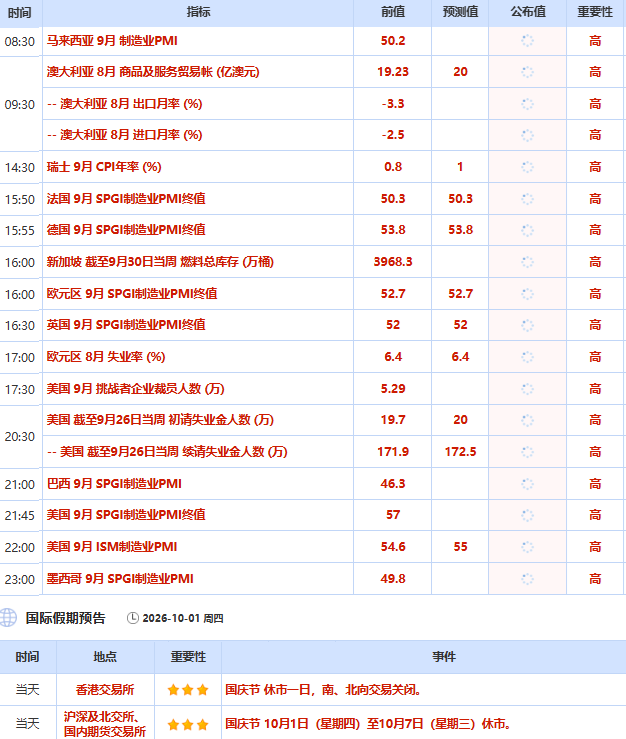
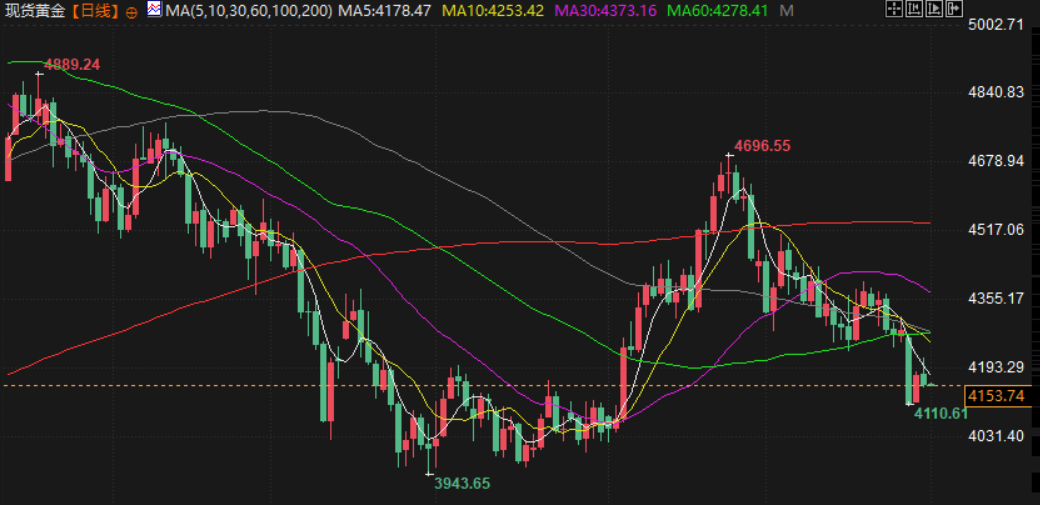 Independent precious metals trader Tai Wong said that precious metals came under renewed pressure as energy prices rose and Treasury bonds gave back their gains. Although the likelihood of an October rate hike has significantly decreased after the core personal consumption expenditures (PCE) data came in lower than expected, it was still a disappointing day for gold. The U.S. Bureau of Economic Analysis reported on Wednesday that the PCE price index rose 0.3% in August, with the July increase revised down to 0.1%; the core PCE price index rose 3.0% year-on-year in August, with the July year-on-year increase also revised down to 3.0%. The CME Group's FedWatch tool shows that financial markets currently perceive a 39% probability of a Fed rate hike in October, down from about 45% before the PCE data release; the probability of a December rate hike is 90%. The dollar fell after the data release but still recorded a monthly gain, making dollar-denominated gold more expensive for overseas buyers. Meanwhile, oil prices rose, recording a significant monthly gain, as negotiations between the US and Iran aimed at ending the war stalled. The lack of progress in the talks fueled market concerns about persistently high energy prices, which could lead to prolonged inflation and prompt further tightening of monetary policy. Spot silver fell 1.77% to $60.37 per ounce; platinum fell 0.4% to $1699.40 per ounce; and palladium fell 1.5% to $1204.53 per ounce, all three precious metals recording monthly declines.
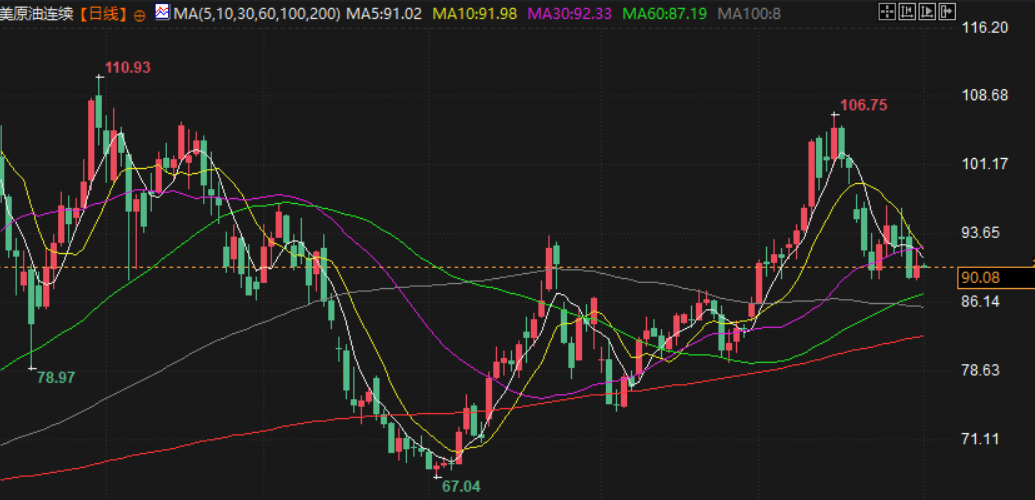 Qatar said on Tuesday it hoped for a breakthrough in shuttle diplomacy between Tehran and Washington, but US President Trump denied reports from Axios and CNN that cited US officials as saying he was willing to ease sanctions on Iran and unfreeze frozen Iranian funds in exchange for "concrete" action from Tehran on its nuclear program. Saudi Arabia resumed loading oil tankers from the Red Sea port of Yanbu on Tuesday after the East-West pipeline resumed operation. Goldman Sachs said in a report on Tuesday that, according to its estimates, Gulf oil exports have recovered to 23.3 million barrels per day in the past week, comparable to the 2025 average, as exports doubled in September. JPMorgan Chase estimates that the 10-day average of total oil exports over the past five days remained at 20.5 million barrels per day, equivalent to 89% of the 2025 level. Two sources familiar with the matter said the OPEC+ alliance is likely to keep its November oil production target unchanged when it meets on Sunday. Analysts at Mitsubishi UFJ Financial Group said the recovery in crude oil supply should ease price pressures caused by supply factors; however, continued shortages of refined products and high freight rates could keep the overall energy market tight. According to two sources familiar with the matter, the White House has urged the EU to use its emergency diesel reserves to lower global prices. Data released by the U.S. Energy Information Administration on Wednesday showed that U.S. gasoline inventories fell by 1.7 million barrels to 204.4 million barrels last week; distillate fuel inventories, including diesel and heating oil, fell by 2.3 million barrels to 105.2 million barrels; and U.S. crude oil inventories rose by 922,000 barrels to 427.3 million barrels.
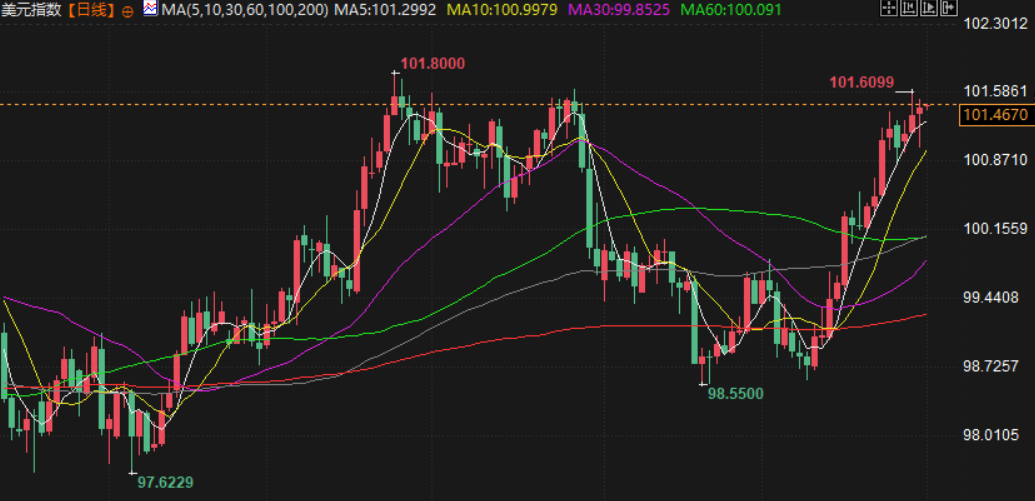 Data from the U.S. Commerce Department showed that the Personal Consumption Expenditures (PCE) price index, the inflation gauge favored by the Federal Reserve, rose 0.3% in August. The CME Group's FedWatch tool shows that traders now expect a 37% chance of a Fed rate hike in October, down from 70% a week ago. Joel Krueger, market strategist at LMAX Group, said that Wednesday's weaker PCE report prompted the market to significantly lower its expectations for consecutive Fed rate hikes after New York Fed President Williams questioned the urgency of another rate hike. This repricing is pulling down U.S. Treasury yields, narrowing the dollar's yield advantage, and providing a clear fundamental catalyst for the latest round of dollar selling. The dollar was flat against the yen at 157.29 yen; the dollar rose 0.26% against the Swiss franc to 0.83575 francs, marking its second consecutive monthly gain in September; the pound rose 0.26% against the dollar to $1.3265, but fell in September, ending a two-month winning streak.
Key Focus Today
stock market
U.S. stocks closed mixed on Wednesday. The Dow Jones Industrial Average fell 0.86% to 50,906.05 points; the S&P 500 fell 0.25% to 7,651.54 points; and the Nasdaq Composite rose 0.24% to 26,861.06 points. For the month, the S&P 500 fell 0.45%, the Nasdaq rose 1.86%, and the Dow fell 4.29%. The Dow ended its five-month winning streak, the S&P 500 fell for the third time in the past four months, and the Nasdaq rose for the second consecutive month. Both the S&P 500 and Nasdaq have risen for the second consecutive quarter, the fifth time in the past six quarters, while the Dow fell for the second time in the past three quarters. Lower-than-expected inflation data weakened market expectations for a Federal Reserve rate hike in October. The U.S. Commerce Department reported that the personal consumption expenditures (PCE) price index rose 3.4% year-on-year in August, lower than economists' forecast of 3.7%. Other data showed that the final reading of second-quarter GDP annualized growth was revised upward to 2.2%, driven by robust consumer spending and investment related to AI infrastructure construction. The Iraq War has led to rising oil and diesel prices, exacerbating inflation concerns and pushing up Treasury yields. Federal Reserve officials indicated that if price pressures do not ease after a 25-basis-point rate hike this month, further rate increases may be necessary. The CME Group's FedWatch tool shows that the market's expectation of a Fed rate hike of at least 25 basis points in October has fallen to about 37%, down from about 51% the previous trading day and nearly 71% a week ago. Analysts also pointed to the Bureau of Economic Analysis's adjustment to its PCE calculation methodology as one of the reasons for the lower data. Anthony Saglimbene, chief market strategist at Ameriprise Financial, said the market is focused on whether the economy can continue to grow and withstand higher interest rates. If interest rates remain high for longer, it could damage the bond market and restrict credit. If investors believe these conditions will drag down economic growth or corporate profits, the market will react negatively quickly. Most mega-cap and growth stocks rose slightly, with Microsoft, Apple, and Nvidia all rising, pushing the S&P 500 technology sector up 0.6%, making it the best-performing sector of the day. However, nine of the 11 major sectors closed lower. The ADP National Employment Report showed that private sector jobs increased by 90,000 in September, while the August increase was revised down to 36,000; Federal Reserve Governor Cook stated that he is committed to keeping inflation low without harming the labor market.Gold Market
Spot gold fell 0.59% on Wednesday to settle at $4,157.02 an ounce, while also declining 3.03% for the week and 6.55% for the month, as rising energy prices outweighed support from lower-than-expected U.S. inflation data. This data reduced market expectations for a near-term interest rate hike by the Federal Reserve. Independent precious metals trader Tai Wong said that precious metals came under renewed pressure as energy prices rose and Treasury bonds gave back their gains. Although the likelihood of an October rate hike has significantly decreased after the core personal consumption expenditures (PCE) data came in lower than expected, it was still a disappointing day for gold. The U.S. Bureau of Economic Analysis reported on Wednesday that the PCE price index rose 0.3% in August, with the July increase revised down to 0.1%; the core PCE price index rose 3.0% year-on-year in August, with the July year-on-year increase also revised down to 3.0%. The CME Group's FedWatch tool shows that financial markets currently perceive a 39% probability of a Fed rate hike in October, down from about 45% before the PCE data release; the probability of a December rate hike is 90%. The dollar fell after the data release but still recorded a monthly gain, making dollar-denominated gold more expensive for overseas buyers. Meanwhile, oil prices rose, recording a significant monthly gain, as negotiations between the US and Iran aimed at ending the war stalled. The lack of progress in the talks fueled market concerns about persistently high energy prices, which could lead to prolonged inflation and prompt further tightening of monetary policy. Spot silver fell 1.77% to $60.37 per ounce; platinum fell 0.4% to $1699.40 per ounce; and palladium fell 1.5% to $1204.53 per ounce, all three precious metals recording monthly declines.oil market
Oil prices rose on Wednesday, with U.S. crude up 1.57% to settle at $90.34 a barrel and Brent crude up 2.4% to settle at $97.90 a barrel, as peace talks between the U.S. and Iran stalled and the U.S. fuel market tightened. Qatar said on Tuesday it hoped for a breakthrough in shuttle diplomacy between Tehran and Washington, but US President Trump denied reports from Axios and CNN that cited US officials as saying he was willing to ease sanctions on Iran and unfreeze frozen Iranian funds in exchange for "concrete" action from Tehran on its nuclear program. Saudi Arabia resumed loading oil tankers from the Red Sea port of Yanbu on Tuesday after the East-West pipeline resumed operation. Goldman Sachs said in a report on Tuesday that, according to its estimates, Gulf oil exports have recovered to 23.3 million barrels per day in the past week, comparable to the 2025 average, as exports doubled in September. JPMorgan Chase estimates that the 10-day average of total oil exports over the past five days remained at 20.5 million barrels per day, equivalent to 89% of the 2025 level. Two sources familiar with the matter said the OPEC+ alliance is likely to keep its November oil production target unchanged when it meets on Sunday. Analysts at Mitsubishi UFJ Financial Group said the recovery in crude oil supply should ease price pressures caused by supply factors; however, continued shortages of refined products and high freight rates could keep the overall energy market tight. According to two sources familiar with the matter, the White House has urged the EU to use its emergency diesel reserves to lower global prices. Data released by the U.S. Energy Information Administration on Wednesday showed that U.S. gasoline inventories fell by 1.7 million barrels to 204.4 million barrels last week; distillate fuel inventories, including diesel and heating oil, fell by 2.3 million barrels to 105.2 million barrels; and U.S. crude oil inventories rose by 922,000 barrels to 427.3 million barrels.Foreign exchange market
The dollar index rose on Wednesday, closing at 101.45, up more than 2% for the month, after inflation data came in below expectations. John Willis, a foreign exchange and macro strategist at BNY Mellon, said it was impossible to determine whether the lower-than-expected reading was due to the revised PCE data itself or other factors. The data initially drove up bond prices, lower yields, and a weaker dollar. "We saw some strong GDP data, and the yield curve has risen at the longer end while the shorter end remains low, making the yield curve steeper. The decline in the two-year Treasury yield reflects a weakening market expectation of an October rate hike, and the dollar has fallen in tandem." Data from the U.S. Commerce Department showed that the Personal Consumption Expenditures (PCE) price index, the inflation gauge favored by the Federal Reserve, rose 0.3% in August. The CME Group's FedWatch tool shows that traders now expect a 37% chance of a Fed rate hike in October, down from 70% a week ago. Joel Krueger, market strategist at LMAX Group, said that Wednesday's weaker PCE report prompted the market to significantly lower its expectations for consecutive Fed rate hikes after New York Fed President Williams questioned the urgency of another rate hike. This repricing is pulling down U.S. Treasury yields, narrowing the dollar's yield advantage, and providing a clear fundamental catalyst for the latest round of dollar selling. The dollar was flat against the yen at 157.29 yen; the dollar rose 0.26% against the Swiss franc to 0.83575 francs, marking its second consecutive monthly gain in September; the pound rose 0.26% against the dollar to $1.3265, but fell in September, ending a two-month winning streak.International News
The probability of a Fed rate hike in October is 38.2%, according to CME's FedWatch Tool. The probability of the Fed maintaining interest rates at 3.75% to 4.00% at its October meeting is 61.8%, and the probability of a 25 basis point hike is 38.2%. The probability of the Fed maintaining rates at 3.75% to 4.00% by December is 13.3%, the probability of a cumulative 25 basis point hike is 56.7%, and the probability of a cumulative 50 basis point hike is 30%. Iranian Foreign Minister receives US feedback in Doha; the main disagreement on the seven-day proposal lies in the implementation order. An official briefed on the negotiations stated that Iranian Foreign Minister Araqchi and his team held talks with Qatari mediators in Doha on Tuesday evening. Araqchi received US feedback on the seven-day proposal and will discuss it in Tehran on Wednesday. The documents under negotiation describe a seven-day plan aimed at building mutual trust and returning to an enhanced version of the memorandum of understanding signed between the US and Iran in June. The main disagreement between the US and Iran lies in the order of implementation of the measures in the seven-day plan, rather than the specific content of the plan itself. Russia Extends Diesel Export Ban On September 30, the Russian government announced that, due to the continued impact of regional conflict and supply shortages on the global energy market, it had decided to extend the ban on direct exports of diesel, marine fuel, and gas oil from fuel producers to October 31. A statement released by the Russian Cabinet press office said that this decision aims to maintain the stability of the domestic fuel market, especially given the increased demand for engine fuel during the current agricultural harvest season, which exacerbates supply shortages. (Xinhua) Report Shows Middle East Crude Oil Exports Rebound in September A new report released on September 28 by ship tracking agency Kepler shows that crude oil exports from major oil-producing countries in the Middle East rebounded significantly in September. Data shows that Saudi Arabia, the UAE, Iraq, Oman, Qatar, Kuwait, and Iran exported an average of nearly 16.33 million barrels of oil per day in September, about 3.2 million barrels less than the approximately 19.51 million barrels before the outbreak of the Iranian conflict in February this year. According to Kepler, Middle East crude oil exports in September had recovered to about 80% of pre-war levels. (CCTV International News) International Flight Bookings Surge The Ministry of Transport predicts that during the National Day holiday, the national passenger traffic is expected to reach 2.13 billion trips. Officials at the Capital Airport Operations Control Center stated that the peak travel days are October 1st and October 7th, with daily passenger traffic exceeding 245,000 trips each day. Popular domestic destinations are concentrated in Shanghai, Guangzhou, Shenzhen, Chengdu, Chongqing, and Guiyang, while popular international destinations are Ho Chi Minh City, Bangkok, and Bali. Currently, international flight bookings have increased by 22.5% year-on-year, and civil aviation passenger volume is expected to reach a new historical high for the same period. (CCTV Finance) Chilean Copper Production Falls to Lowest Level in Over 15 Years As the world's largest copper supplier, Chile's copper production in August recorded its worst monthly performance in over 15 years. This exacerbated the country's recession and explains why global market supply is tight and copper prices have repeatedly hit record highs. August's production decline exacerbated an already difficult year for Chile's mining industry. Following storms that struck several mines in the north in July, severe winter weather and port disruptions in August further impacted mine operations. These disruptions exacerbated other widespread challenges facing the country, including declining ore grades and accidents and other operational setbacks at some of the country's largest mines. Iran Raises Alert Level for 46 Infrastructure Sites According to Al Arabiya TV, Iran's Civil Defense is raising the alert level for 46 facilities to guard against potential attacks on critical infrastructure. EU to Open Single Market Access to Accession Candidates A draft proposal from the European Commission indicates that the EU will open its vast economic system to countries awaiting accession, provided they agree to stand with the EU in combating hostile states and industrial competitors. The draft plan stipulates that during the accession application process, candidate countries (some of which have been waiting for decades) will have unprecedented opportunities for "gradual integration" into the single market, including smoother trade and participation in EU research projects. An assessment document on providing benefits to candidate countries during the "pre-accession" phase states: "The single market is the primary objective for achieving economic convergence."Domestic News
The peak charging period for new energy vehicles is approaching during the National Day holiday. According to the State Grid Corporation of China , the popularity of new energy vehicle self-driving travel is expected to surge during the National Day holiday. The intelligent vehicle network platform predicts that the peak charging period will occur on October 1st, with peak charging hours from 7:00 AM to 8:00 PM. October 5th and 6th are the core return travel periods, and the number of vehicles charging on highways will remain high, with peak charging hours from 11:00 AM to 9:00 PM on October 5th and from 10:00 AM to 10:00 PM on October 6th. Regionally, highway charging volumes in provinces such as Zhejiang, Jiangsu, Anhui, Shandong, Hebei, Henan, and Fujian are expected to reach record highs. Among highways, the Changchun-Shenzhen Expressway, Shenyang-Haikou Expressway, and Shanghai-Kunming Expressway will see the busiest new energy vehicle charging stations. (CCTV Finance) People's Bank of China: 1.2 Trillion Yuan Buy-Back Reverse Repurchase Operation to be Conducted on October 8, 2026 The People's Bank of China announced that on October 8, 2026, it will conduct 1.2 trillion yuan of buy-back reverse repurchase operations using a fixed-quantity, interest rate bidding, and multiple-price bidding method, with a term of 3 months (89 days).- Risk Warning and Disclaimer
- The market involves risk, and trading may not be suitable for all investors. This article is for reference only and does not constitute personal investment advice, nor does it take into account certain users’ specific investment objectives, financial situation, or other needs. Any investment decisions made based on this information are at your own risk.