One more rate hike this year, and another in 2027! Federal Reserve's Kashkari has drawn an extended line for the rate hike path.
2026-10-01 07:50:15
On Thursday (October 1st) during the Asian session, the US dollar index fluctuated narrowly, currently trading around 101.45, still in the high range since the end of July. Despite overnight inflation data slightly below expectations, the dollar did not experience significant pressure, as the market continues to assess the actual impact of this data on the Federal Reserve's policy path. Data released Wednesday by the US Bureau of Economic Analysis (BEA) showed that the US core PCE price index rose 3.0% year-on-year in August, lower than the market expectation of 3.3%, with the July year-on-year increase revised down to 3%, and a month-on-month increase of 0.25%, also lower than expected. Federal Reserve official Kashkari stated on Wednesday that inflation remains too high, currently hovering around 3%, and the newly released data has not changed this assessment. He expects one more rate hike this year and another in 2027, meaning this tightening cycle may have two more rate hikes. 
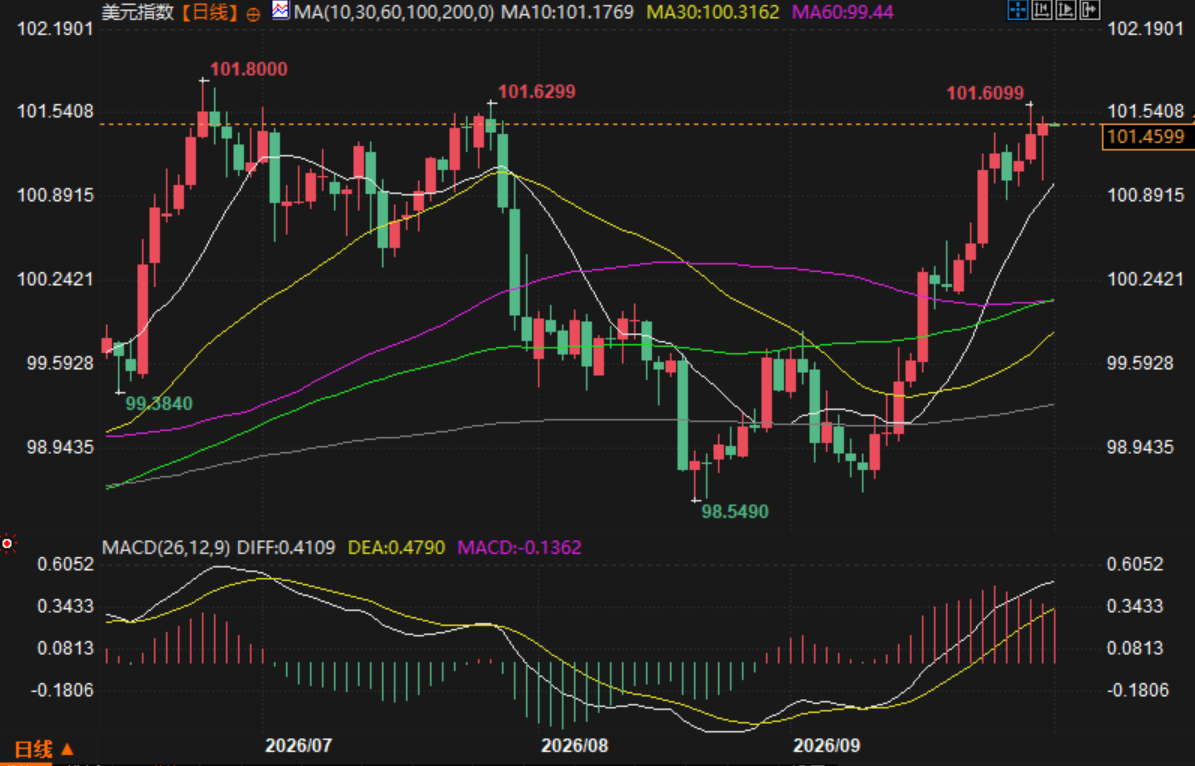 (US Dollar Index Daily Chart, Source: EasyForex) At 7:48 Beijing time, the US Dollar Index was at 101.47.
Inflation forecast: Stagnation around 3%, data does not change view.
Kashkari explicitly stated that inflation remains too high, hovering around 3%, and that newly released data has not changed this assessment. This judgment forms the direct basis for his support for further interest rate hikes. For the market, this means that some within the Federal Reserve still believe that the current inflation level is significantly far from the 2% target, and that tightening policies should not be withdrawn prematurely. Although key indicators such as the core PCE have recently fallen slightly below some expectations, Kashkari emphasized that inflation has remained high for more than five years, and a single data point is unlikely to reverse the overall trajectory. He pointed out that regardless of the measurement method used, upward price pressures remain widespread and are not limited to highly volatile sectors such as energy or food. The stickiness of the service sector and other core categories further supports his judgment that inflation is "still too high." This stance reflects the wariness of some Federal Reserve officials towards a premature shift to easing: if inflation cannot substantially fall back to the target range, the policy stance will be difficult to adjust easily. Therefore, the market needs to reassess the duration of the interest rate hike cycle and the potential impact on asset pricing from persistently high interest rates. Kashkari's remarks also reminded investors that the decline in inflation may be slower than previously expected, and any optimistic pricing needs to be verified by actual data.Interest rate path: One more rate hike this year, and another in 2027.
Kashkari revealed that he expects one more rate hike this year and another in 2027. This path implies two rate hikes this year and next, further postponing any window for rate cuts. For traders, the key implication of this statement is that even as this rate hike cycle nears its end, interest rates may remain high for longer than the market currently prices. His personal dot plot showing two rate hikes contrasts with the more dovish expectations of some officials, highlighting the internal divisions within the Federal Reserve regarding the policy path. Kashkari also pointed out that the longer the economy remains strong, the deeper his doubts will become about the current "tightening" of monetary policy, and the neutral interest rate level may be higher than previously estimated. This means the "end point" for policy rates may need to be revised upwards, and the timing of rate cuts will be correspondingly delayed. For bonds and stocks, a higher and longer-lasting interest rate environment will raise the risk-free rate benchmark, compress valuation space, and affect financing costs and risk appetite. Traders need to be wary of the discrepancy between market pricing and officials' actual assessments, and avoid over-betting on a rapid shift to easing. Kashkari's path forecast also suggests that policy adjustments will be highly dependent on the evolution of subsequent inflation and growth data, rather than simply following short-term market sentiment.Economic resilience: Consumer spending and employment support – a judgment that “does not blindly follow the market”
Kashkari described the economy as resilient in the face of shocks. He pointed out that consumers are still spending, and those who want to work have jobs. He expressed skepticism about the notion that "the economy is underperforming except for the AI sector," arguing that the overall economic resilience is not solely supported by AI. Regarding the market, Kashkari stated that policymakers should not blindly follow the market, but also should not ignore the information it conveys. This reflects his cautious approach to the relationship between market pricing and policy judgment. Continued consumer spending and a robust job market provide an important buffer for the economy, and growth momentum has not significantly weakened even in the face of geopolitical and supply shocks. Kashkari emphasized that signs of productivity improvement and overall growth performance further validate that the economy is not driven by a single industry. His balanced stance on market signals avoids policy being hijacked by short-term fluctuations while acknowledging the reference value of market information in judging neutral interest rates and policy effectiveness. This view suggests to investors that economic resilience may support a higher interest rate environment, but it also implies that the conditions for a policy shift to easing are more stringent. Going forward, it is necessary to continuously observe the interaction between consumption, employment, and inflation to determine whether economic resilience is sufficient to change expectations regarding the interest rate path.Neutral interest rate: The most valuable detail to trade
The most noteworthy detail in Kashkari's speech was his commentary on the neutral interest rate. The neutral interest rate is the level of interest rate that neither stimulates nor inhibits the economy. He stated that this level may be higher than previously assumed, and while the exact current position is uncertain, it is likely at least high for now. The significance of this judgment lies in the fact that if the neutral interest rate is higher, then any given policy rate is less restrictive than originally assumed. This could strengthen the argument for further rate hikes. In other words, the resilience of the economy and robust hiring may be telling policymakers that interest rates are not as restrictive as they seem. This is also what traders may value most—it suggests that current policy may not be as tight as it appears.Nature of the statement and subsequent concerns
It's important to clarify that Kashkari's remarks reflect his personal views and forecasts, not the collective decision of the Federal Reserve. Other officials may have different perspectives on the balance of risks. Therefore, market pricing will still depend on inflation and employment data, as well as statements from other Fed officials. The focus going forward includes upcoming inflation and labor market data, and further comments from other policymakers. This information will help the market determine whether Kashkari's arguments about the neutral interest rate have broader support, and how firmly his outlined path of rate hikes is positioned within the committee.Summarize
Kashkari's remarks were generally hawkish, with three key messages: inflation is stagnating around 3%, there will be one more rate hike this year and another in 2027, and the neutral interest rate may be higher than previously assumed. The third point is the most significant for trading—if the neutral interest rate is higher, current policy is not as tight as it appears, providing a theoretical basis for further tightening. This statement supported US Treasury yields and the dollar, while putting pressure on interest rate-sensitive assets. However, it's important to note that this is an official's personal opinion, not a committee decision. Market pricing will continue to revolve around inflation data, employment data, and statements from other Fed officials. If subsequent data shows persistently sticky inflation and undiminished economic resilience, Kashkari's rate hike path may gain more support; if the data weakens, the market may repric this hawkish expectation. (US Dollar Index Daily Chart, Source: EasyForex) At 7:48 Beijing time, the US Dollar Index was at 101.47.
- Risk Warning and Disclaimer
- The market involves risk, and trading may not be suitable for all investors. This article is for reference only and does not constitute personal investment advice, nor does it take into account certain users’ specific investment objectives, financial situation, or other needs. Any investment decisions made based on this information are at your own risk.