Widening interest rate differentials and falling oil prices put pressure on the Canadian dollar, causing the USD/CAD exchange rate to remain high.
2026-10-01 10:18:16
The USD/CAD pair traded in a narrow range around 1.4235 during Asian trading on Thursday, continuing its strong upward momentum of about four weeks, with a cumulative gain of approximately 2.5% , reaching a three-month high. From a fundamental perspective, the balance clearly favors the US dollar: the Bank of Canada's overall dovish policy stance, coupled with ongoing trade concerns between the US and Canada, already weakened the Canadian dollar; furthermore, the recent decline in international oil prices has further weakened the support for the Canadian dollar, which is highly correlated with commodity prices. Against the backdrop of a generally strong US dollar, the upward trend of USD/CAD is doubly validated.  The Canadian dollar's continued weakness stems from pressure from both interest rate differentials and oil prices. On the monetary policy front, the Bank of Canada has repeatedly maintained its policy rate at 2.25% . Faced with the dilemma of weak economic growth and rising energy inflation, its wait-and-see approach contrasts sharply with the Federal Reserve's tightening stance. The widening US-Canada interest rate differential has reduced the attractiveness of Canadian dollar assets. On the trade front, Canada's exports are highly dependent on its southern neighbor's market. Recurring concerns about bilateral trade have kept market risk appetite for the Canadian dollar low. Coupled with the decline in international oil prices from their highs, Canada, as a major oil exporter, has seen its energy export revenue expectations and terms of trade both suffer. The Canadian dollar continues to weaken under the triple pressure of interest rate differentials, trade, and oil prices . Meanwhile, the US dollar remains relatively strong. Wednesday's US PCE inflation data was generally moderate, and market bets on a Fed rate hike in October briefly fell to around 35% . However, inflation concerns triggered by rising energy prices have not dissipated, instead keeping US Treasury yields firm near multi-year highs . Furthermore, investors are still pricing in a high probability that the Federal Reserve will continue to raise interest rates before the end of the year. This expectation gap, along with safe-haven demand due to US-Iran tensions, has provided support for the US dollar. The geopolitical situation is a significant source of this round of dollar buying. Recent developments indicate that the US rejected Iran's seven-day ceasefire proposal , and the market widely believes that the US may resume large-scale military operations after the November midterm elections. This prospect means that the tail risks of the Middle East situation have not been cleared, and the geopolitical risk premium continues to remain in the market, strengthening safe-haven buying of the US dollar and providing a basis for further appreciation of the USD/CAD exchange rate. On the data and event front, investors will focus on the US economic calendar today: weekly initial jobless claims and the September ISM Manufacturing PMI will be released tonight Beijing time. The market expects the Manufacturing PMI to be around 54.8; a stronger-than-expected reading will further solidify the dollar's high level. At the same time, several Federal Reserve officials will deliver speeches, and their policy wording will directly influence the market's pricing of the October and year-end interest rate hike path. In addition, short-term fluctuations in oil prices remain an important variable for USD/CAD – if oil prices continue to fall, the Canadian dollar will be under further pressure; and Friday's US non-farm payroll report will be the highlight of this week's market, and its impact on interest rate expectations is expected to be transmitted to the direction of USD/CAD. Market sentiment is generally in a consensus of "stronger US dollar and weaker Canadian dollar", and investors are focused on three aspects: whether the ISM manufacturing PMI will continue to expand tonight, whether Fed officials will release stronger tightening signals, and the repricing of the probability of an October rate hike by Friday's non-farm payroll report . From a technical point of view, the bullish structure of USD/CAD on the daily chart remains intact, but short-term momentum has clearly stretched: RSI (14) has risen to the overbought zone of about 78 , suggesting that the price is more likely to see a corrective consolidation at the current level rather than an accelerated rise. However, the overall pattern still supports buying on dips , and even if overbought conditions trigger short-term fluctuations or mild pullbacks, they are likely to be seen as opportunities for a new round of buying. On the downside support level, the psychological level of 1.4200 is the first line of defense, followed by the 1.4170-1.4165 area. If this area is breached, the exchange rate may further retreat to around 1.4100 . On the upside resistance level, the recent highs of 1.4235-1.4250 form the first resistance. A break above this level could lead to further expansion towards 1.4300 or even higher. Looking at the 4-hour chart, the exchange rate is consolidating around 1.4235, with slightly narrowing highs. Short-term momentum indicators have retreated from overbought territory, indicating a risk of a pullback. However, if the pullback finds support above 1.4200, the overall upward structure remains intact. Conversely, a significant drop below 1.4165 would deepen the short-term correction, requiring close attention to the support level at 1.4100. In terms of trading strategy, the main approach should be to buy on dips, with a focus on the effectiveness of the support level in the 1.4200-1.4170 range. Be aware of the risk of increased volatility before and after data release windows.
 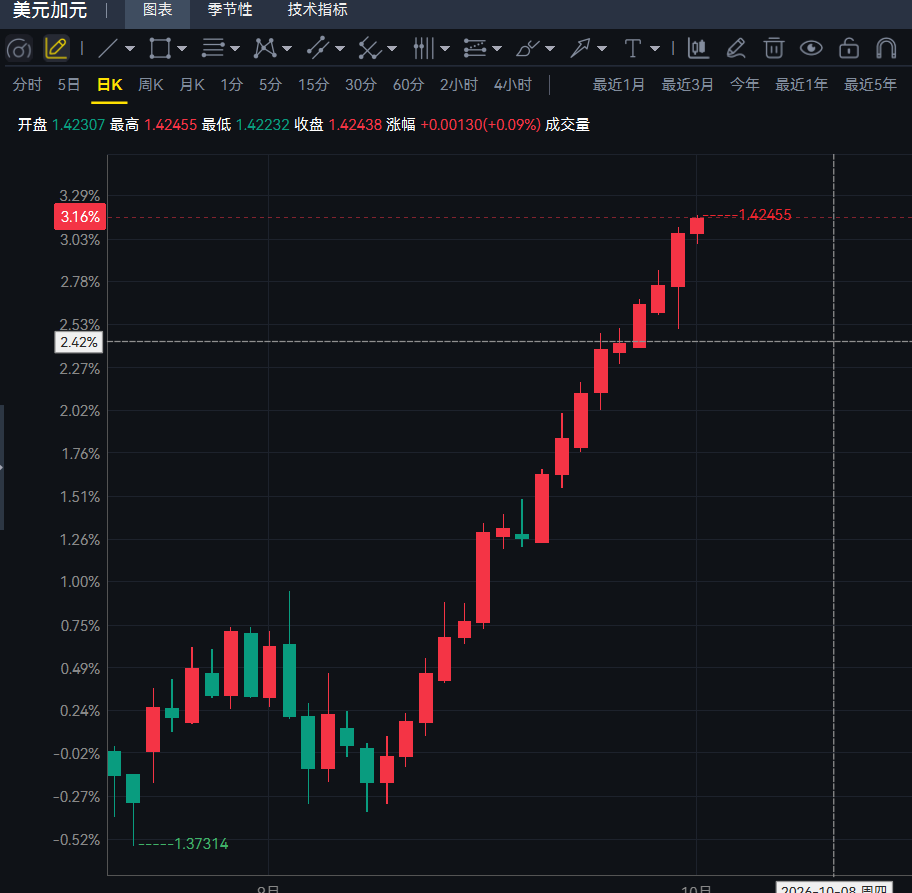 Editor's Summary : Overall, the USD/CAD pair's relatively strong trend is rooted in the combined effects of the Bank of Canada holding rates steady, widening interest rate differentials, falling oil prices, and a generally strong US dollar. The short-term direction is likely to continue upward, but the overbought RSI suggests a potential pause or correction in the price action. Looking ahead, tonight's US initial jobless claims and ISM manufacturing PMI, statements from several Fed officials, and Friday's non-farm payroll report will be key indicators of the dollar's direction: if US data remains resilient and oil prices remain weak, USD/CAD could break through the 1.4235-1.4250 area and extend towards 1.4300; conversely, if US data unexpectedly weakens and oil prices rebound, the exchange rate may retrace to the 1.4200 or even the 1.4170-1.4165 area for support.
The Canadian dollar's continued weakness stems from pressure from both interest rate differentials and oil prices. On the monetary policy front, the Bank of Canada has repeatedly maintained its policy rate at 2.25% . Faced with the dilemma of weak economic growth and rising energy inflation, its wait-and-see approach contrasts sharply with the Federal Reserve's tightening stance. The widening US-Canada interest rate differential has reduced the attractiveness of Canadian dollar assets. On the trade front, Canada's exports are highly dependent on its southern neighbor's market. Recurring concerns about bilateral trade have kept market risk appetite for the Canadian dollar low. Coupled with the decline in international oil prices from their highs, Canada, as a major oil exporter, has seen its energy export revenue expectations and terms of trade both suffer. The Canadian dollar continues to weaken under the triple pressure of interest rate differentials, trade, and oil prices . Meanwhile, the US dollar remains relatively strong. Wednesday's US PCE inflation data was generally moderate, and market bets on a Fed rate hike in October briefly fell to around 35% . However, inflation concerns triggered by rising energy prices have not dissipated, instead keeping US Treasury yields firm near multi-year highs . Furthermore, investors are still pricing in a high probability that the Federal Reserve will continue to raise interest rates before the end of the year. This expectation gap, along with safe-haven demand due to US-Iran tensions, has provided support for the US dollar. The geopolitical situation is a significant source of this round of dollar buying. Recent developments indicate that the US rejected Iran's seven-day ceasefire proposal , and the market widely believes that the US may resume large-scale military operations after the November midterm elections. This prospect means that the tail risks of the Middle East situation have not been cleared, and the geopolitical risk premium continues to remain in the market, strengthening safe-haven buying of the US dollar and providing a basis for further appreciation of the USD/CAD exchange rate. On the data and event front, investors will focus on the US economic calendar today: weekly initial jobless claims and the September ISM Manufacturing PMI will be released tonight Beijing time. The market expects the Manufacturing PMI to be around 54.8; a stronger-than-expected reading will further solidify the dollar's high level. At the same time, several Federal Reserve officials will deliver speeches, and their policy wording will directly influence the market's pricing of the October and year-end interest rate hike path. In addition, short-term fluctuations in oil prices remain an important variable for USD/CAD – if oil prices continue to fall, the Canadian dollar will be under further pressure; and Friday's US non-farm payroll report will be the highlight of this week's market, and its impact on interest rate expectations is expected to be transmitted to the direction of USD/CAD. Market sentiment is generally in a consensus of "stronger US dollar and weaker Canadian dollar", and investors are focused on three aspects: whether the ISM manufacturing PMI will continue to expand tonight, whether Fed officials will release stronger tightening signals, and the repricing of the probability of an October rate hike by Friday's non-farm payroll report . From a technical point of view, the bullish structure of USD/CAD on the daily chart remains intact, but short-term momentum has clearly stretched: RSI (14) has risen to the overbought zone of about 78 , suggesting that the price is more likely to see a corrective consolidation at the current level rather than an accelerated rise. However, the overall pattern still supports buying on dips , and even if overbought conditions trigger short-term fluctuations or mild pullbacks, they are likely to be seen as opportunities for a new round of buying. On the downside support level, the psychological level of 1.4200 is the first line of defense, followed by the 1.4170-1.4165 area. If this area is breached, the exchange rate may further retreat to around 1.4100 . On the upside resistance level, the recent highs of 1.4235-1.4250 form the first resistance. A break above this level could lead to further expansion towards 1.4300 or even higher. Looking at the 4-hour chart, the exchange rate is consolidating around 1.4235, with slightly narrowing highs. Short-term momentum indicators have retreated from overbought territory, indicating a risk of a pullback. However, if the pullback finds support above 1.4200, the overall upward structure remains intact. Conversely, a significant drop below 1.4165 would deepen the short-term correction, requiring close attention to the support level at 1.4100. In terms of trading strategy, the main approach should be to buy on dips, with a focus on the effectiveness of the support level in the 1.4200-1.4170 range. Be aware of the risk of increased volatility before and after data release windows. Editor's Summary : Overall, the USD/CAD pair's relatively strong trend is rooted in the combined effects of the Bank of Canada holding rates steady, widening interest rate differentials, falling oil prices, and a generally strong US dollar. The short-term direction is likely to continue upward, but the overbought RSI suggests a potential pause or correction in the price action. Looking ahead, tonight's US initial jobless claims and ISM manufacturing PMI, statements from several Fed officials, and Friday's non-farm payroll report will be key indicators of the dollar's direction: if US data remains resilient and oil prices remain weak, USD/CAD could break through the 1.4235-1.4250 area and extend towards 1.4300; conversely, if US data unexpectedly weakens and oil prices rebound, the exchange rate may retrace to the 1.4200 or even the 1.4170-1.4165 area for support.
- Risk Warning and Disclaimer
- The market involves risk, and trading may not be suitable for all investors. This article is for reference only and does not constitute personal investment advice, nor does it take into account certain users’ specific investment objectives, financial situation, or other needs. Any investment decisions made based on this information are at your own risk.