Cooling US inflation reduces the probability of interest rate hikes; USD/JPY remains range-bound.
2026-10-01 10:24:16
This week's unexpectedly mild US inflation data became the primary variable in the foreign exchange market. The US core personal consumption expenditure price index rose 3.0% year-on-year in August, lower than market expectations. Traders quickly reduced their bets on a Fed rate hike in October, with the probability falling to about 35% . After the data release, the USD/JPY pair briefly fell below 156.50 , hitting a near one-week low. However, after the expected "negative news" for the yen materialized, the exchange rate failed to extend its gains, instead returning to around the 157.00 level at the close, ultimately closing above this level for the fourth consecutive trading day , even slightly higher than the opening level – the decline was slow and hesitant. During Thursday's Asian session, the pair continued its oscillation, trading around 158.  The short-term movement of the Japanese yen is essentially a game of policy pace between the two major central banks. The Bank of Japan raised its policy rate by 25 basis points to 1.25% on September 18th, its second rate hike this year; while the Federal Reserve's interest rate range remains at 3.75%-4.00% , creating a policy interest rate differential of at least 2.5 percentage points . The end of October will be a crucial crossroads: the Federal Reserve's policy meeting is scheduled for October 28th, followed by the Bank of Japan's policy meeting on October 30th. According to interest rate swap market pricing, the probability of the Bank of Japan raising rates again in October is about 36% , roughly equivalent to the market's probability of a rate hike by the Federal Reserve in October—two central banks with a 2.5 percentage point policy interest rate differential are being assigned the same roughly one-third probability of reversal by the market, a rare situation that reflects the high degree of uncertainty in the exchange rate market. The upcoming data releases will directly test these expectations. First to be released is the Bank of Japan's quarterly Tankan survey: the latest large-scale manufacturing business sentiment index rose from 22 to 24 , marking the sixth consecutive quarter of improvement and reaching a new high in over eight years. Although slightly lower than the market expectation of 25, the clear recovery in business confidence reinforces the Bank of Japan's judgment to maintain its tightening path. Following closely is the Tokyo September Consumer Price Index, expected to be released early Friday morning Beijing time. The market expectation for the core CPI, excluding fresh food, is a year-on-year increase of 2.4% , a significant jump from August's 1.8%—if realized, this will significantly increase the probability of a Bank of Japan rate hike in October. Later that evening at 8:30 PM Beijing time, the US September non-farm payroll report will be released . Strong data will raise expectations for a Federal Reserve rate hike in October. Within two days, both ends of the same USD/JPY interest rate differential will be tested by data, and exchange rate volatility is expected to increase. In terms of market sentiment, investors are currently in a wait-and-see state, with expectations preceding data confirmation. If Tokyo prices surge as expected, the market will price in a more aggressive stance on the Bank of Japan's (BOJ) consecutive interest rate hikes this year; conversely, a strong US jobs report will provide renewed support for the dollar's yield curve. For USD/JPY, these two data points influence both ends of the interest rate differential: Tokyo inflation benefits the yen, while US employment data benefits the dollar, and the final direction of the exchange rate will depend on the relative strength of these two factors. It's worth noting that the yield curve implies a December rate hike based on a roughly one-third probability of an October rate hike, meaning that unless Tokyo prices surge unexpectedly, the BOJ is more likely to wait until December. Previous statements by the Japanese Finance Minister regarding the yen's "undervaluation" and the continuation of the Japan-US coordination mechanism have also created a policy constraint on exchange rate fluctuations. From a global perspective, if the prospect of a narrowing US-Japan interest rate differential gradually materializes, it will lower the central value of the USD/JPY exchange rate, easing cost pressures on energy and raw materials reliant on imports. Simultaneously, a stronger yen may also lead to a moderate strengthening of other Asian currencies, creating a marginal impact on regional capital flows. Conversely, if the interest rate differential remains high and the yen continues to weaken, imported inflationary pressures will continue to plague economies needing price stability. The current market focus is on three points: whether Tokyo's September inflation data will meet the expected jump of 2.4%, the actual reading of the US non-farm payroll report, and the policy hints before the interest rate meetings of the two major central banks at the end of October. These three factors will jointly determine the direction of the struggle around the 157 level. From a technical perspective, on the daily chart, the USD/JPY has closed below the 200-day exponential moving average for four consecutive trading days. This moving average has been suppressing rebounds since the decline on September 25th, forming the first technical resistance level above; the next resistance level is 159.00 , the high point of the rebound on September 24th. On the downside support level, 156.50 is the low area for this week, having briefly fallen to around 156.35 on Wednesday. This level is the first line of defense, followed by the psychological level of 156.00 . In terms of market momentum, the daily stochastic oscillator RSI has risen to nearly 79 and is still trending upwards, indicating that short-term overbought pressure is accumulating rather than weakening. This means that a test of the 200-day moving average is not surprising. Looking at the 4-hour chart, the price has repeatedly encountered resistance around 158, forming a slightly lower high converging structure. If short-term momentum fails to break through, there is a risk of a retest of 156.50 or even 156.00. Conversely, if it holds above 158 and rises with increased volume, it will challenge the 159.00 range.
 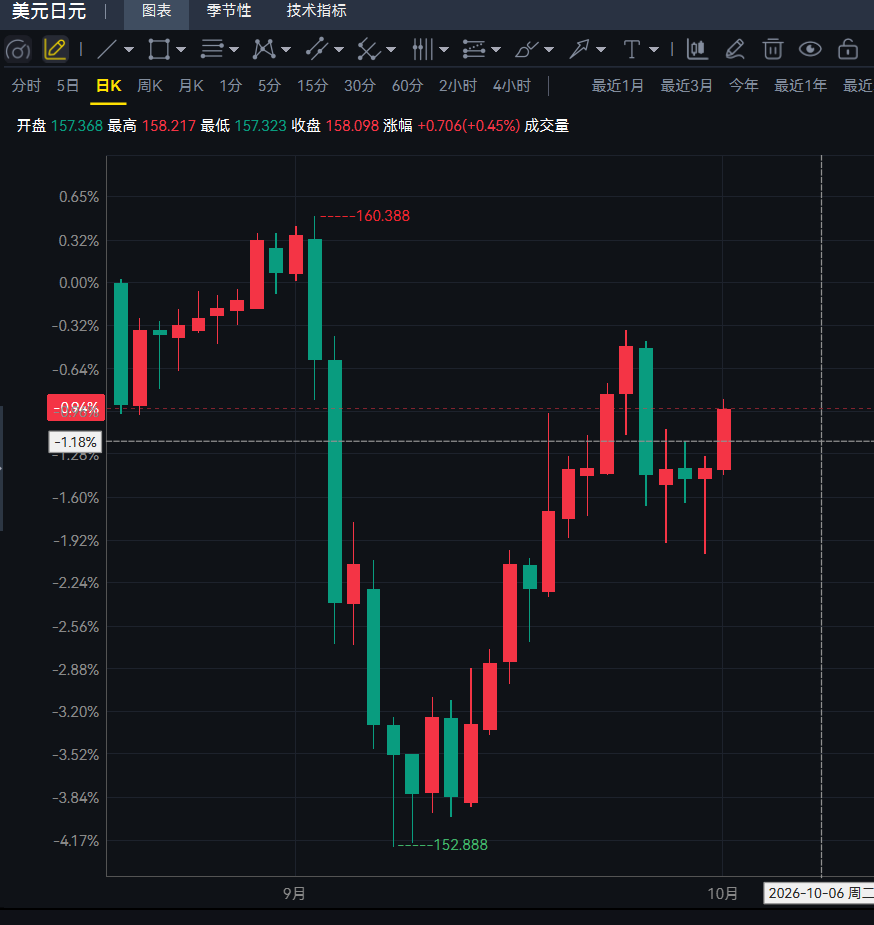 Editor's Summary : Overall, the USD/JPY pair is currently in a delicate window of "interest rate expectation repricing": Cooling US inflation has weakened the support of high interest rates for the dollar, while the Bank of Japan's tightening stance continues to strengthen. Theoretically, the yen should receive double support, but the exchange rate is still fluctuating above the 157 level, indicating that the market remains divided on the speed of policy implementation – a roughly one-third probability of a rate hike in October means that the Bank of Japan's actual action is more likely to occur in December. In the short term, the risk of a jump in Tokyo inflation data and the strength of the US non-farm payroll report will directly determine the direction: if both are favorable for the yen, USD/JPY is expected to break below 156.00 and move towards 155.00; if US data is unexpectedly strong and the Bank of Japan holds rates steady, the exchange rate may return to consolidate above 158.00. On the risk side, attention should be paid to the possibility of renewed intervention in the foreign exchange market by the Japanese authorities, and the potential amplified volatility due to the potential clash between the two central banks' interest rate decisions at the end of October.
The short-term movement of the Japanese yen is essentially a game of policy pace between the two major central banks. The Bank of Japan raised its policy rate by 25 basis points to 1.25% on September 18th, its second rate hike this year; while the Federal Reserve's interest rate range remains at 3.75%-4.00% , creating a policy interest rate differential of at least 2.5 percentage points . The end of October will be a crucial crossroads: the Federal Reserve's policy meeting is scheduled for October 28th, followed by the Bank of Japan's policy meeting on October 30th. According to interest rate swap market pricing, the probability of the Bank of Japan raising rates again in October is about 36% , roughly equivalent to the market's probability of a rate hike by the Federal Reserve in October—two central banks with a 2.5 percentage point policy interest rate differential are being assigned the same roughly one-third probability of reversal by the market, a rare situation that reflects the high degree of uncertainty in the exchange rate market. The upcoming data releases will directly test these expectations. First to be released is the Bank of Japan's quarterly Tankan survey: the latest large-scale manufacturing business sentiment index rose from 22 to 24 , marking the sixth consecutive quarter of improvement and reaching a new high in over eight years. Although slightly lower than the market expectation of 25, the clear recovery in business confidence reinforces the Bank of Japan's judgment to maintain its tightening path. Following closely is the Tokyo September Consumer Price Index, expected to be released early Friday morning Beijing time. The market expectation for the core CPI, excluding fresh food, is a year-on-year increase of 2.4% , a significant jump from August's 1.8%—if realized, this will significantly increase the probability of a Bank of Japan rate hike in October. Later that evening at 8:30 PM Beijing time, the US September non-farm payroll report will be released . Strong data will raise expectations for a Federal Reserve rate hike in October. Within two days, both ends of the same USD/JPY interest rate differential will be tested by data, and exchange rate volatility is expected to increase. In terms of market sentiment, investors are currently in a wait-and-see state, with expectations preceding data confirmation. If Tokyo prices surge as expected, the market will price in a more aggressive stance on the Bank of Japan's (BOJ) consecutive interest rate hikes this year; conversely, a strong US jobs report will provide renewed support for the dollar's yield curve. For USD/JPY, these two data points influence both ends of the interest rate differential: Tokyo inflation benefits the yen, while US employment data benefits the dollar, and the final direction of the exchange rate will depend on the relative strength of these two factors. It's worth noting that the yield curve implies a December rate hike based on a roughly one-third probability of an October rate hike, meaning that unless Tokyo prices surge unexpectedly, the BOJ is more likely to wait until December. Previous statements by the Japanese Finance Minister regarding the yen's "undervaluation" and the continuation of the Japan-US coordination mechanism have also created a policy constraint on exchange rate fluctuations. From a global perspective, if the prospect of a narrowing US-Japan interest rate differential gradually materializes, it will lower the central value of the USD/JPY exchange rate, easing cost pressures on energy and raw materials reliant on imports. Simultaneously, a stronger yen may also lead to a moderate strengthening of other Asian currencies, creating a marginal impact on regional capital flows. Conversely, if the interest rate differential remains high and the yen continues to weaken, imported inflationary pressures will continue to plague economies needing price stability. The current market focus is on three points: whether Tokyo's September inflation data will meet the expected jump of 2.4%, the actual reading of the US non-farm payroll report, and the policy hints before the interest rate meetings of the two major central banks at the end of October. These three factors will jointly determine the direction of the struggle around the 157 level. From a technical perspective, on the daily chart, the USD/JPY has closed below the 200-day exponential moving average for four consecutive trading days. This moving average has been suppressing rebounds since the decline on September 25th, forming the first technical resistance level above; the next resistance level is 159.00 , the high point of the rebound on September 24th. On the downside support level, 156.50 is the low area for this week, having briefly fallen to around 156.35 on Wednesday. This level is the first line of defense, followed by the psychological level of 156.00 . In terms of market momentum, the daily stochastic oscillator RSI has risen to nearly 79 and is still trending upwards, indicating that short-term overbought pressure is accumulating rather than weakening. This means that a test of the 200-day moving average is not surprising. Looking at the 4-hour chart, the price has repeatedly encountered resistance around 158, forming a slightly lower high converging structure. If short-term momentum fails to break through, there is a risk of a retest of 156.50 or even 156.00. Conversely, if it holds above 158 and rises with increased volume, it will challenge the 159.00 range. Editor's Summary : Overall, the USD/JPY pair is currently in a delicate window of "interest rate expectation repricing": Cooling US inflation has weakened the support of high interest rates for the dollar, while the Bank of Japan's tightening stance continues to strengthen. Theoretically, the yen should receive double support, but the exchange rate is still fluctuating above the 157 level, indicating that the market remains divided on the speed of policy implementation – a roughly one-third probability of a rate hike in October means that the Bank of Japan's actual action is more likely to occur in December. In the short term, the risk of a jump in Tokyo inflation data and the strength of the US non-farm payroll report will directly determine the direction: if both are favorable for the yen, USD/JPY is expected to break below 156.00 and move towards 155.00; if US data is unexpectedly strong and the Bank of Japan holds rates steady, the exchange rate may return to consolidate above 158.00. On the risk side, attention should be paid to the possibility of renewed intervention in the foreign exchange market by the Japanese authorities, and the potential amplified volatility due to the potential clash between the two central banks' interest rate decisions at the end of October.
- Risk Warning and Disclaimer
- The market involves risk, and trading may not be suitable for all investors. This article is for reference only and does not constitute personal investment advice, nor does it take into account certain users’ specific investment objectives, financial situation, or other needs. Any investment decisions made based on this information are at your own risk.