Has Rubio's expulsion order completely derailed US-Iran negotiations?
2026-10-01 10:54:15
Brent crude futures traded slightly lower in Asian trading on Thursday (October 1), currently hovering around $97.35 per barrel. Despite renewed tensions in US-Iran relations, oil prices failed to see a significant boost, as the market continues to weigh the possibility of a breakdown in negotiations against an escalation of conflict. According to the latest reports from prominent media outlets, US Secretary of State Marco Rubio ordered the Iranian mission to the United Nations to leave the US immediately on Monday (September 28), including Iranian Foreign Minister Araqchi. The media described this move as an unusual diplomatic rebuke, exposing the deep-seated distrust between the US and Iran. Qatari mediators had previously attempted to facilitate a diplomatic breakthrough, but progress was minimal, with neither side willing to make concessions. The delegation flew from New York to Doha early Tuesday morning. This development suggests an increased risk of a breakdown in negotiations, and the geopolitical risk premium will continue to be reflected in oil prices. Qatari mediation continues, while Trump indicated on Wednesday that he might strike Iran, stating that "things will be over soon anyway"—creating a double-edged sword: a deal would be bearish for oil prices, while military action would support them. 
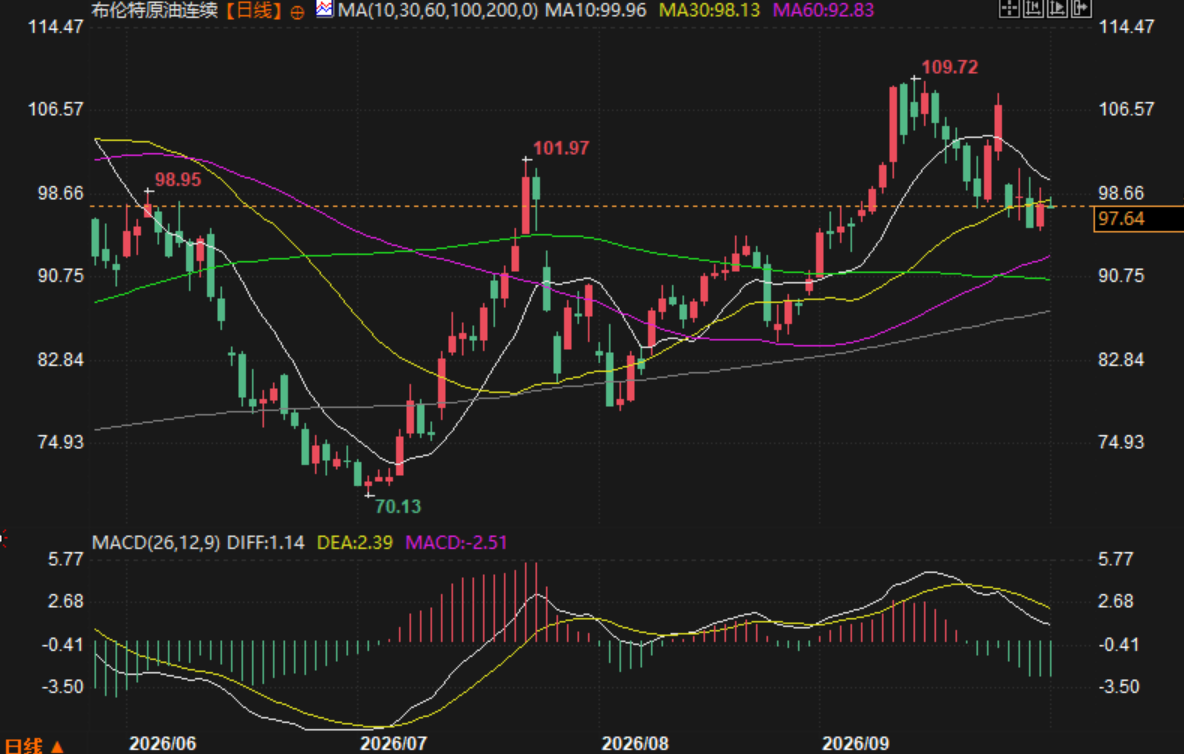 (Brent crude oil futures daily chart, source: EasyTrade) At 10:53 Beijing time, Brent crude oil futures were trading at $97.31 per barrel.
Event sequence: From negotiation deadlock to deportation order
According to a prominent media outlet citing a US official and another source familiar with the matter, Rubio ordered the Iranian delegation to the UN General Assembly to leave the United States immediately on Monday. This order came after negotiations stalled. The delegation, including Iranian Foreign Minister Araqchi, Rubio's counterpart, was among those asked to leave. The report stated that the White House had initially believed on Monday morning that negotiations with Iran might make progress later that day, but by the afternoon, the deadlock had become clear. That evening, under Rubio's orders, the US mission to the UN notified the Iranian mission that Araqchi and his delegation must leave New York immediately. The delegation traveled to the airport hours later and boarded a flight from New York to Doha early Tuesday morning. A second source confirmed the US order to leave but stated that Araqchi was originally scheduled to return to Tehran on Monday evening. The media outlet noted that the Iranians were likely to leave soon anyway, making the timing and manner of the order crucial. A US official stated that the delegation had stayed too long and that the UN General Assembly had concluded, making it time for them to leave.Diplomatic implications: An unusual rebuke that exposes deep-seated distrust.
The media described the move as an "unusual diplomatic rebuke," highlighting the deep distrust between Washington and Tehran as efforts to end the conflict stall. Qatari mediators had attempted to forge a diplomatic breakthrough, but with little progress and neither side willing to compromise. The core message of this event is that even with Qatari mediators pushing for a compromise, the trust deficit between the US and Iran is too large to be bridged in the short term. The timing and manner of the expulsion—rather than whether the Iranian delegation would have left in the first place—are the truly significant aspects.Market Impact: Geopolitical risk premium will remain in oil prices.
The breakdown in negotiations and Trump's comments have clearly kept the risk of escalation on the table, which is likely to keep the geopolitical risk premium in oil prices, as crude oil is the market most directly affected by conflict-related news. The ongoing Qatar mediation and Trump's statement that "things will be over soon anyway" present a double-edged sword: a deal would be bearish for oil prices, while military action would provide support. Traders are likely to view any statements from the mediators or the White House as triggers for sharp fluctuations in crude oil prices, and safe-haven assets and risk sentiment may also shift accordingly.Follow-up: Mediation progress and Tehran's response
It's important to clarify that this report is based on anonymous sources and a single media outlet, making confirmation or a response from Tehran crucial. A formal response from Iranian officials or the release of details of a compromise agreement by the Qatari mediators would provide the market with a clearer signal. Trump's remarks on Wednesday further increased uncertainty. When asked how he would reach a deal with the regime he called "crazy," Trump told reporters he might strike Iran. He stated that a decision must be made between attacking or reaching a deal, and that the situation would "be over soon anyway." This statement has made the market highly sensitive to any news from the White House or the mediators.Summarize
Rubio's order for the Iranian delegation to leave New York represents an unusual diplomatic escalation following the deadlock in US-Iran negotiations. This event exposes deep-seated distrust between the two countries, and even with Qatari mediators pushing for a compromise, the prospect of a short-term agreement remains bleak. For the oil market, a breakdown in negotiations means that geopolitical risk premiums will remain priced in, while Trump's statements about "attack or a deal" present a double-edged sword—a deal would be bearish for oil prices, while military action would be bullish. Traders should view any statements from mediators or the White House as potential triggers for significant oil price volatility. Given that current reports are based on anonymous sources, Tehran's response will be crucial in determining the course of events. (Brent crude oil futures daily chart, source: EasyTrade) At 10:53 Beijing time, Brent crude oil futures were trading at $97.31 per barrel.
- Risk Warning and Disclaimer
- The market involves risk, and trading may not be suitable for all investors. This article is for reference only and does not constitute personal investment advice, nor does it take into account certain users’ specific investment objectives, financial situation, or other needs. Any investment decisions made based on this information are at your own risk.