The yield on 10-year US Treasury bonds once broke through 5.3%, reaching a new high since 2002, prompting institutions to warn of structural upward pressure.
2026-10-01 11:38:17
The US bond market is turning its interest rate clock back to the turn of the century. Under sustained selling pressure, the 10-year US Treasury yield briefly broke through 5.3% on Wednesday (September 30), closing at 5.292%, having reached a high of 5.312% during the session. This not only surpasses the 2007 peak but also marks the highest level since 2002. This level is significant: it indicates that the US lending environment is not simply returning to the normalcy before the 2008-2009 financial crisis, but may be facing a more lasting structural change. 
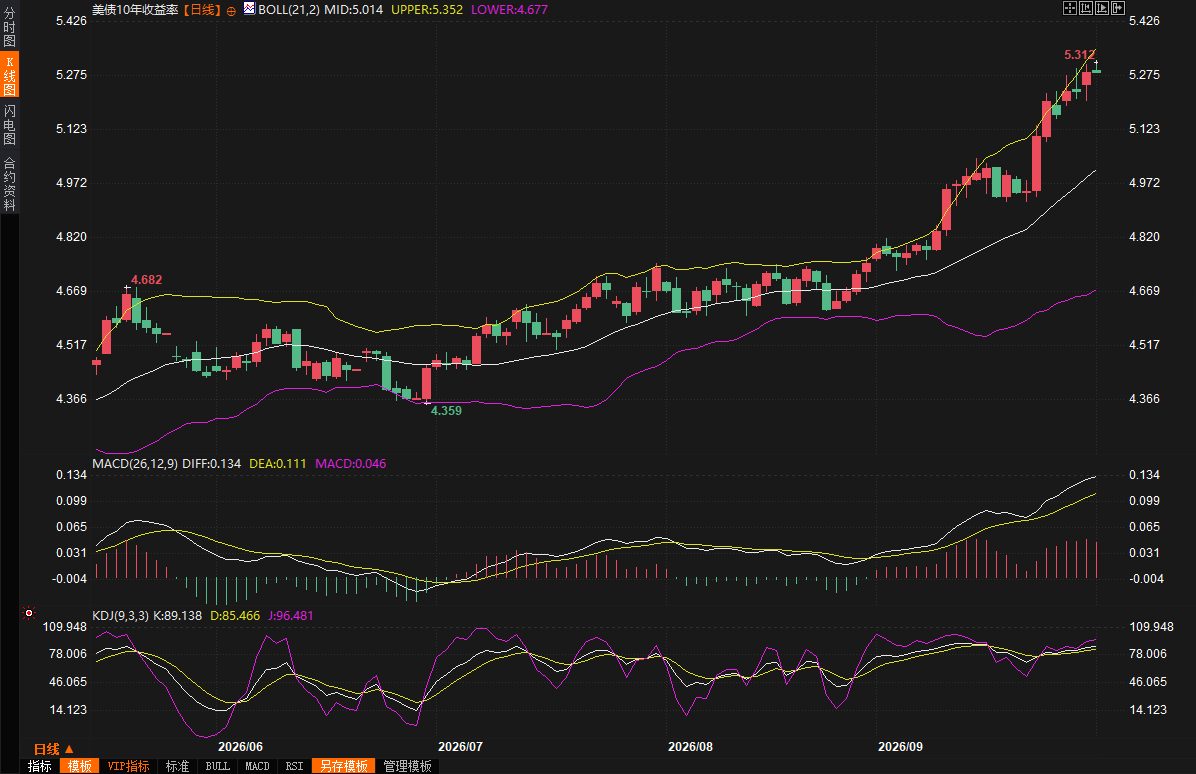 (Daily chart of the US 10-year Treasury yield, source: EasyTrade)
Yields Return to High Levels: From an Era of Low Interest Rates to Long-Term High-Cost Expectations
The last time the 10-year Treasury yield climbed to such a high level, the US economy was still reeling from the collapse of the dot-com bubble. Investors vividly remember the strong growth and high interest rates of the 1990s, and the suffocating inflation of the early 1980s. For many years afterward, yields remained low, leading many economists to believe that the world had entered a new era of moderate inflation and persistently low interest rates. The surge in inflation at the beginning of the COVID-19 pandemic challenged this assessment. Now, that view has been completely abandoned. In its place is a new consensus: borrowing costs will remain high for a considerable period. Blerina Uruçi, chief US economist at T. Rowe Price, points out that while bonds may experience short-term volatility, "the trend in yields is upward." She emphasizes, "Many of the factors driving yields higher are structural, and these factors are not going away."Structural forces and geopolitical conflicts jointly boost yields
Beyond unforeseen events like the pandemic and conflicts, investors and economists are pointing to more enduring drivers. The continued expansion of government debt is testing investors' resilience; the AI investment boom is fueling economic growth; and rising trade barriers are pushing up inflation expectations. These factors combined have solidified the market's priced-in demand for persistently high interest rates. The 10-year Treasury yield is particularly noteworthy because it directly determines borrowing costs across the US. In recent months, this yield has been steadily climbing, with both household mortgage costs and corporate debt issuance costs increasing. This is painful for potential borrowers and a real pressure on the political landscape ahead of the midterm elections. However, the overall resilience of the economy has not significantly weakened as a result; instead, it has further supported the rise in yields—investors expect the Federal Reserve to maintain or even continue raising interest rates to control inflation. Geopolitical risks remain a short-term focus. Before the outbreak of conflict between the US and Israel in February, the 10-year yield fell below 4%. Subsequently, Iranian actions impacted shipping in the Strait of Hormuz, causing energy prices to surge. Despite recent improvements in traffic flow between the U.S. Navy and Gulf oil-producing nations, leading to increased tanker traffic, Brent crude remains hovering around $100 a barrel, while diesel prices recently hit record highs. John Briggs, head of U.S. interest rate strategy at Natixis's corporate and investment banking division, said, "We're seeing increased traffic in the strait, which is a good thing." However, he added, "Just because supplies can get out now doesn't mean this situation will continue indefinitely."The interplay between Federal Reserve policy and market forces
According to traditional theory, inflation triggered by energy shocks may not necessarily require continuous interest rate hikes by central banks—no matter how high the interest rate, it cannot conjure oil out of thin air, and the shock may subside on its own. However, current inflation has been above the Fed's 2% target for several years, raising market concerns that it has taken root in the economy. Factors such as investment in artificial intelligence are also pushing up prices. Under Chairman Kevin Warsh's leadership, the Fed's interest rate-setting committee unanimously voted to raise interest rates earlier this month. Investors expect several more rate hikes in the next 12 months, partly because businesses may pass on fuel costs to consumers, further pushing up inflation. On Tuesday, yields on short-term Treasury bonds, which are sensitive to policy, fell slightly after New York Fed President John Williams said there was no "urgency" for further rate hikes. However, long-term yields remained almost unchanged and quickly resumed their upward trend on Wednesday. Some analysts believe this indicates that market forces have surpassed the Fed's statements. As long as inflation concerns persist, yields are likely to continue to climb regardless of official statements. The Fed may even be forced to take further action to appease the market and prevent long-term yields from rising too quickly.Stock Market Resilience and Potential Vulnerability
So far, the stock market has largely withstood the impact of rising bond yields, mainly thanks to strong corporate earnings. However, some worry that the market is actually fragile. Warsh has pointed out that the overall financial environment is not "restrictive," meaning that a booming market itself could fuel inflation—both increasing investor wealth and making it easier for companies to obtain financing. Bob Doll, chief investment officer at Crossmark Global Investments, said that if Federal Reserve officials "really want to bring inflation down to 2%, they may have to adopt restrictive policies/make the environment restrictive, which is not a result the stock market wants."Editor's Summary
The 10-year US Treasury yield broke through 5.3%, reaching a new high since 2002, marking the official end of the era of low interest rates. Structural factors—government debt expansion, AI-driven growth, and trade barriers—combined with geopolitical and energy shocks, are pushing borrowing costs into a long-term high. Market pricing has, to some extent, preceded Federal Reserve policy signals, creating a self-reinforcing cycle of economic resilience and inflation stickiness. For borrowers, businesses, and policymakers, this means higher costs and stricter financial constraints will become the norm, rather than temporary fluctuations. Future trends will still depend on the inflation path, the progress of conflicts, and the Federal Reserve's trade-off between "restraint" and growth. (Daily chart of the US 10-year Treasury yield, source: EasyTrade)Frequently Asked Questions
Q: Why is it significant that the 10-year US Treasury yield has broken through 5.3%? A: This level not only surpasses the 2007 peak but is also the highest point since 2002. It indicates that the current environment is not simply a return to the "normal" interest rates before the financial crisis, but rather a potential entry into a more prolonged era of high costs. Historically, such high yields have often corresponded to periods of lingering inflation and strong but volatile economic growth. Now, coupled with debt expansion and structural changes, the market is more firmly pricing in long-term high interest rates, directly impacting a wide range of costs, including mortgages and corporate financing. Q: What are the main structural factors driving yields upward? A: Core factors include the continued expansion of government debt testing investor demand, the AI investment boom supporting economic growth expectations, and trade barriers pushing up inflationary pressures. These forces are different from short-term shocks and are persistent. Praxair economists have clearly pointed out that many of the driving factors are structural and will not easily disappear. Therefore, even with short-term fluctuations, the upward trend is still widely anticipated by the market. Q: How does the US-Iran conflict affect the bond market? A: The conflict has disrupted shipping in the Strait of Hormuz, causing energy prices to soar, directly pushing up inflation expectations and consequently pushing up Treasury yields. Despite recent recovery in traffic, Brent crude remains around $100 a barrel, while diesel prices have hit record highs. The market is concerned that the lack of a peace agreement could lead to a further deterioration in supply. While the energy shock itself may not necessarily require continued interest rate hikes, central banks are finding it more difficult to remain indifferent given years of excessive inflation. Q: What are the differences between the Fed's current stance and market expectations? A: Under Kevin Warsh's leadership, the Fed has consistently raised interest rates, and the market still expects further action over the next 12 months. Short-term yields are sensitive to official statements, but long-term yields have reacted only moderately and continued to rise, indicating increasing market dominance. As long as inflation concerns persist, yields may continue to climb, even forcing the Fed to adopt more restrictive policies to stabilize the market. Q: What do high yields mean for the economy and the stock market? A: For households and businesses, rising borrowing costs create direct pressure; it also poses a political challenge. However, the economy has remained resilient so far, supporting further increases in yields. The stock market has not yet suffered a significant setback due to earnings support, but if the Fed truly shifts to a restrictive environment to suppress inflation to 2%, the market may face a more severe test. Overall, high interest rates are shifting from "abnormal" to the "new normal." At 11:36 Beijing time, the yield on the 10-year US Treasury bond was 5.284%.- Risk Warning and Disclaimer
- The market involves risk, and trading may not be suitable for all investors. This article is for reference only and does not constitute personal investment advice, nor does it take into account certain users’ specific investment objectives, financial situation, or other needs. Any investment decisions made based on this information are at your own risk.