US-Iran negotiations failed, and internal strife intensified in Iran.
2026-10-01 15:16:16
On Thursday (October 1st) during the Asian and European sessions, international oil prices rebounded sharply after hitting a low, with the WTI crude oil futures contract currently trading around 90.31. The US-Iran conflict has entered its 215th day. Although Qatar has mediated, the diplomatic standoff continues with neither side willing to compromise. The US rejected Iran's proposal for a seven-day stay in the Strait of Hormuz; meanwhile, factional infighting has erupted within Iran, with a pro-war lawmaker imprisoned on September 27th. The incident has escalated, leading to internal strife and a split within the conservative camp, hindering unified foreign policy decisions and further impeding negotiations. As negotiations stalled, the US took unusual diplomatic punitive action. According to Axios, Rubio demanded the immediate departure of the Iranian mission to the United Nations, and Iranian Foreign Minister Araqchi was also on the evacuation list. The US cited the mission's overstaying and the conclusion of the UN General Assembly as reasons. Araqchi and his entourage subsequently went to the airport and boarded a flight from New York to Doha at 1:20 AM local time on Tuesday. This incident fully exposed the deep-seated distrust between the US and Iran, and the space for diplomatic détente continued to shrink. 
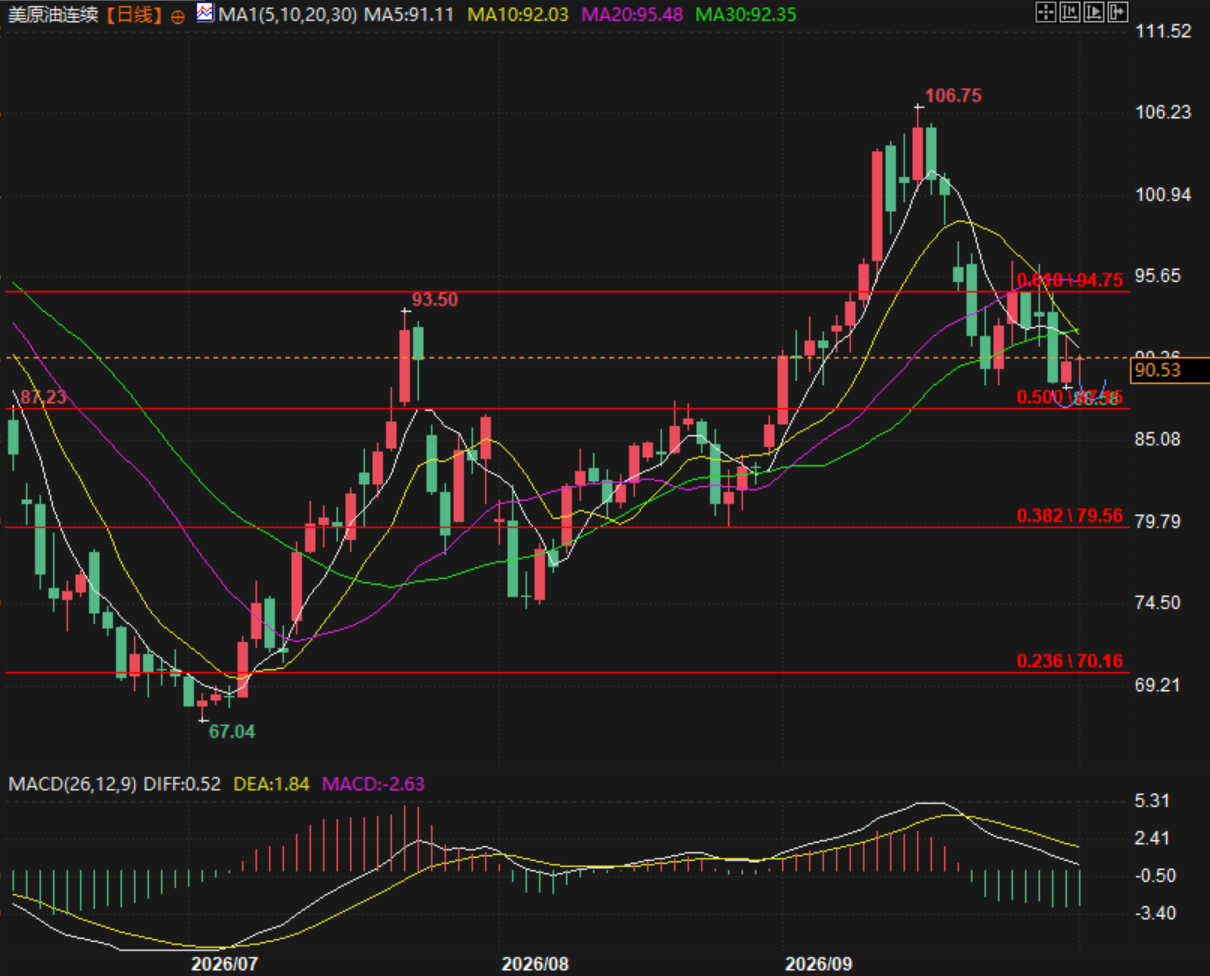 (WTI crude oil futures contract daily chart, source: EasyTrade) At 15:06 Beijing time, the WTI crude oil futures contract was trading at $90.96 per barrel.
Strait of Hormuz: Crude oil shipments recover, but the refined oil crisis remains unresolved.
As a global energy chokepoint, the Strait of Hormuz remains open to navigation, but the area is highly militarized. Small oil tankers face significant risk premiums and soaring insurance costs, deterring many ship owners from entering the strait. The main battleground of the global energy crisis has shifted to refined oil products. Market data is diverging: CNN's early estimates suggested that crude oil flow through the strait had recovered to about 80% of pre-war levels; however, subsequent statistics from Goldman Sachs, JPMorgan Chase, and Kpler showed that the seven-day average of crude oil exports from the strait had rebounded to 13.5 million barrels per day, essentially returning to pre-war levels. While crude oil shipping capacity appears to have returned to normal, the cost is heavy: a persistently tight supply of refined oil products, with diesel retail prices hitting record highs, dragging down the global economy. US President Trump is still considering implementing a diesel export ban to lower domestic refined oil retail prices; if this policy is implemented, it will further disrupt global oil trade.Maritime blockade intensifies: US military continues to exert pressure, and control over merchant ships is strengthened.
On the military front, the United States continues to strengthen its maritime blockade against Iran. On September 30, the U.S. Central Command announced on the social media platform X that the USS George H.W. Bush aircraft carrier was deployed to the Arabian Sea to support the blockade operation. As of that day, the U.S. military had diverted 125 merchant ships, strictly enforcing the blockade rules. The addition of 10 more merchant ships in just one week indicates that the U.S. is continuing to tighten maritime control, and the uncertainty surrounding shipping in the Strait of Hormuz remains long-term. Regional ripple effects: The spillover effects of the conflict, including aviation disruptions and pressure on energy supplies in multiple countries, continue to spread. The UAE has suspended all flights operated by Iranian airlines since September 24, and many international airlines have extended their cancellation plans to the end of 2026 or the beginning of 2027. While local airports remain open, flight schedules, fuel prices, and security warnings are subject to change at any time, leaving UAE residents facing multiple pressures: disrupted air travel, rising fuel prices, and increased regional security risks. In addition to crude oil, natural gas transportation is also hampered by the situation in the Strait of Hormuz. Pakistan is negotiating with Iran to ensure the smooth passage of two shipments of Qatari liquefied natural gas through the Strait of Hormuz in October. The Middle East conflict has disrupted the stability of natural gas transport across the Straits, exacerbating Pakistan's domestic energy shortage. The country relies on its friendly relations with Iran to stabilize this energy corridor, alleviating domestic supply pressures. This also indicates that Iran still controls a large portion of the region's energy supply.Trading Perspective: Risks Cannot Be Ignored in a Fragile Balance
For crude oil traders, although crude oil traffic through the Strait of Hormuz has returned to pre-war levels, the transportation and price of refined petroleum products are still affected by the cost of passage through the Strait. Meanwhile, pro-war factions in Iran still have the ability to continue influencing crude oil prices. The ongoing maritime blockade, the breakdown of US-Iranian diplomacy, refined petroleum product supply gaps, and air traffic disruptions, coupled with the energy supply pressures on neighboring countries, make the current energy market balance extremely fragile. Traders cannot focus solely on crude oil transport volume data; internal factional struggles within Iran, the intensity of the US maritime blockade, diesel export policies, and unforeseen security incidents in the Strait are all core risk variables that need continuous monitoring. Technically, the WTI crude oil futures contract has formed a double bottom on the daily chart, and has also stopped falling ahead of the recent Fibonacci 0.5 level, indicating a potential rebound. However, the overall moving averages are currently in a bearish alignment, limiting the upside potential. (WTI crude oil futures contract daily chart, source: EasyTrade) At 15:06 Beijing time, the WTI crude oil futures contract was trading at $90.96 per barrel.
- Risk Warning and Disclaimer
- The market involves risk, and trading may not be suitable for all investors. This article is for reference only and does not constitute personal investment advice, nor does it take into account certain users’ specific investment objectives, financial situation, or other needs. Any investment decisions made based on this information are at your own risk.