Why is it that the real factor suppressing gold prices is not the PCE rate, but the US Treasury yield?
2026-10-01 17:54:15
On Thursday, October 1st, spot gold remained in a weak and volatile state, quoted at around $4160 per ounce, having fallen by more than 6% cumulatively in September. A more crucial change occurring in tandem with gold came from the interest rate market: the yield on the 10-year US Treasury note rose to 5.342%, a high since 2002, while the US dollar index touched a three-month high of around 101.84. Meanwhile, Brent crude oil returned to trading near $100 per barrel. Gold is facing not just a single inflation variable, but a repricing of real interest rates, term premiums, energy prices, and safe-haven flows. 
 More noteworthy is the strength of the correlation between prices and macroeconomic variables. If long-term yields, the US dollar, and crude oil continue to exhibit high volatility, gold's intraday fluctuations may reflect more of a cross-asset positioning adjustment than simply changes in traditional safe-haven flows. The US September jobs report, released on October 2nd, will provide new information for the market to reassess the policy path.
The core pressure on gold has shifted from inflation data to long-term interest rates.
The US Personal Consumption Expenditures (PCE) price index rose 3.4% year-on-year in August, the same as the revised level in July; the core index, excluding food and energy, rose 3.0% year-on-year. On a month-on-month basis, the overall price index rose 0.3%, and the core index rose 0.2%, both indicating that short-term price pressures were milder than previously feared by the market. However, gold did not receive a sustained boost as a result, mainly because the bond market did not simultaneously trade in more accommodative financial conditions. The 10-year US Treasury yield broke through 5.3%, meaning that non-interest-bearing assets face higher opportunity costs. Meanwhile, the rise in long-term yields is not entirely driven by short-term policy rate expectations; energy prices, Treasury supply, term premiums, and inflation risk compensation are all at play. Therefore, even if the market lowers its expectations for a Fed rate hike in October, gold may still be constrained by the relatively high actual financing costs at the long end. This structure also explains the phased divergence between the safe-haven attributes of the US dollar and gold. Regional conflict risks can both increase the safe-haven demand for gold and enhance the yield advantage of dollar assets by pushing up energy prices, inflation expectations, and bond yields. Currently, the market is trading more clearly in the latter transmission chain.The cooling of PCE does not mean that monetary policy constraints have been lifted.
In September, the Federal Reserve raised its target range for the federal funds rate by 25 basis points to 3.75% to 4.00%. Latest interest rate futures pricing indicates that the probability of another 25 basis point rate hike in October has fallen to about 37%, but the probability of a further rate hike before December remains close to 89%, reflecting that the market has only postponed some tightening expectations, rather than completely eliminating policy risks. The problem lies in the fact that US demand-side data is not weak. Personal consumption expenditures rose 0.9% month-on-month in August, real consumption grew 0.6%, and the personal savings rate fell to 4.1%; the third estimate of second-quarter real GDP annualized growth was 2.2%, revised upward by 0.7 percentage points from the previous estimate of 1.5%. The main reason is the revision in consumption and investment. This forms the most important macroeconomic contradiction for gold at present: the marginal cooling of inflation data reduces the necessity for an immediate rate hike, but consumption, investment, and energy prices make continued easing lack sufficient justification. For gold, what really needs to be observed is not a single inflation figure, but whether policy rate expectations and long-term yields are simultaneously repriced.Daily technical structure
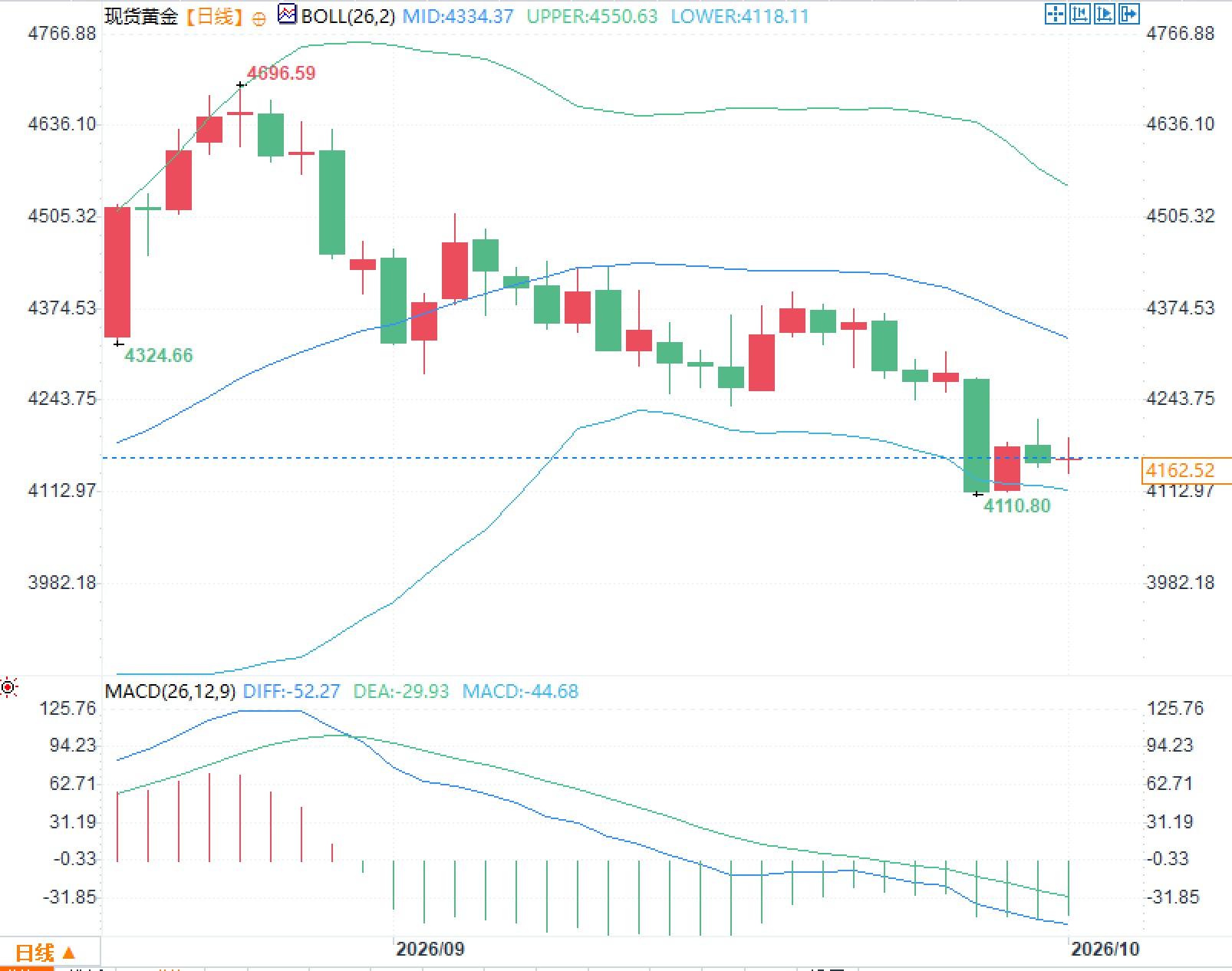
The daily chart shows that the Bollinger Band's middle band continues to slope downwards, with the price below the middle band and approaching the lower band area, while the distance between the upper and lower bands is widening. This indicates a significant increase in price volatility recently, with the market shifting from a relatively balanced state to a more volatile environment. As for the MACD, both the DIF and DEA are below the zero line, with the DIF still lower than the DEA, and the negative histogram persisting, suggesting that the daily momentum is still dominated by a weak structure. More noteworthy is the strength of the correlation between prices and macroeconomic variables. If long-term yields, the US dollar, and crude oil continue to exhibit high volatility, gold's intraday fluctuations may reflect more of a cross-asset positioning adjustment than simply changes in traditional safe-haven flows. The US September jobs report, released on October 2nd, will provide new information for the market to reassess the policy path.Frequently Asked Questions
Question 1: Why hasn't gold shown a significant and sustained reaction despite the lower-than-expected US PCE? Answer: Because the dominant variable in gold pricing is no longer solely the inflation data itself. The cooling of core PCE has reduced the probability of an immediate Fed rate hike in October, but the 10-year US Treasury yield remains at multi-year highs, and the dollar is also relatively strong. The opportunity cost of non-interest-bearing gold has not decreased significantly, thus the positive impact of inflation data is partially offset by interest rate factors. Question 2: Why haven't regional conflicts driven gold prices in one direction? Answer: Conflict risks have two transmission paths. One is increased safe-haven demand, and the other is pushed up energy prices and reinforced inflation risks, thereby increasing bond yields and dollar demand. Currently, the latter has a more significant impact, so geopolitical risks cannot be simply equated with rising gold prices.- Risk Warning and Disclaimer
- The market involves risk, and trading may not be suitable for all investors. This article is for reference only and does not constitute personal investment advice, nor does it take into account certain users’ specific investment objectives, financial situation, or other needs. Any investment decisions made based on this information are at your own risk.