Crude oil reversed its decline and began a rebound.
2026-10-02 00:26:15
The supply gap that drove crude oil prices higher on Thursday was in diesel, gasoline, and jet fuel, rather than in the crude oil itself used by refineries to produce these products. Crude oil rebounded to around $91.50 after an earlier decline, influenced by news that Chinese refineries had halted sales of refined oil products. Currently, diesel prices in the Asian market are about $75 per barrel higher than crude oil, a price difference roughly equivalent to the price of a full barrel of crude oil in early August.  China Takes Steps to Stabilize Domestic Refined Oil Supply Sources familiar with the matter revealed that Chinese refineries have suspended refined oil exports to regions excluding Hong Kong and Macau. A state-owned refinery cancelled multiple October gasoline and jet fuel cargo orders on Wednesday, most of which were deals finalized within the last two weeks. China began its week-long National Day holiday on Thursday and has not yet approved October refined oil export quotas. Sources indicated that whether export quota approvals will resume after the holiday on October 7th will depend on domestic refined oil inventory levels and refinery output. This export suspension comes less than a week after President Trump requested China's assistance in stabilizing global refined oil supplies in Washington. China has the world's largest refining capacity, but its refined oil exports are typically smaller than those of India and South Korea. The cancelled cargo orders themselves have limited impact, but trade sources say the root cause of the export suspension is declining domestic refined oil inventories. Replenishing inventories requires crude oil; simultaneously, the rise in Asian diesel crack spreads to a one-week high has also spurred refineries worldwide to increase processing capacity. US crude oil inventories are higher than normal, and diesel inventories are down by 14%. Middle Eastern crude oil exports rose to their highest level since the outbreak of conflict on February 28th in September. Saudi Arabia also resumed loading operations at the Yanbu Red Sea port, where crude oil shipments no longer need to pass through the Strait of Hormuz. Data from the US Energy Information Administration (EIA) shows that US crude oil inventories increased by 922,000 barrels in the week ending September 25th, 2% higher than the five-year average. During the same period, distillate fuel inventories, including diesel and heating oil, decreased by 2.3 million barrels, 14% lower than the five-year average; gasoline inventories decreased by 1.7 million barrels. The predicament of US refineries is not a lack of crude oil feedstock, but rather insufficient refined product inventories, thus crude oil prices are fluctuating in tandem with diesel prices. A consulting firm estimates that if the US implements a diesel export ban, storage tanks will be full within a month, and domestic refinery operating rates could drop by up to 12%. On September 24th, rumors of a ban circulated in the market, pushing the discount of US crude oil relative to international benchmark crude oil to its largest level since early May. Reduced refinery processing means that these crude oils need to find alternative buyers. Therefore, the US response to the refined oil shortage poses a downside risk to US crude oil itself. In September, the average price of diesel in the US exceeded $6.50 per gallon for the first time. The US government hopes to lower diesel prices before the November 3 midterm elections. Officials are weighing options such as voluntary export restrictions and expanding the release of red-dyed diesel, but have not yet finalized an export ban. Trump has publicly stated his support for keeping diesel for domestic use in the US, and the White House has also requested the EU to release its emergency diesel reserves to lower global oil prices. The Iranian delegation left New York, with both sides offering conflicting accounts . Indirect negotiations between the US and Iran stalled on Monday. US officials stated that Secretary of State Rubio subsequently ordered the Iranian delegation to leave the country. The Iranian Permanent Mission to the UN stated that the delegation left New York according to the schedule informed to the US State Department on September 17. Qatar continues to relay messages between the two sides, and Iran has not yet responded to the latest US proposal. On Monday, reports surfaced that the US offered to lift sanctions and unfreeze Iranian assets in exchange for substantive measures from Iran on the nuclear issue. However, Trump subsequently publicly denied the report. If the two sides fail to reach an agreement, oil shipments through the Strait of Hormuz will remain well below pre-conflict levels, and oil prices will continue to reflect the risk premium incurred since the conflict began on February 28. Key price levels and trends .
 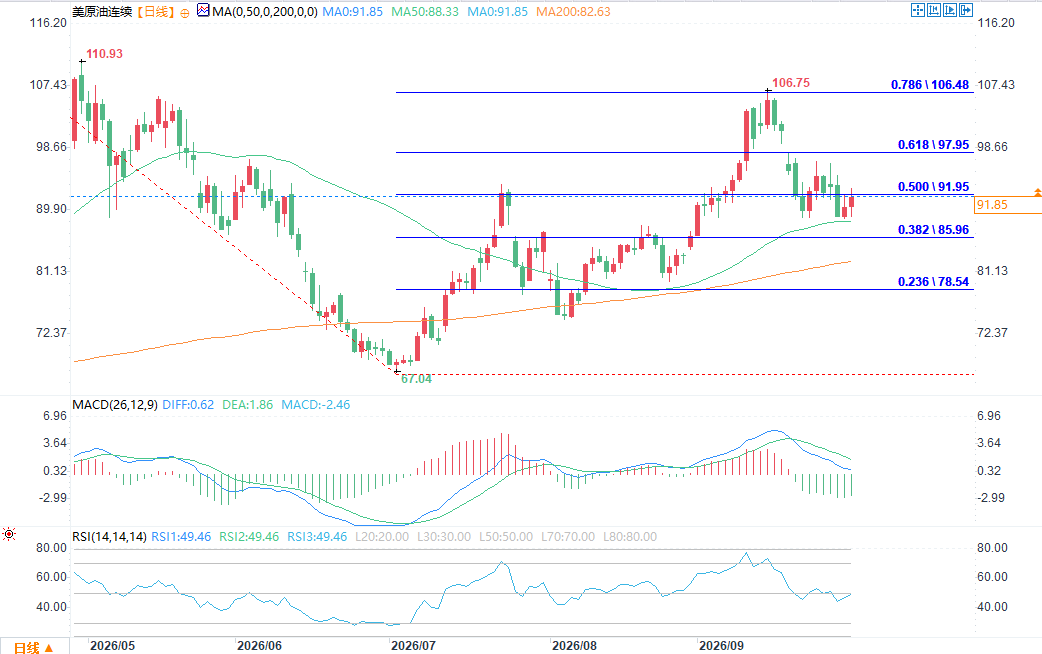 (WTI Crude Oil Daily Chart Source: EasyTrade) Resistance Level: Thursday's rebound stalled below $92.00; on Friday and Tuesday, oil prices encountered selling pressure in the $93.00-$93.50 range. On Monday, oil prices surged to $95.00 but failed to break through the high of nearly $96.00 on September 24th, and the September 24th high is still significantly lower than the peak near $102.00 on September 15th. Support Level: On Tuesday, Wednesday, and Thursday, buying interest emerged below $88.00. The 50-day exponential moving average (EMA) is around $88.50, just above this support level; Tuesday's closing price briefly dipped below this EMA, but only held for one trading day. The next support level is near the September 4th low of $87.00. Market Trend: As long as buyers continue to hold the $88.00 level, the bias is towards long positions; the first target is $93.50, and the second target is Monday's high of $95.00. The daily Stochastic Relative Strength Index (StochRSI) has not yet turned upward. If the daily closing price falls below $87.50 (breaking below the lows of Tuesday to Thursday), the long position logic will be invalidated.
China Takes Steps to Stabilize Domestic Refined Oil Supply Sources familiar with the matter revealed that Chinese refineries have suspended refined oil exports to regions excluding Hong Kong and Macau. A state-owned refinery cancelled multiple October gasoline and jet fuel cargo orders on Wednesday, most of which were deals finalized within the last two weeks. China began its week-long National Day holiday on Thursday and has not yet approved October refined oil export quotas. Sources indicated that whether export quota approvals will resume after the holiday on October 7th will depend on domestic refined oil inventory levels and refinery output. This export suspension comes less than a week after President Trump requested China's assistance in stabilizing global refined oil supplies in Washington. China has the world's largest refining capacity, but its refined oil exports are typically smaller than those of India and South Korea. The cancelled cargo orders themselves have limited impact, but trade sources say the root cause of the export suspension is declining domestic refined oil inventories. Replenishing inventories requires crude oil; simultaneously, the rise in Asian diesel crack spreads to a one-week high has also spurred refineries worldwide to increase processing capacity. US crude oil inventories are higher than normal, and diesel inventories are down by 14%. Middle Eastern crude oil exports rose to their highest level since the outbreak of conflict on February 28th in September. Saudi Arabia also resumed loading operations at the Yanbu Red Sea port, where crude oil shipments no longer need to pass through the Strait of Hormuz. Data from the US Energy Information Administration (EIA) shows that US crude oil inventories increased by 922,000 barrels in the week ending September 25th, 2% higher than the five-year average. During the same period, distillate fuel inventories, including diesel and heating oil, decreased by 2.3 million barrels, 14% lower than the five-year average; gasoline inventories decreased by 1.7 million barrels. The predicament of US refineries is not a lack of crude oil feedstock, but rather insufficient refined product inventories, thus crude oil prices are fluctuating in tandem with diesel prices. A consulting firm estimates that if the US implements a diesel export ban, storage tanks will be full within a month, and domestic refinery operating rates could drop by up to 12%. On September 24th, rumors of a ban circulated in the market, pushing the discount of US crude oil relative to international benchmark crude oil to its largest level since early May. Reduced refinery processing means that these crude oils need to find alternative buyers. Therefore, the US response to the refined oil shortage poses a downside risk to US crude oil itself. In September, the average price of diesel in the US exceeded $6.50 per gallon for the first time. The US government hopes to lower diesel prices before the November 3 midterm elections. Officials are weighing options such as voluntary export restrictions and expanding the release of red-dyed diesel, but have not yet finalized an export ban. Trump has publicly stated his support for keeping diesel for domestic use in the US, and the White House has also requested the EU to release its emergency diesel reserves to lower global oil prices. The Iranian delegation left New York, with both sides offering conflicting accounts . Indirect negotiations between the US and Iran stalled on Monday. US officials stated that Secretary of State Rubio subsequently ordered the Iranian delegation to leave the country. The Iranian Permanent Mission to the UN stated that the delegation left New York according to the schedule informed to the US State Department on September 17. Qatar continues to relay messages between the two sides, and Iran has not yet responded to the latest US proposal. On Monday, reports surfaced that the US offered to lift sanctions and unfreeze Iranian assets in exchange for substantive measures from Iran on the nuclear issue. However, Trump subsequently publicly denied the report. If the two sides fail to reach an agreement, oil shipments through the Strait of Hormuz will remain well below pre-conflict levels, and oil prices will continue to reflect the risk premium incurred since the conflict began on February 28. Key price levels and trends . (WTI Crude Oil Daily Chart Source: EasyTrade) Resistance Level: Thursday's rebound stalled below $92.00; on Friday and Tuesday, oil prices encountered selling pressure in the $93.00-$93.50 range. On Monday, oil prices surged to $95.00 but failed to break through the high of nearly $96.00 on September 24th, and the September 24th high is still significantly lower than the peak near $102.00 on September 15th. Support Level: On Tuesday, Wednesday, and Thursday, buying interest emerged below $88.00. The 50-day exponential moving average (EMA) is around $88.50, just above this support level; Tuesday's closing price briefly dipped below this EMA, but only held for one trading day. The next support level is near the September 4th low of $87.00. Market Trend: As long as buyers continue to hold the $88.00 level, the bias is towards long positions; the first target is $93.50, and the second target is Monday's high of $95.00. The daily Stochastic Relative Strength Index (StochRSI) has not yet turned upward. If the daily closing price falls below $87.50 (breaking below the lows of Tuesday to Thursday), the long position logic will be invalidated.
- Risk Warning and Disclaimer
- The market involves risk, and trading may not be suitable for all investors. This article is for reference only and does not constitute personal investment advice, nor does it take into account certain users’ specific investment objectives, financial situation, or other needs. Any investment decisions made based on this information are at your own risk.