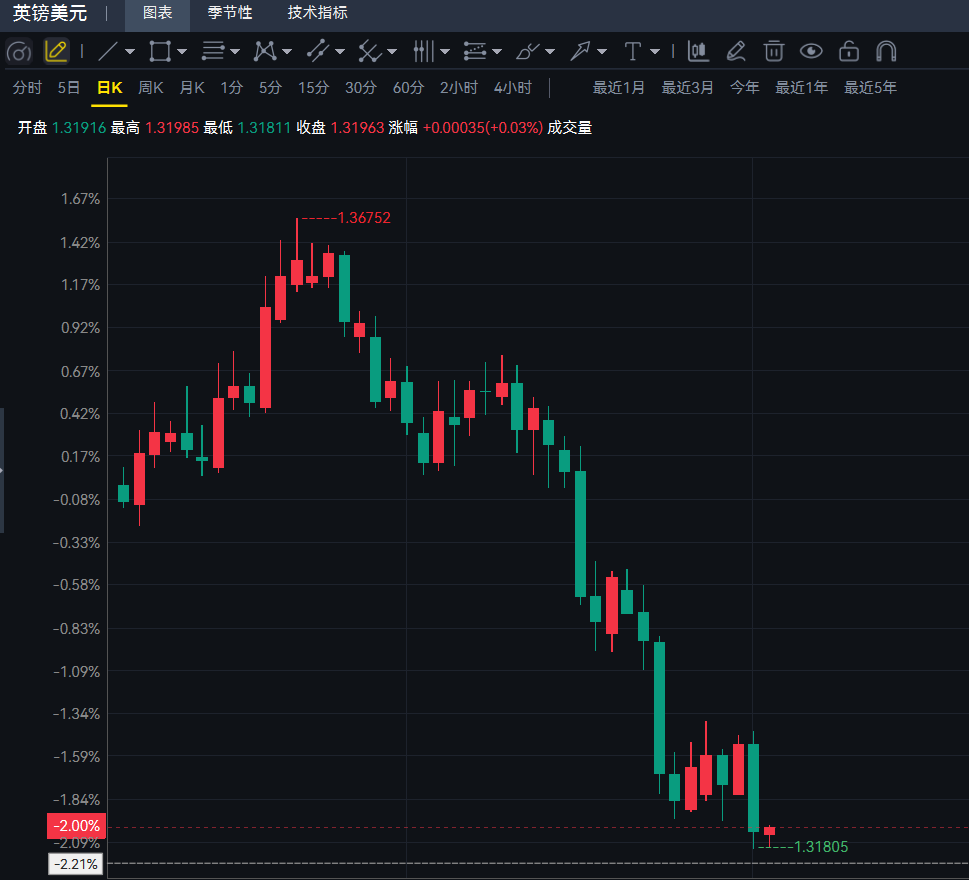
British bond yields hit a 27-year high, exacerbating fiscal concerns and causing the pound to fall below 1.32 against the dollar, marking its third consecutive week of decline.
2026-10-02 10:34:17
On Friday during Asian trading hours, the pound continued its weakness against the dollar, trading below 1.3200 and touching a low from the previous day, its lowest level since late June . It is highly likely to record its third consecutive weekly decline. The immediate pressure on the market comes from the overall strength of the dollar: the dollar index, which measures the dollar against a basket of currencies, has risen above 102, hitting a roughly 18-month high ; inflation concerns triggered by high oil prices have only slightly reduced US Treasury yields from multi-year highs, limiting the dollar's downside; and the continued tensions between the US and Iran have fueled safe-haven demand, further solidifying the dollar's buying base.  Equally noteworthy as the strengthening US dollar is the deterioration of the UK's own fundamentals. Market surveys show that the yield on 30-year UK government bonds has risen above 6% , the first time it has broken through this psychological barrier since early 1998 ; the yield on 10-year UK government bonds has simultaneously risen to its highest level since 2007. The sharp rise in long-term yields has directly amplified market concerns about UK public finances – the autumn budget is scheduled to be announced on October 28 , and investors are closely assessing the Chancellor's budgetary space and policy orientation against the backdrop of high borrowing costs. The volatility in the bond market has spilled over into the currency market, with the pound sterling, as a currency highly sensitive to the fiscal outlook, experiencing additional selling pressure. However, the downside for the pound may be limited in the short term. The US September non-farm payrolls report , to be released Friday evening, is the most important risk event for the currency market this week: the market expects an increase of approximately 90,000 jobs and an average hourly wage increase of approximately 3.2% year-on-year, compared to August's non-farm payrolls of 162,000, far exceeding expectations. Before the data release, traders tend to avoid establishing aggressive directional positions, resulting in a more gradual, slow decline in the pound rather than a panic sell-off. On the other hand, market bets on a Fed rate hike in October have cooled significantly. If Friday's employment data falls short of expectations, the dollar's interest rate support will weaken, potentially giving the pound a breather. From a global market perspective, the current weakness in the pound is the result of a combination of factors: a strong dollar, high oil prices, and fiscal concerns. The dollar benefits from interest rate expectations and safe-haven demand, while the UK faces stagflation risks due to high energy import costs and soaring bond yields. This interplay of strength and weakness has led to a continued downward shift in the pound's exchange rate against the dollar. Furthermore, if the US-Iran situation escalates again, safe-haven funds will flow further into the dollar, potentially increasing pressure on the pound. Conversely, if there are signs of easing tensions, coupled with weaker US data, the pound may experience a correction from its oversold condition. A significant characteristic of market sentiment is "cautious pessimism": investors acknowledge the pound's weak fundamentals while simultaneously fearing a potential reversal in volatility triggered by the non-farm payroll data, resulting in a strong wait-and-see attitude . From a technical perspective, the GBP/USD pair maintains a bearish tone on the daily chart. The overnight break below 1.3200 paves the way for a downward test of the year's lows – around 1.3140 (the area of the June lows). Following that is the psychological level of 1.3100 ; a breach of this level would likely extend the downtrend of the past month. On the upside, any attempt to rally is likely to encounter significant resistance around 1.3300. Only a sustained hold above this level would provide a more convincing signal to the bulls, at which point the pair may further test the technically significant 200-day moving average (around 1.3448) . From a 4-hour chart perspective, the short-term structure shows a bearish pattern with progressively lower highs, indicating insufficient upward momentum. Technical indicators are operating in weak territory, with no clear bottom divergence signal. If weak non-farm payroll data pushes the dollar lower, the GBP/USD pair may have a chance for a technical correction towards the 1.3260-1.3300 area. However, if the rebound is weak and 1.3140 is breached again, the probability of testing 1.3100 and extending the decline will significantly increase. It is advisable to remain on the sidelines before the non-farm payroll data is released, and then follow the trend once the direction becomes clearer, paying close attention to the 1.3140 level as a key support/resistance level.
  Editor's Summary : Overall, the British pound is currently facing both internal and external challenges: externally, it faces a strong dollar and geopolitical uncertainty; internally, it is suppressed by the 27-year high yields on UK bonds and the upcoming autumn budget's fiscal uncertainties. The three-week losing streak is unlikely to reverse in the short term. Looking ahead, Friday's non-farm payroll data and the autumn budget on October 28th are two key turning points: if the US employment data is weak, the dollar takes profits, and the UK budget does not significantly exceed expectations in terms of spending, the pound/dollar exchange rate is expected to stabilize around 1.3140 and begin a recovery towards 1.3300; conversely, if the data is strong and the budget raises questions about fiscal discipline, the risk of the pound falling below 1.3100 and exploring lower levels should not be underestimated. On the risk side, oil price movements, the US-Iran situation, and UK fiscal signals need to be continuously monitored.
Equally noteworthy as the strengthening US dollar is the deterioration of the UK's own fundamentals. Market surveys show that the yield on 30-year UK government bonds has risen above 6% , the first time it has broken through this psychological barrier since early 1998 ; the yield on 10-year UK government bonds has simultaneously risen to its highest level since 2007. The sharp rise in long-term yields has directly amplified market concerns about UK public finances – the autumn budget is scheduled to be announced on October 28 , and investors are closely assessing the Chancellor's budgetary space and policy orientation against the backdrop of high borrowing costs. The volatility in the bond market has spilled over into the currency market, with the pound sterling, as a currency highly sensitive to the fiscal outlook, experiencing additional selling pressure. However, the downside for the pound may be limited in the short term. The US September non-farm payrolls report , to be released Friday evening, is the most important risk event for the currency market this week: the market expects an increase of approximately 90,000 jobs and an average hourly wage increase of approximately 3.2% year-on-year, compared to August's non-farm payrolls of 162,000, far exceeding expectations. Before the data release, traders tend to avoid establishing aggressive directional positions, resulting in a more gradual, slow decline in the pound rather than a panic sell-off. On the other hand, market bets on a Fed rate hike in October have cooled significantly. If Friday's employment data falls short of expectations, the dollar's interest rate support will weaken, potentially giving the pound a breather. From a global market perspective, the current weakness in the pound is the result of a combination of factors: a strong dollar, high oil prices, and fiscal concerns. The dollar benefits from interest rate expectations and safe-haven demand, while the UK faces stagflation risks due to high energy import costs and soaring bond yields. This interplay of strength and weakness has led to a continued downward shift in the pound's exchange rate against the dollar. Furthermore, if the US-Iran situation escalates again, safe-haven funds will flow further into the dollar, potentially increasing pressure on the pound. Conversely, if there are signs of easing tensions, coupled with weaker US data, the pound may experience a correction from its oversold condition. A significant characteristic of market sentiment is "cautious pessimism": investors acknowledge the pound's weak fundamentals while simultaneously fearing a potential reversal in volatility triggered by the non-farm payroll data, resulting in a strong wait-and-see attitude . From a technical perspective, the GBP/USD pair maintains a bearish tone on the daily chart. The overnight break below 1.3200 paves the way for a downward test of the year's lows – around 1.3140 (the area of the June lows). Following that is the psychological level of 1.3100 ; a breach of this level would likely extend the downtrend of the past month. On the upside, any attempt to rally is likely to encounter significant resistance around 1.3300. Only a sustained hold above this level would provide a more convincing signal to the bulls, at which point the pair may further test the technically significant 200-day moving average (around 1.3448) . From a 4-hour chart perspective, the short-term structure shows a bearish pattern with progressively lower highs, indicating insufficient upward momentum. Technical indicators are operating in weak territory, with no clear bottom divergence signal. If weak non-farm payroll data pushes the dollar lower, the GBP/USD pair may have a chance for a technical correction towards the 1.3260-1.3300 area. However, if the rebound is weak and 1.3140 is breached again, the probability of testing 1.3100 and extending the decline will significantly increase. It is advisable to remain on the sidelines before the non-farm payroll data is released, and then follow the trend once the direction becomes clearer, paying close attention to the 1.3140 level as a key support/resistance level. Editor's Summary : Overall, the British pound is currently facing both internal and external challenges: externally, it faces a strong dollar and geopolitical uncertainty; internally, it is suppressed by the 27-year high yields on UK bonds and the upcoming autumn budget's fiscal uncertainties. The three-week losing streak is unlikely to reverse in the short term. Looking ahead, Friday's non-farm payroll data and the autumn budget on October 28th are two key turning points: if the US employment data is weak, the dollar takes profits, and the UK budget does not significantly exceed expectations in terms of spending, the pound/dollar exchange rate is expected to stabilize around 1.3140 and begin a recovery towards 1.3300; conversely, if the data is strong and the budget raises questions about fiscal discipline, the risk of the pound falling below 1.3100 and exploring lower levels should not be underestimated. On the risk side, oil price movements, the US-Iran situation, and UK fiscal signals need to be continuously monitored.
- Risk Warning and Disclaimer
- The market involves risk, and trading may not be suitable for all investors. This article is for reference only and does not constitute personal investment advice, nor does it take into account certain users’ specific investment objectives, financial situation, or other needs. Any investment decisions made based on this information are at your own risk.