AI, the Federal Reserve, and Inventory Divergence: The Logic Behind the Gold Price Rebound
2026-10-02 17:58:16
Gold prices have recently rebounded, primarily driven by a flurry of pronouncements from Federal Reserve officials. The market has repriced its expectations for an October rate hike, and declining real interest rates have lowered the opportunity cost of holding gold, thus boosting the price of this non-interest-bearing asset. The core focus of this round of discussions among Fed officials has been the structural inflation resulting from AI capital expenditures, which has become the main theme of current macroeconomic dynamics. 
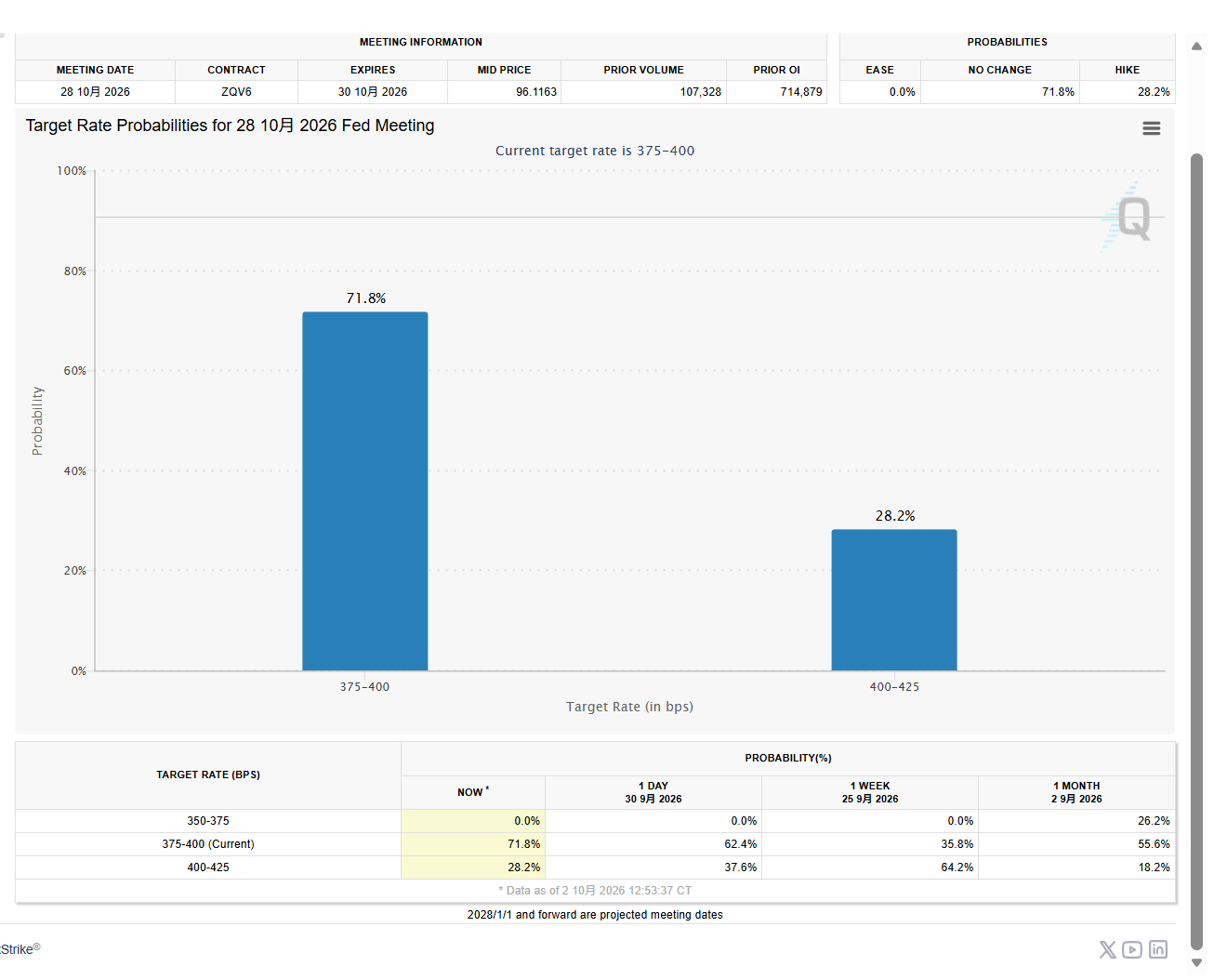 (FedWatch interest rate monitoring tool, source: CME Group)
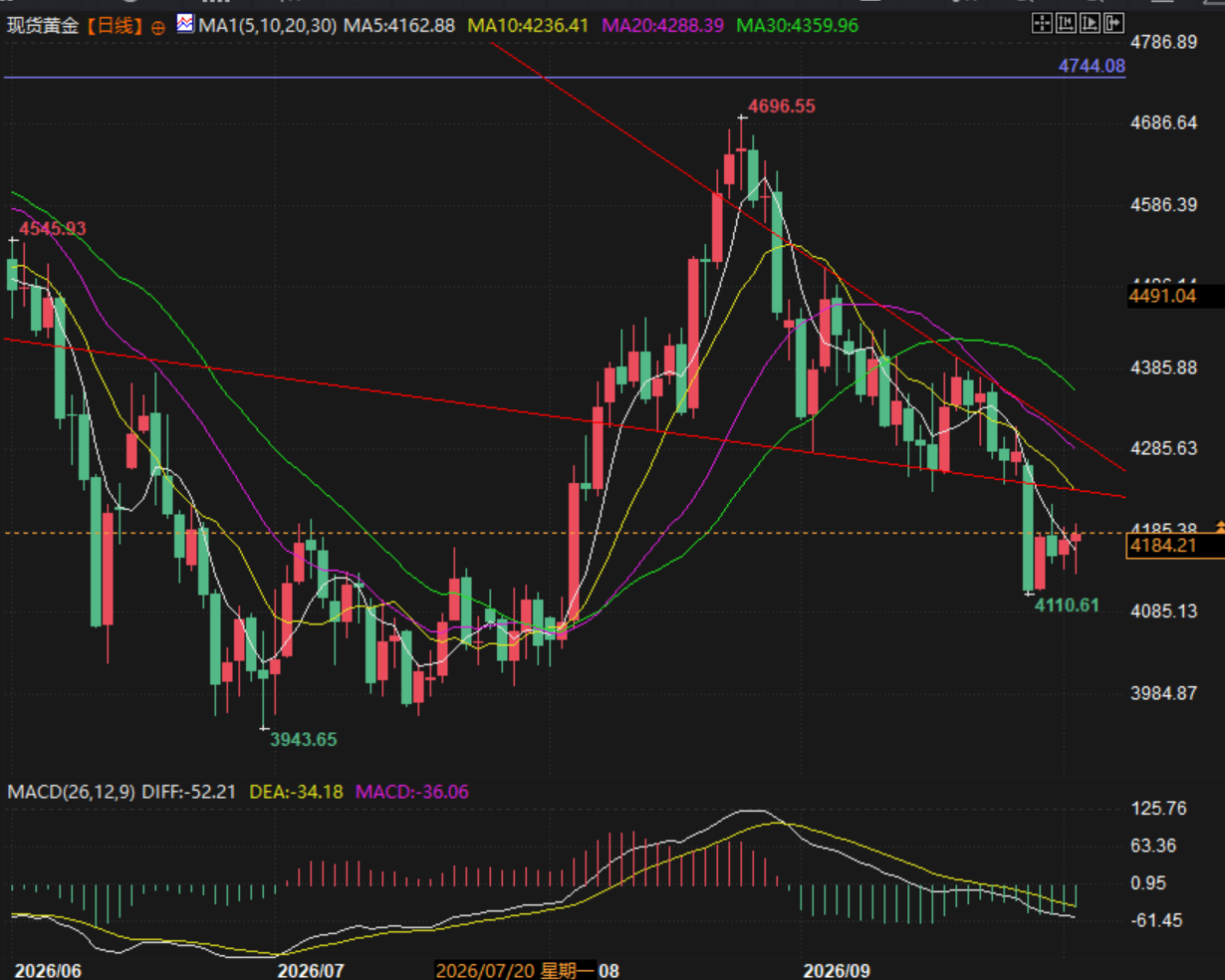 (Spot gold daily chart, source: EasyTrade) At 17:50 Beijing time, spot gold is currently trading at $4183 per ounce.
The Federal Reserve's intensive discussions on the macroeconomic impact of AI cooled expectations for an October rate hike, pushing up gold prices.
Several Federal Reserve officials recently focused on the complex impact of AI on the macroeconomy and inflation. Fed Governor Cook pointed out that AI investment is creating localized inflationary pressures that are unlikely to subside quickly in the short term; the supply shocks brought about by AI are more persistent than expected, and the risk of supply bottlenecks warrants attention. He also stressed the need for a careful assessment of AI's long-term reshaping of the labor market structure to prevent inflation expectations from derailing. Williams similarly noted that the impact of AI on the supply side is not yet fully understood. AI's application in manufacturing, logistics, and other fields is reshaping production capacity and resource allocation, and its long-term effects still require continued observation. Kashkari, Jefferson, and Logan also discussed economic resilience and inflation stickiness: Kashkari believes the economy and labor market remain strong, and the current monetary policy may be insufficiently restrictive (i.e., it will not affect the job market), necessitating further interest rate hikes, but he has no strong inclination towards action in October; Jefferson advocates for more time to observe data trends and not to make decisions based solely on single-month data; Logan suggests that the rising premium on US Treasury bonds can replace some interest rate hikes, but overall, at least another 50 basis points are needed to balance inflation and employment goals. Based on the statements from various officials, the market interprets this as the Federal Reserve taking a wait-and-see approach to AI-driven structural inflation and not immediately tightening monetary policy aggressively. Expectations for an October rate hike have significantly declined, real interest rates have fallen, and the cost of holding gold has decreased, triggering a rebound in gold prices. (FedWatch interest rate monitoring tool, source: CME Group)Federal Reserve options are back in focus: mirroring the tech bubble of the 1990s, a gradual cooling-off is the priority.
Meanwhile, the market has begun trading "Federal Reserve options." The AI boom has boosted the valuation of US tech stocks, and the market is starting to compare it to the dot-com bubble cycle during Greenspan's era in the 1990s. Back then, facing the prosperity brought by new technologies, Greenspan did not immediately and violently raise interest rates to burst asset prices, but instead adopted a gradual tightening approach, waiting for the bubble to cool naturally, and even later cutting rates to rescue the market. Now, facing the stock market valuation rise driven by AI, the market expects the Federal Reserve to likely choose a similar path: maintaining interest rates unchanged or adopting a moderate, cooling stance, relying on higher interest rates to slowly deflate the stock market bubble, rather than a one-time large-scale rate hike that directly triggers an asset bubble. This expectation continues to alleviate the liquidity crisis, further enhancing the demand for gold as a safe-haven asset, supporting gold prices. At the same time, the recent dovish turn by the Federal Reserve and the decline in TIPS mean that even if the Federal Reserve turns hawkish again in the short term, the negative impact on gold prices will be limited, because the IRP inflation risk premium has already been pulled up relatively high recently, meaning that even if the Federal Reserve turns hawkish again in the near future, the rate of increase in real interest rates will be much smaller than that of nominal interest rates. There is no need to panic about the rebound in 10-year Treasury yields due to the Federal Reserve.The ISM Manufacturing PMI reveals structural divergence and exposes inherent contradictions in the Federal Reserve's policies.
Interesting divergent signals have emerged in the real economy. The September US ISM Manufacturing PMI data can help understand the current policy contradictions of the Federal Reserve. The composite PMI fell slightly to 54.5, below the market expectation of 55.0, which the market's initial reaction might easily be interpreted as a weakening of manufacturing activity. However, a breakdown of the sub-indices reveals that the main drag on the composite index came from a decline in raw material inventories coupled with a slight improvement in supplier deliveries; new orders, order backlogs, manufacturing employment, and input prices all strengthened. Businesses are not experiencing a contraction in demand, but rather high loan interest rates, high diesel prices, and cost uncertainties stemming from Middle East geopolitical tensions have led companies to actively control their inventory levels, avoiding large-scale stockpiling of raw materials and adopting a low-inventory, order-based production approach. Once inflation subsides and financing pressures ease, with ample orders on hand, companies have significant potential to replenish inventory and expand hiring. This set of real economy data precisely exposes the current policy contradictions of the Federal Reserve: on the one hand, it wants to control financing costs; on the other hand, as long as external risks ease and financing costs decline, the potential for companies to replenish inventory and expand can be released at any time, posing a risk of a rebound in aggregate demand and making it difficult to quickly eliminate inflation stickiness.Medium- to long-term strategy: Closely monitor the neutral interest rate, and pay close attention to non-farm payrolls and the unemployment rate.
From a medium- to long-term perspective, the market needs to continuously monitor the dynamic changes in the neutral interest rate (r*), and the judgment of the neutral interest rate is highly tied to labor market data. The two key indicators to watch tonight's non-farm payrolls report are wage growth and whether the unemployment rate breaks through 4.2%. Currently, the unemployment rate is stable at 4.1%, near the generally accepted natural unemployment rate, indicating that the overall labor market remains relatively healthy. If wages continue to rise and the unemployment rate remains around 4.1%, it will push up the market's judgment of the neutral interest rate, meaning the Federal Reserve needs to maintain a higher interest rate level, putting downward pressure on gold prices. Conversely, if the unemployment rate continues to rise and wage growth declines, it proves that the labor market is gradually cooling, the neutral interest rate expectation is revised downward, and the space for real interest rates to fall opens up, which will continue to benefit gold.Conclusion:
The current gold price rebound is essentially a market game between the Federal Reserve's policy dilemma: AI is causing localized inflation and asset valuation bubbles, while the seemingly slowing real manufacturing sector actually harbors the potential for a demand rebound. Tonight's key drivers for gold prices will be non-farm payrolls, unemployment rate, and inflation data. (Spot gold daily chart, source: EasyTrade) At 17:50 Beijing time, spot gold is currently trading at $4183 per ounce.
- Risk Warning and Disclaimer
- The market involves risk, and trading may not be suitable for all investors. This article is for reference only and does not constitute personal investment advice, nor does it take into account certain users’ specific investment objectives, financial situation, or other needs. Any investment decisions made based on this information are at your own risk.