A chart: The Baltic Dry Index rose slightly, but closed lower for the week.
2026-10-02 22:58:16
Latest data shows that the Baltic Dry Index (BDI) reached 3148 points on October 2, 2026, a three-day high, up 0.25% month-on-month, marking the second consecutive day of increase (including zero growth). Looking at the short-term charts, the recent 11 BDI data points show: 6 positive increases, 5 negative increases, and 0 zero increases. Specifically, the Panamax Freight Index (BPI) was 2372 points, down 0.29% from the previous value; the Capesize Freight Index (BCI) was 5042 points, up 0.64%; and the Supramax Freight Index (BSI) was 1789 points, down 0.28%. For detailed 720-day and 10-year trend charts of the Baltic Dry Index and its three sub-indices, please refer to the charts specially created by FX678. 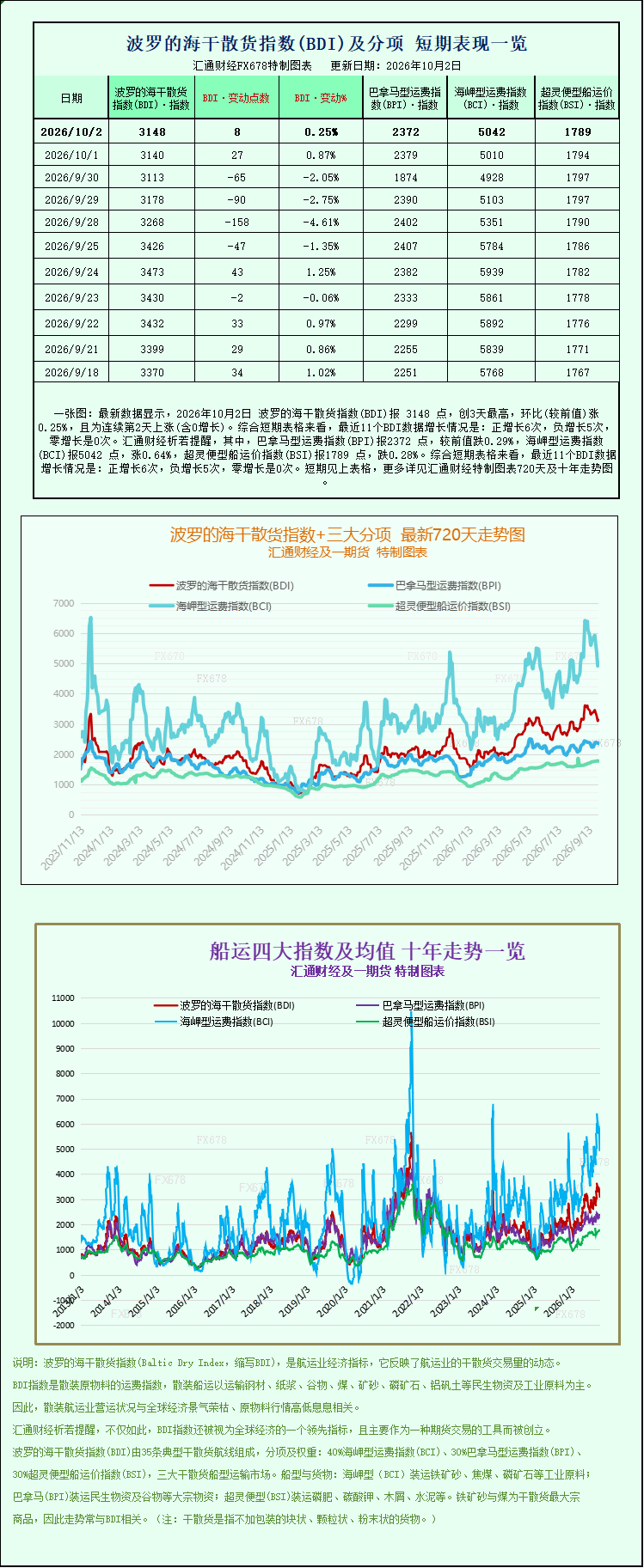 Bangalore, October 2, 2026 – The Baltic Dry Index (BDI) rose for the second consecutive trading day on Friday, mainly driven by a recovery in Capesize freight rates. However, dragged down by previous market corrections, the index recorded a significant weekly decline, with a clear divergence in market conditions across different vessel types. The Baltic Exchange Composite Dry Index rose 8 points, or 0.3%, to close at 3148 points on Friday, but still fell 8.1% for the week, resulting in a sharp weekly decline. This index comprehensively tracks time charter rates for Capesize, Panamax, and Supramax dry bulk vessels, directly reflecting the health of global ocean shipping for commodities such as iron ore, coal, and grain. Large Capesize vessels were the only strong sector on the day, with the Capesize index rising 32 points, or 0.6%, to close at 5042 points, also marking its second consecutive day of gains, but still showing a significant weekly decline of 12.8%. These vessels, with a deadweight tonnage of approximately 150,000 tons, primarily transport bulk industrial raw materials such as iron ore and thermal coal across the ocean. Data shows that the average daily charter income for Capesize vessels rose by $296 to $42,228. The short-term rebound was mainly due to the concentrated release of some deep-sea iron ore cargoes, increased inquiries on Atlantic routes, and a temporary tightening of available berths in some areas, driving a recovery in spot charter rates. However, concerns about downstream steel demand earlier this week still led to a significant pullback in freight rates for large vessels. In contrast to the rebound in Capesize vessels, freight rates for medium-sized Panamax vessels continued to weaken. The Panamax index fell 7 points, a decrease of 0.3%, closing at 2372 points, a slight weekly decline of 1.5%. The corresponding average daily earnings per vessel decreased by $58 to $21,349. Panamax vessels mainly carry 60,000-70,000 tons of coal and grain, covering global food export and energy trade routes. Market analysts believe that the recent slowdown in coal procurement in some parts of the world, coupled with a lull in long-distance grain shipments and lower-than-expected supply, along with relatively ample available shipping capacity, has suppressed the upward potential of Panamax freight rates. Among smaller vessels, the Supramax bulk carrier index fell 5 points, a 0.3% decrease, closing at 1789 points. Although there was a slight daily correction, this vessel type recorded a slight increase of 0.2% this week, making it the only category among the three major vessel types to achieve a weekly gain. Supramax vessels primarily serve short-haul regional trade, handling goods such as steel, fertilizers, and small-batch grains. Regional trade demand provides a buffer, making them more resilient to market fluctuations than larger bulk carriers, and they have shown relative resilience in a market downturn. Overall, the dry bulk market exhibited a pattern of "a sharp drop during the week followed by a slight recovery at the weekend." Market sentiment was cautious at the beginning of the week, with downstream steel mills adopting a conservative approach to procurement, leading to a decrease in iron ore imports. This directly pressured Capesize freight rates, the most heavily weighted vessel, causing a significant decline in the Baltic Dry Index (BDI). Friday's rebound in Capesize shipments was largely a technical correction after the decline and did not fundamentally reverse the week's weak overall trend. Industry insiders point out that future market trends will depend on the extent to which the traditional peak season in the fourth quarter materializes. The fourth quarter is traditionally a window of opportunity for iron ore and coal exports, with Brazilian and Australian mining companies pushing for increased shipments, coupled with winter energy storage demand in the Northern Hemisphere, potentially providing new cargo volume support for large vessels. However, the strength of the global steel industry's demand recovery, port operational efficiency in various regions, and fluctuations in fuel costs will all introduce uncertainty to freight rates. The divergence in market performance between different vessel types is likely to continue, with Capesize vessels remaining the core variable determining the BDI's direction.
Bangalore, October 2, 2026 – The Baltic Dry Index (BDI) rose for the second consecutive trading day on Friday, mainly driven by a recovery in Capesize freight rates. However, dragged down by previous market corrections, the index recorded a significant weekly decline, with a clear divergence in market conditions across different vessel types. The Baltic Exchange Composite Dry Index rose 8 points, or 0.3%, to close at 3148 points on Friday, but still fell 8.1% for the week, resulting in a sharp weekly decline. This index comprehensively tracks time charter rates for Capesize, Panamax, and Supramax dry bulk vessels, directly reflecting the health of global ocean shipping for commodities such as iron ore, coal, and grain. Large Capesize vessels were the only strong sector on the day, with the Capesize index rising 32 points, or 0.6%, to close at 5042 points, also marking its second consecutive day of gains, but still showing a significant weekly decline of 12.8%. These vessels, with a deadweight tonnage of approximately 150,000 tons, primarily transport bulk industrial raw materials such as iron ore and thermal coal across the ocean. Data shows that the average daily charter income for Capesize vessels rose by $296 to $42,228. The short-term rebound was mainly due to the concentrated release of some deep-sea iron ore cargoes, increased inquiries on Atlantic routes, and a temporary tightening of available berths in some areas, driving a recovery in spot charter rates. However, concerns about downstream steel demand earlier this week still led to a significant pullback in freight rates for large vessels. In contrast to the rebound in Capesize vessels, freight rates for medium-sized Panamax vessels continued to weaken. The Panamax index fell 7 points, a decrease of 0.3%, closing at 2372 points, a slight weekly decline of 1.5%. The corresponding average daily earnings per vessel decreased by $58 to $21,349. Panamax vessels mainly carry 60,000-70,000 tons of coal and grain, covering global food export and energy trade routes. Market analysts believe that the recent slowdown in coal procurement in some parts of the world, coupled with a lull in long-distance grain shipments and lower-than-expected supply, along with relatively ample available shipping capacity, has suppressed the upward potential of Panamax freight rates. Among smaller vessels, the Supramax bulk carrier index fell 5 points, a 0.3% decrease, closing at 1789 points. Although there was a slight daily correction, this vessel type recorded a slight increase of 0.2% this week, making it the only category among the three major vessel types to achieve a weekly gain. Supramax vessels primarily serve short-haul regional trade, handling goods such as steel, fertilizers, and small-batch grains. Regional trade demand provides a buffer, making them more resilient to market fluctuations than larger bulk carriers, and they have shown relative resilience in a market downturn. Overall, the dry bulk market exhibited a pattern of "a sharp drop during the week followed by a slight recovery at the weekend." Market sentiment was cautious at the beginning of the week, with downstream steel mills adopting a conservative approach to procurement, leading to a decrease in iron ore imports. This directly pressured Capesize freight rates, the most heavily weighted vessel, causing a significant decline in the Baltic Dry Index (BDI). Friday's rebound in Capesize shipments was largely a technical correction after the decline and did not fundamentally reverse the week's weak overall trend. Industry insiders point out that future market trends will depend on the extent to which the traditional peak season in the fourth quarter materializes. The fourth quarter is traditionally a window of opportunity for iron ore and coal exports, with Brazilian and Australian mining companies pushing for increased shipments, coupled with winter energy storage demand in the Northern Hemisphere, potentially providing new cargo volume support for large vessels. However, the strength of the global steel industry's demand recovery, port operational efficiency in various regions, and fluctuations in fuel costs will all introduce uncertainty to freight rates. The divergence in market performance between different vessel types is likely to continue, with Capesize vessels remaining the core variable determining the BDI's direction.
- Risk Warning and Disclaimer
- The market involves risk, and trading may not be suitable for all investors. This article is for reference only and does not constitute personal investment advice, nor does it take into account certain users’ specific investment objectives, financial situation, or other needs. Any investment decisions made based on this information are at your own risk.