ING: US job growth slows, supporting a Fed pause in rate hikes in October.
2026-10-03 01:52:16
Amid dovish signals from Federal Reserve officials and lower-than-expected inflation data, the latest weaker-than-expected employment data has further reduced the likelihood of a Fed rate hike in October. The market generally believes the next rate hike is most likely to occur in December. We still believe the market's pricing in subsequent Fed rate hikes is too aggressive. The three core indicators of the September US non-farm payroll report all fell short of expectations: non-farm payrolls increased by only 29,000 jobs, compared to a market consensus of 90,000, and the combined downward revision of 60,000 jobs in the previous two months; the unemployment rate rose from 4.1% to 4.2%, mainly due to a rebound in the labor force participation rate, with more people returning to the labor market; and wage growth was 3% year-on-year, lower than the expected 3.1%, meaning the job market has not generated upward inflation risk. This employment data echoes recent statements from key officials such as New York Fed President John Williams and Fed Vice Chairman Philip Jefferson. Both officials have hinted that the Fed may need more time to observe and is not in a hurry to raise interest rates. In summary, the Federal Reserve leadership clearly favors maintaining interest rates unchanged at the October meeting; only a significantly stronger-than-expected September CPI inflation data, to be released on October 14, could potentially change the policy direction of the October meeting. We maintain our assessment that the next Fed rate hike is most likely to occur in December. 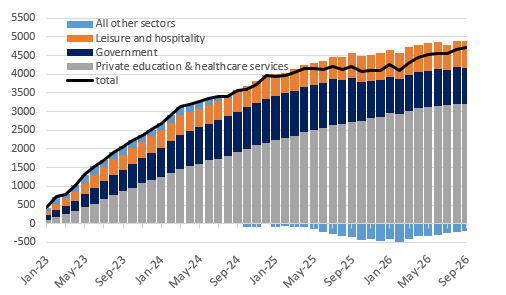 (Cumulative employment changes since December 2022, in thousands) Looking at specific industries, manufacturing stands out as one of the few bright spots, achieving job growth for the fourth consecutive month, with a cumulative increase of 72,000 jobs this year. This aligns with industry surveys showing strong performance, with high-end manufacturing sectors such as pharmaceuticals, transportation, aerospace, and computer electronics performing particularly well. Construction employment also improved, possibly related to the booming investment in data center construction. Conversely, the service sector as a whole remained weak, with the information technology sector losing 10,000 jobs, the financial sector losing 7,000, professional and business services losing 9,000, and government positions losing 17,000. The three pillar industries driving employment remain: private education and healthcare, state and local government (excluding the federal government), and leisure and hospitality.
 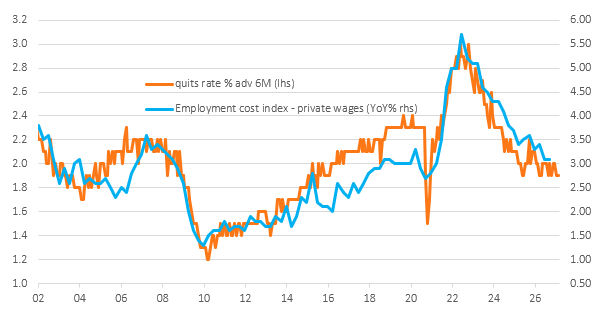 (The low turnover rate indicates that wage levels remain weak.) The current labor market is showing signs of easing, which explains the weakening wage growth. The US economy is currently characterized by "low hiring, low layoffs," with fewer job opportunities and a large number of people leaving the labor market earlier. The labor force participation rate fluctuates significantly each month; in September, the total labor force increased by 485,000 month-on-month, pushing the participation rate up from 61.6% to 61.8%. Currently, the number of unemployed people in the US is roughly equal to the number of job vacancies; while at the beginning of 2022, there were two job vacancies for every unemployed worker. This reversal in the labor supply and demand pattern is suppressing wage growth. The current low turnover rate suggests that even though wage growth has fallen to a year-on-year rate of 3%, there is still room for further wage declines. This again demonstrates that the job market does not pose a threat of inflation, and confirms our view that the market's expectation of 3-4 more Fed rate hikes is clearly overly optimistic and aggressive.
(Cumulative employment changes since December 2022, in thousands) Looking at specific industries, manufacturing stands out as one of the few bright spots, achieving job growth for the fourth consecutive month, with a cumulative increase of 72,000 jobs this year. This aligns with industry surveys showing strong performance, with high-end manufacturing sectors such as pharmaceuticals, transportation, aerospace, and computer electronics performing particularly well. Construction employment also improved, possibly related to the booming investment in data center construction. Conversely, the service sector as a whole remained weak, with the information technology sector losing 10,000 jobs, the financial sector losing 7,000, professional and business services losing 9,000, and government positions losing 17,000. The three pillar industries driving employment remain: private education and healthcare, state and local government (excluding the federal government), and leisure and hospitality. (The low turnover rate indicates that wage levels remain weak.) The current labor market is showing signs of easing, which explains the weakening wage growth. The US economy is currently characterized by "low hiring, low layoffs," with fewer job opportunities and a large number of people leaving the labor market earlier. The labor force participation rate fluctuates significantly each month; in September, the total labor force increased by 485,000 month-on-month, pushing the participation rate up from 61.6% to 61.8%. Currently, the number of unemployed people in the US is roughly equal to the number of job vacancies; while at the beginning of 2022, there were two job vacancies for every unemployed worker. This reversal in the labor supply and demand pattern is suppressing wage growth. The current low turnover rate suggests that even though wage growth has fallen to a year-on-year rate of 3%, there is still room for further wage declines. This again demonstrates that the job market does not pose a threat of inflation, and confirms our view that the market's expectation of 3-4 more Fed rate hikes is clearly overly optimistic and aggressive.
- Risk Warning and Disclaimer
- The market involves risk, and trading may not be suitable for all investors. This article is for reference only and does not constitute personal investment advice, nor does it take into account certain users’ specific investment objectives, financial situation, or other needs. Any investment decisions made based on this information are at your own risk.