The Bank of Japan has its eye on AI: it is both an inflation driver and a source of market risk.
2026-10-05 09:58:18
On Monday (October 5th) during the Asian session, the USD/JPY pair fluctuated slightly lower, currently trading around 157.55. Recent remarks by Bank of Japan Deputy Governor Shinichi Uchida provide a new perspective on the yen's medium-term trajectory. Uchida stated on Sunday that artificial intelligence has so far constituted a large positive demand shock, exerting upward pressure on economic activity and prices, and loosening financial conditions overall. However, he warned of a potential correction risk if corporate profits fail to keep pace with the investment boom. Uchida pointed out that AI has become a key topic at policy meetings of central banks worldwide, including the Bank of Japan, with its impact affecting core parameters such as the output gap, financial conditions, and the neutral interest rate. He also mentioned that the large amount of bond issuance by AI-related companies is pushing up long-term interest rates, providing a non-monetary explanation for yield pressures in global bond markets, including Japanese government bonds. While Uchida did not directly comment on the near-term interest rate path, his framework of characterizing AI as a demand shock driving inflation while simultaneously loosening financial conditions aligns with the stance of a central bank that believes there are still reasons to continue tightening but remains wary of the risk of a market correction. 
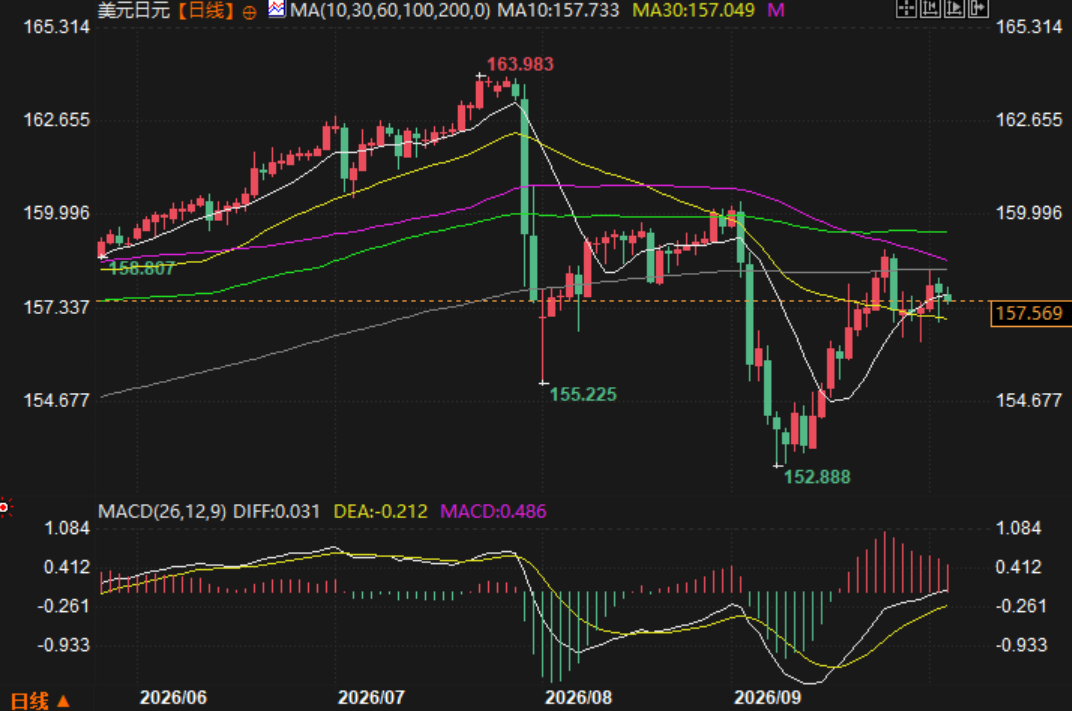 (USD/JPY daily chart, source: FX678) At 9:56 Beijing time, USD/JPY was trading at 157.57/58.
AI as a demand shock: pushing up prices and loosening financial conditions.
Uchida stated that AI investment has already exerted upward pressure on the economy and prices. From the demand side, the AI investment boom constitutes a significant positive demand shock; in the long term, AI may also have a positive impact on the supply side by improving productivity and accelerating capital accumulation. He added that the adoption of AI may have both positive and negative effects on productivity and the labor market. Regarding financial markets, Uchida emphasized two opposing forces: AI has driven up stock prices, thereby easing financial conditions; while the large amount of bond issuance by AI-related companies has pushed up long-term interest rates. His initial assessment is that the demand-side impact has manifested first, making financial conditions generally more relaxed. However, he warned that if profits fail to keep pace with the investment boom, a correction may occur.AI is impacting core parameters of monetary policy, becoming a key issue for central banks.
Uchida points out that AI has become a key topic at policy meetings of central banks around the world, including the Bank of Japan itself. He states that this technology has an impact on some core parameters of monetary policy formulation, including the output gap, financial conditions, and so-called "star variables"—unobservable benchmarks used by policymakers to determine whether policy is tight or loose, such as the neutral interest rate. The significance of this statement is that AI is no longer merely seen as an industry trend or a stock market narrative, but has been incorporated into the core considerations of the monetary policy framework. If AI does indeed push up the neutral interest rate, then current policy rates may not be as restrictive as they appear, providing a theoretical basis for continued tightening.AI bond issuance pushes up long-term yields: A non-monetary explanation for global bond market pressures.
One noteworthy observation by Uchida is that the large volume of bond issuances by AI-related companies is pushing up long-term interest rates. This provides a non-monetary explanation for yield pressures in global bond markets, including Japanese government bonds. The recent global bond sell-off has continued, with the yield on the 30-year US Treasury note rising to 5.48%, its highest level since 2004, and the 10-year yield reaching 5.20%. Uchida's comments suggest that, in addition to inflation expectations, fiscal deficits, and central bank policy paths, the financing needs of AI-related companies are also a structural factor driving up long-term yields.Policy implications: Inclined towards continued tightening, but wary of the risk of AI correction.
Uchida did not directly comment on the near-term interest rate path. However, his characterization of AI as a demand shock driving inflation, coupled with a framework for easing financial conditions, aligns with the stance of a central bank that believes there are still reasons to continue tightening. This statement marginally supported the yen and maintained expectations of further interest rate hikes by the Bank of Japan. At the same time, Uchida's warning that "a correction could occur if profits fail to keep pace with the investment boom" serves as a reminder that the Bank of Japan is monitoring stock valuations, and any AI-led sell-off could directly impact its assessment of financial conditions. In other words, AI is both a factor driving inflation and a potential source of market instability, and the central bank needs to strike a balance between the two.Uchida's speech has three implications for the USD/JPY exchange rate: marginally positive for the yen, but unable to offset the interest rate differential.
Uchida's remarks have three implications for the short- and medium-term trend of USD/JPY. First, he characterized AI as a demand shock that drives up inflation, while emphasizing that overall financial conditions are loose. This framework implies that the Bank of Japan still has reasons to continue tightening. This provides marginal support for the yen—market expectations for further interest rate hikes by the Bank of Japan are maintained, and the yen's interest rate disadvantage is expected to gradually narrow. Second, Uchida did not give a direct signal on the near-term interest rate path, meaning that whether or not there will be an interest rate hike at the October meeting still depends on inflation, wages, and financial market data. USD/JPY will not experience a trend reversal in the short term due to this speech. Third, and most importantly, the yield on 10-year US Treasury bonds is still above 5.2%, and the US-Japan interest rate differential remains significant. This is the core support for USD/JPY to remain at a high level (currently around 158). Uchida's comments on "AI bond issuance pushing up long-term yields" actually suggest that Japanese government bond yields may also face upward pressure. If Japanese long-term yields rise rapidly, it may prompt Japanese investors to reduce overseas asset allocation and return funds to the domestic market, which will put medium-term downward pressure on USD/JPY. However, the realization of this channel will take time and depends on the actual pace of the Bank of Japan's interest rate hikes. Overall, Uchida's remarks were bullish for the yen, but not enough to unilaterally reverse the interest rate differential dominance of the USD/JPY exchange rate. The exchange rate will likely continue to fluctuate between interest rate differentials and intervention risks in the short term.Summarize
Uchida's remarks conveyed three key signals: First, the Bank of Japan views AI as a large-scale positive demand shock, pushing up prices and easing financial conditions, thus justifying continued tightening. Second, the impact of AI has penetrated into core parameters of monetary policy, including the output gap, financial conditions, and the neutral interest rate, meaning AI is no longer an external variable but an endogenous factor within the policy framework. Third, the issuance of AI-related bonds has pushed up long-term yields, providing a non-monetary explanation for global bond market pressures, while also reminding the market that if the profits from the AI investment cycle fail to materialize, corrective risks could quickly emerge. For Uchida, AI is primarily a story of booming demand, and only secondarily a story of productivity—meaning more inflation in the short term, while a failure to generate profits implies corrective risks. The Bank of Japan will continue to closely monitor economic and financial data to construct a coherent assessment of the impact of AI. (USD/JPY daily chart, source: FX678) At 9:56 Beijing time, USD/JPY was trading at 157.57/58.
- Risk Warning and Disclaimer
- The market involves risk, and trading may not be suitable for all investors. This article is for reference only and does not constitute personal investment advice, nor does it take into account certain users’ specific investment objectives, financial situation, or other needs. Any investment decisions made based on this information are at your own risk.