Supply anxieties have eased, but geopolitical risks remain. Who will determine the next move in oil prices?
2026-10-05 10:22:18
On Monday (October 5th) during Asian trading hours, international oil prices fell, with Brent crude down about 1.3% to around $101.35 per barrel and WTI crude down about 1.2% to around $90 per barrel. Price pressure stemmed from two factors: a rebound in Middle Eastern oil exports and the G7's agreement to release 100 million barrels of diesel and crude oil from emergency reserves. These supply-side easing factors temporarily overshadowed the Houthi announcement of a new round of attacks on Saudi Aramco facilities. The current game can be summarized as oil prices being caught between "more crude oil" and "more missiles," with crude oil gaining the upper hand in the first few hours of the week. However, with Gulf infrastructure still under attack, this balance could shift rapidly. 
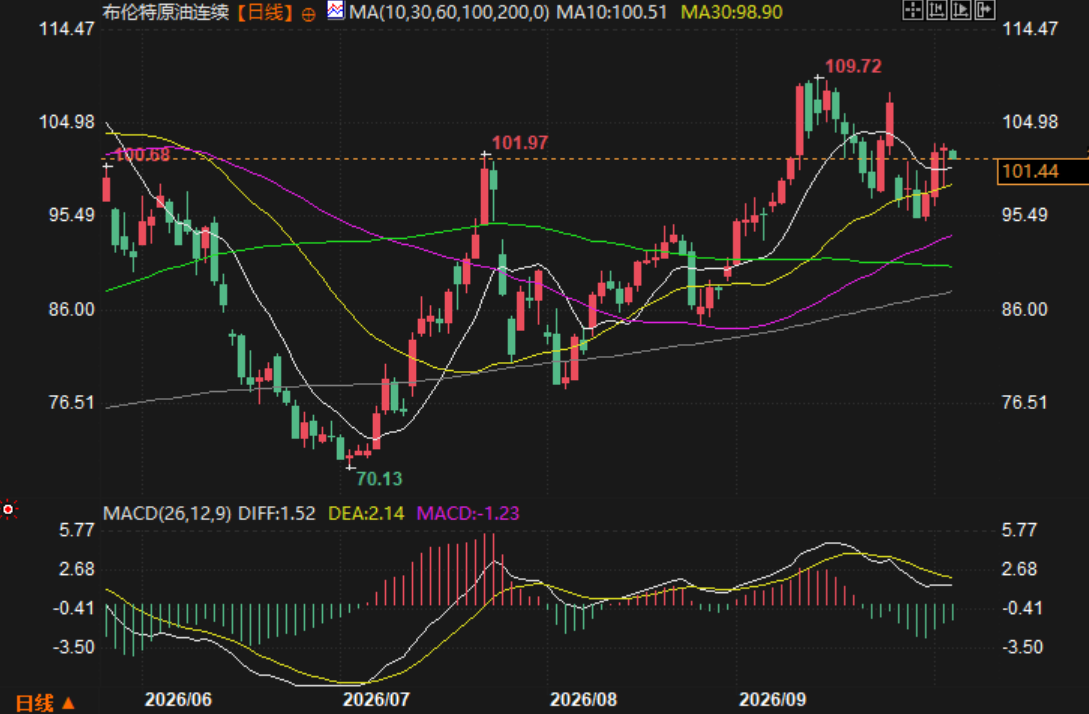 (Brent crude oil futures daily chart, source: FX678) At 10:16 Beijing time, Brent crude oil futures were trading at $101.43 per barrel.
G7 releases 100 million barrels from reserves, easing supply concerns in the short term.
The G7 agreed on Friday to release 100 million barrels of diesel and crude oil from its emergency reserves and pledged to avoid restrictions on energy exports, following pressure from Trump. This decision continued last week's oil price correction—Brent crude gave back most of its weekly gains, and WTI closed down about 1.5%. One analyst stated that the reserve release is easing immediate supply anxieties, and Saudi exports appear to be returning to pre-war levels, despite higher costs and less efficient routes. This combination is currently sufficient to suppress prices, but the risk of further damage to Gulf infrastructure remains. The market will closely monitor the progress of the release and actual arrivals to determine whether the short-term supply easing can continue to translate into price pressure.Gulf exports rebound: Four days in the last four days of September exceeded pre-war levels.
Improved physical flows are a key factor suppressing oil prices. Shipping data shows that despite ongoing attacks on tankers in the Strait of Hormuz, Middle Eastern crude oil exports exceeded pre-war levels for four out of seven days in the last week of September. This data indicates that despite persistent geopolitical risks, actual supply flows are recovering, thus reducing market pricing of supply disruptions. The rebound in exports reflects the ability of oil-producing countries like Saudi Arabia to maintain shipments through alternative routes and higher costs, which helps balance market expectations and reduce the premium for extreme shortages in the short term.Houthi attacks and the Yemeni offensive: Geopolitical risks have not dissipated.
However, geopolitical risks are far from over. The Houthi rebels in Yemen have stated that they have launched ballistic missiles and drones at Saudi Aramco facilities in Riyadh and Khurais in retaliation for approximately 50 attacks launched by the Saudi-led coalition in Yemen. Saudi Arabia has not yet confirmed these attacks. Meanwhile, Yemen's internationally recognized government has announced a major military operation aimed at retaking all territory controlled by the Iranian-backed group. These events serve as a reminder to markets that Gulf energy infrastructure remains vulnerable to attack. Any confirmed damage to facilities, an escalation of the situation in Yemen, or a new disruption in the Strait of Hormuz could quickly rebuild risk premiums.Saudi Aramco cuts prices in Asia to a six-year low: a signal of its quest for market share.
Saudi Aramco unexpectedly lowered its November crude oil prices for Asian buyers to a six-year low. This move may reflect Saudi Arabia's push to regain market share as exports recover. For the physical market, this is a bearish signal – it indicates that Saudi Arabia is prioritizing volume over price, which could put pressure on competing Middle Eastern crude grades and narrow the Brent premium. While the price cut strategy may help solidify relationships with Asian customers, it could also intensify regional competition in crude oil, further suppressing near-month price performance.Other supply-side variables: OPEC+ capacity assessment delayed, Ukraine plans to escalate refinery attacks.
OPEC+ has postponed the capacity assessment needed to determine 2027 production quotas due to uncertainty surrounding production estimates caused by the conflict in Iran. This postponement means that OPEC+ is unlikely to adjust its production policy before 2027, and supply-side policy uncertainty will persist. In Ukraine, President Zelensky stated that Kyiv will intensify attacks on Russian refineries. This poses additional upside risks to refined products, especially diesel. Global diesel inventories were already tight, and Russia's previous export ban was extended to October; Ukraine's increased attacks on refineries could further tighten refined product supplies.Summarize
The core contradiction in the current crude oil market is the tug-of-war between "supply recovery" and "geopolitical risks." The G7's release of 100 million barrels from reserves and the recovery of Gulf exports to pre-war levels have temporarily alleviated supply anxieties, overshadowing the Houthi attacks on Saudi Aramco facilities. Saudi Aramco's price cut in Asia to a six-year low further signals its competition for market share, putting downward pressure on the physical market. However, the downside seems limited—as long as Brent crude remains around $100, any confirmed damage to Saudi facilities, escalation of the situation in Yemen, or a new disruption in the Strait of Hormuz could quickly rebuild the risk premium. Furthermore, Ukraine's planned increased attacks on Russian refineries bring independent upside risks to refined products such as diesel. In the short term, oil prices will find direction between supply recovery and geopolitical risks, with the $100/barrel level remaining a key support area for Brent crude. (Brent crude oil futures daily chart, source: FX678) At 10:16 Beijing time, Brent crude oil futures were trading at $101.43 per barrel.- Risk Warning and Disclaimer
- The market involves risk, and trading may not be suitable for all investors. This article is for reference only and does not constitute personal investment advice, nor does it take into account certain users’ specific investment objectives, financial situation, or other needs. Any investment decisions made based on this information are at your own risk.