Why is the USD/JPY exchange rate remaining unmoved despite Tokyo's escalating verbal intervention?
2026-10-05 11:52:18
On Monday (October 5th) during the Asian session, the USD/JPY pair fluctuated slightly higher, currently trading around 158. It's worth noting that Japanese officials have recently adopted a significant shift in rhetoric, but the exchange rate has reacted mutedly. Japanese officials have recently changed their rhetoric, moving from discussing deflation to supporting the yen and signaling further tightening by the Bank of Japan. Economy Minister Minoru Shirou stated that Japan is no longer in deflation and does not need excessively loose monetary policy; Finance Minister Satsuki Katayama called for a review of approximately 200 government funds totaling about 7 trillion yen, reiterated that the government is not a proponent of reflation, and stated that Japan and the United States are prepared to take decisive action against excessive exchange rate volatility. 
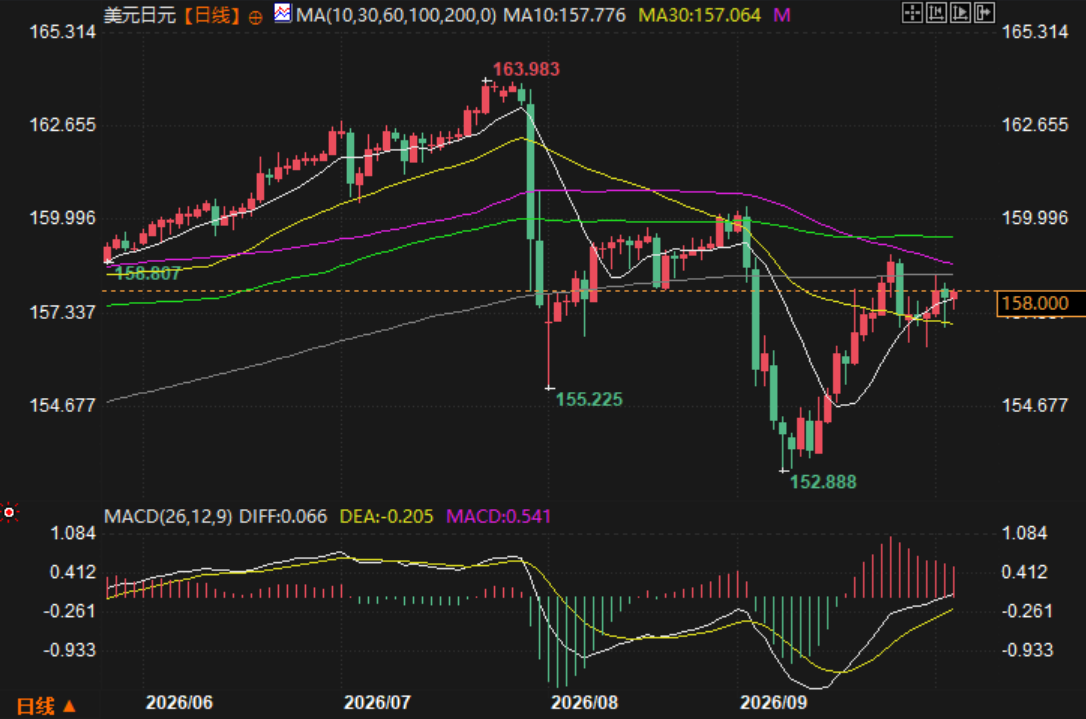 (USD/JPY daily chart, source: EasyForex) At 11:40 Beijing time, USD/JPY was trading at 158.00/01.
Japanese officials shift rhetoric: from deflationary narrative to support for the yen.
A noteworthy shift has occurred in the rhetoric of Japanese officials. Economy Minister Minoru Jonouchi stated last Friday that Japan is no longer in deflation and therefore does not need excessively loose monetary policy. This represents a significant qualitative adjustment to the assessment of the Japanese economy—the Bank of Japan's policy framework has long been based on "combating deflation," and official recognition of the end of deflation provides a stronger theoretical basis for policy normalization. Finance Minister Satsuki Katayama called for a review and streamlining of approximately 200 government-controlled funds, totaling about 7 trillion yen. This move may aim to encourage more domestic investment in the United States. She also reiterated that the government is not a proponent of reflation and stated that Japan and the United States are prepared to take decisive action against excessive exchange rate volatility—a statement widely interpreted as a response to the yen's weakness.The dollar/yen exchange rate reacted mutedly: US Treasury yields and safe-haven demand overshadowed the rhetoric.
Despite a clear shift in Japanese officials' rhetoric towards a supportive stance for the yen, the USD/JPY exchange rate reacted rather mutedly, remaining stable around 157-158. Even Friday's weak US jobs report—which lowered market expectations for a Fed rate hike in October—failed to have a lasting impact. The exchange rate remained firm, supported by persistently high US Treasury yields and safe-haven demand for the dollar amid geopolitical tensions and high oil prices. This suggests that the current pricing power for USD/JPY is not primarily driven by Japanese officials' rhetoric, but rather by the USD/JPY interest rate differential and the dollar's safe-haven appeal. Verbal intervention will have limited effect until the Bank of Japan takes concrete action to raise interest rates and US yields decline.A shift in policy outlook is favorable for the yen: Expectations for a Bank of Japan interest rate hike are rising.
However, the policy outlook is shifting in favor of the yen. The Federal Reserve still expects to raise rates again in December, but the Bank of Japan may also raise rates that month. While some believe the Fed has room to raise rates next year, the market seems more confident that the Bank of Japan will raise rates further in March, narrowing the policy gap between the two central banks. This shift in expectations is key to understanding the medium-term trend of USD/JPY. If the Bank of Japan raises rates in December or March next year, while the Fed's rate hike cycle is nearing its end, the USD/JPY interest rate differential will begin to narrow, putting substantial downward pressure on USD/JPY. Analysts from prominent institutions believe that USD/JPY may have peaked below 160, with the risk balance tilting towards a stronger yen.Key risk: The safe-haven appeal of the US dollar may outweigh everything else.
However, the main risk to this view lies in the safe-haven appeal of the US dollar. Further escalation of the situation in the Middle East, or a further rise in oil prices, could support the USD/JPY exchange rate, regardless of changes in Tokyo's rhetoric. In the current environment, oil prices above $100, stalled US-Iran negotiations, and the continued closure of the Strait of Hormuz all contribute to increased demand for the dollar as a safe haven, forming the main obstacle to a decline in USD/JPY. Furthermore, for stock market investors, a stronger yen will put pressure on Japanese exporters, which offsets the current rally led by AI. A significant appreciation of the yen could suppress profit expectations for Japanese exporters, thereby impacting the performance of Japanese stocks.Summarize
The shift in Japanese officials' rhetoric—from a deflationary narrative to support for the yen and signals of tightening by the Bank of Japan—has added policy support to the yen's medium-term outlook. However, in the short term, high US Treasury yields, oil prices above $100, and safe-haven demand for the dollar driven by Middle East geopolitical risks have outweighed the effectiveness of Tokyo's verbal intervention, keeping the USD/JPY exchange rate stable around 158. The policy outlook is shifting in favor of the yen, with market confidence increasing in a December or March rate hike by the Bank of Japan, potentially narrowing the USD/JPY interest rate differential. The main risks to the dollar's safe-haven status remain—escalating tensions in the Middle East or further increases in oil prices could keep the USD/JPY strong. The true turning point for the exchange rate depends on whether US yields can fall and whether the Bank of Japan can deliver on its policy shift commitment with concrete actions. (USD/JPY daily chart, source: EasyForex) At 11:40 Beijing time, USD/JPY was trading at 158.00/01.- Risk Warning and Disclaimer
- The market involves risk, and trading may not be suitable for all investors. This article is for reference only and does not constitute personal investment advice, nor does it take into account certain users’ specific investment objectives, financial situation, or other needs. Any investment decisions made based on this information are at your own risk.