The euro hit a 17-month low, and French government bonds are rewriting the exchange rate formula.
2026-10-05 15:04:18
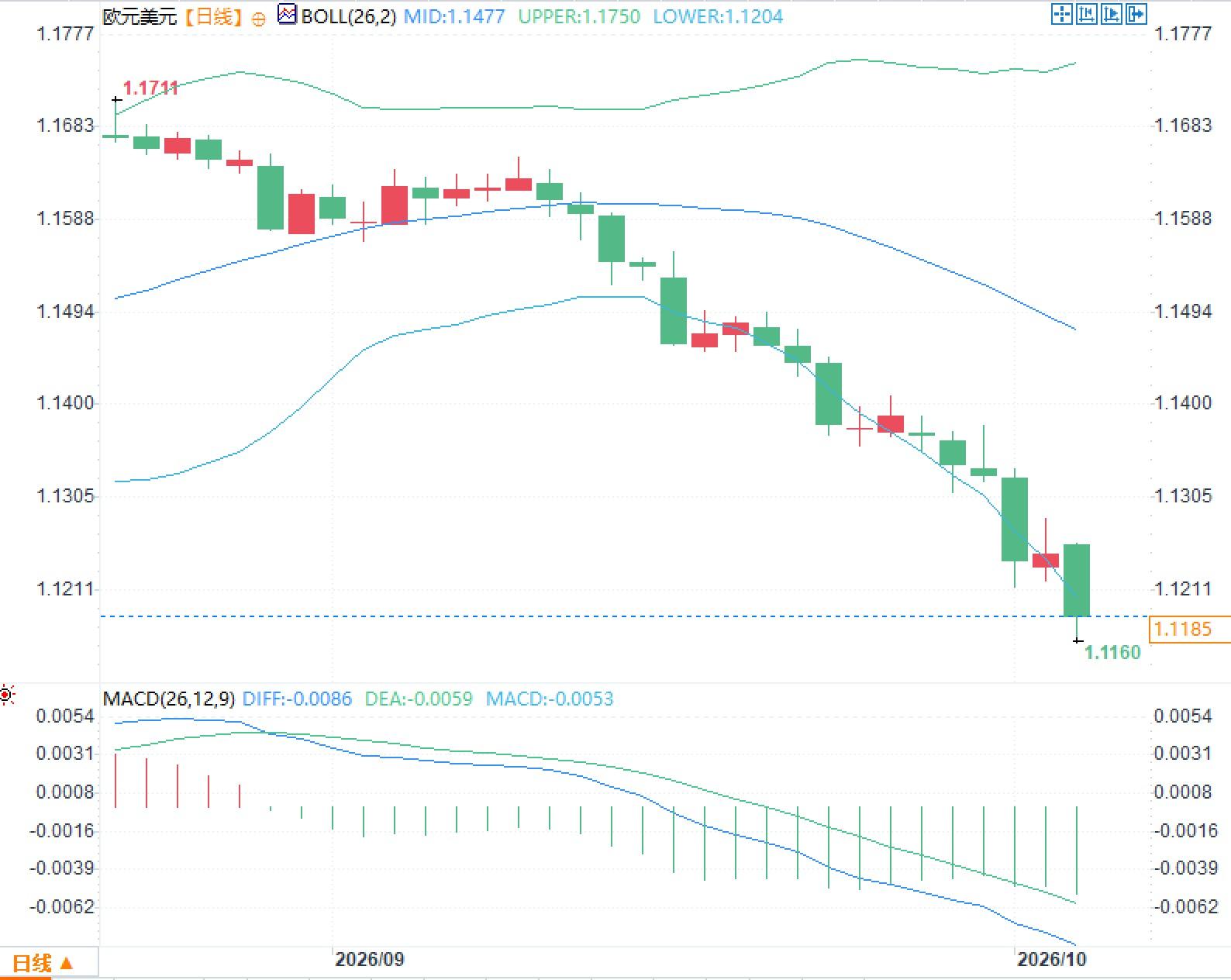
On Monday, October 5th, the euro fell to 1.1160 against the dollar, its lowest level since May 2025, retreating about 0.7% intraday and marking its fourth consecutive week of decline. Since the start of the week last Monday, it has fallen by more than 1.6%, and year-to-date by nearly 5%. During the same trading window, the yield on French 10-year government bonds rose to around 4.9%, having touched 4.99% intraday on October 2nd, widening the spread with German bonds of the same maturity to approximately 140 basis points. Brent crude oil prices remained around $101 per barrel. The convergence of exchange rate, French bond yields, and energy prices within the same trading week forms the core context for the current euro pricing. 
How the sell-off of French government bonds was transmitted to the euro.
The French 10-year yield rose from approximately 3.7% at the end of June to nearly 4.9%, an increase of about 1.2 percentage points. The rise in yields corresponds to a fall in prices, reflecting a simultaneous expansion of term and credit premiums, rather than a simple shift in global interest rates. The German 10-year yield is around 3.46%, with the Franco-German spread at approximately 140 basis points. On October 2nd, the spread widened to 159 basis points intraday before narrowing, but remains in a relatively high range since November 2011. The widening spread indicates a redistribution of sovereign risk within the Eurozone, with French government bonds becoming the focus of this round of selling. As the Eurozone currency, it cannot completely isolate the fiscal risks of individual member states from exchange rates. When the financing costs of core countries rise rapidly, the risk premium of the Eurozone currency usually adjusts upwards in tandem, with the exchange rate becoming another quote for the same risk. Eric Robertson, Global Head of Research at Standard Chartered, pointed out that the French bond market has experienced a substantial deterioration, with the country lacking both the will and the ability to address fiscal issues. The simultaneous decline in the euro against the Swiss franc and the euro against the British pound indicates that the pressure comes from the euro side, rather than from price noise in a single currency pair.Overlapping fiscal pathways and political agendas
The European Commission's spring forecast projects France's deficit to remain at 5.1% of GDP in 2026, with public debt rising from 115.6% in 2025 to 118.1% in 2026 and approximately 120.2% in 2027. The French government's draft budget for 2027, released on October 1st, sets a deficit target of 5.0% for that year, while acknowledging that the deficit may rise to 5.4% in 2026, with debt targets at 119.3% in 2026 and 121.7% in 2027. Finance Minister Laurent Lescuhl stated that 2027 will see a return to fiscal consolidation, with the draft including approximately €43 billion in new measures and a total adjustment of approximately €54 billion. Interest payments are projected to reach €79.2 billion in 2026 and €91.2 billion in 2027, with rising interest rates directly increasing the refinancing costs of existing debt. Jeffrey Yu, senior strategist at BNY Mellon, cautioned against excessive speculation on the euro, noting that comparisons to 2012 are clearly inaccurate. At that time, there was redemption pressure and a tightening of both the banking system and financing channels. Currently, it is closer to a fiscal premium repricing than a payment system crisis. These two sets of facts need to be viewed side by side, not substituted for each other.Rising energy prices and the policy constraints of the European Central Bank
Brent crude fluctuated around $101 per barrel, with energy prices remaining significantly above their year-to-date lows. The ongoing conflict in the Middle East continues to disrupt oil and gas supply expectations. Eurozone inflation rose to 3.3% in August from 2.9% in July, with the energy component reaching 14.3%. Preliminary September data showed Germany at 3.3%, France at 3.4%, Italy at 4.1%, and Spain at 5.0%, all higher than previously estimated. On September 10, the European Central Bank (ECB) raised its three key interest rates by 25 basis points: the deposit facility rate to 2.50%, the main refinancing rate to 2.65%, and the marginal lending rate to 2.90%. The ECB's baseline forecast for 2026 is 3.0% overall inflation and 0.9% growth, noting that inflation risks are skewed to the upside and growth risks to the downside. Robertson added that the timing of energy price inflation coinciding with a period of weak growth puts additional pressure on the monetary system. For the ECB, constraints come from both sides: energy-driven inflation requires policy rates to remain restrained, while rising financing costs in France increase the spillover effects of tight policy on fiscal policy. This isn't a choice of direction at the operational level, but rather a situation where the three variables in the reaction function—growth, inflation, and sovereign debt differential—simultaneously deviate from neutrality. France's own growth forecast is only 0.8%, while the deficit remains above 5%, meaning that growth cannot automatically absorb interest payments through nominal expansion.Market Indicator Observation
On the daily chart, the EUR/USD pair is below the Bollinger Band middle line at 1.1477, with the lower band at 1.1204 and the upper band at 1.1750. The price is currently trading near the lower band. The MACD DIFF is -0.0086, DEA is -0.0059, and the histogram is -0.0053, with both the fast and slow lines and the histogram below the zero line. Historically, the extreme value of the Franco-German 10-year interest rate differential between 2011 and 2012 was approximately 190 basis points, while the current differential is around 140 basis points, still some distance from that extreme value.
- Risk Warning and Disclaimer
- The market involves risk, and trading may not be suitable for all investors. This article is for reference only and does not constitute personal investment advice, nor does it take into account certain users’ specific investment objectives, financial situation, or other needs. Any investment decisions made based on this information are at your own risk.