Despite increased flow at the Hormuz National Park and price cuts by Saudi Arabia, Brent crude oil prices held above $100.
2026-10-05 15:18:19
Brent crude futures edged lower during the European session on Monday (October 5), currently trading around $101.50 per barrel. Despite the slight decline in oil prices, the market continues to weigh supply recovery against geopolitical risks, and ING's latest analysis provides a window into this situation. ING analyst Warren Patterson points out that ICE Brent crude has repeatedly fallen below $100 per barrel but has consistently closed above that level, as the market weighs conflicting supply and geopolitical factors. The recovery in oil flow through the Strait of Hormuz, the release of reserves by the G7, and the restoration of Saudi pipeline capacity are offsetting the ongoing Middle East tensions and OPEC+ maintaining its production levels. 
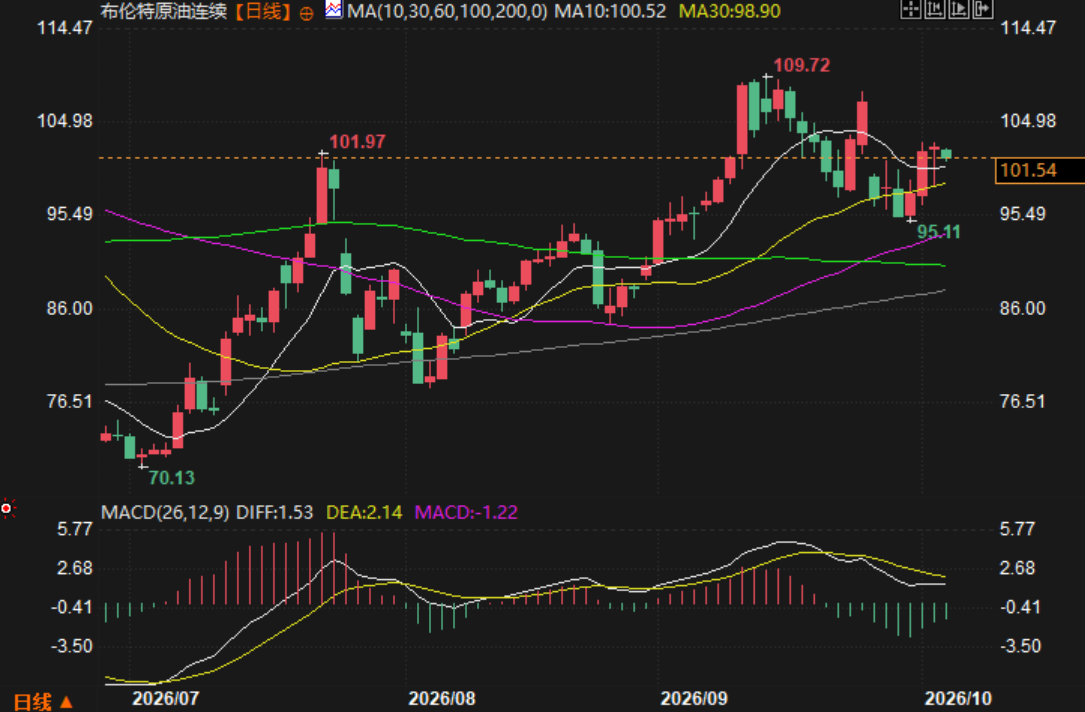 (Brent crude oil futures daily chart, source: EasyTrade) At 15:11 Beijing time, Brent crude oil futures were trading at $101.72 per barrel.
Brent crude oil held above the $100 mark, with mixed bullish and bearish signals.
ING points out that ICE Brent crude oil has repeatedly fallen below $100/barrel, but these dips have been relatively short-lived, with the market continuing to close above this key level as it digests a series of divergent developments. On the bearish side, oil flows through the Strait of Hormuz appear to be trending upwards. Reports indicate that flows have recovered to over 80% of capacity, which will allow crude oil exports from Yanbu port to resume accordingly.Saudi Arabia lowers prices and pipelines resume operations, putting pressure on the supply side.
Further reinforcing expectations of easing conditions in the crude oil market, Saudi Arabia lowered its official selling price for Arab Light crude oil for November shipment to Asia by $3 per barrel, widening its discount to the benchmark to $5 per barrel. Due to the disruption of the east-west pipeline, Saudi Arabia has been transporting larger quantities of crude oil through the Strait of Hormuz in recent weeks. Recently, oil flows through this pipeline have been recovering. This series of improvements on the supply side is putting downward pressure on oil prices.Speculative positions fell to their lowest level since early August, indicating a decline in risk appetite.
Positioning data reveals a shift in market sentiment. The latest data shows that speculators reduced their net long positions in ICE Brent crude by 13,812 contracts to 204,302 contracts in the last reporting week, the smallest position since early August. Signs of increased oil flows from the Persian Gulf may be making speculators less willing to take on excessive risk. This change in positioning is consistent with Brent crude's repeated dips below $100, indicating that market pricing in supply recovery is dampening bullish enthusiasm.OPEC+ maintains production levels, but most of the planned increases are on paper.
OPEC+ kept its November production levels unchanged over the weekend, in line with expectations. ING pointed out that throughout the US-Iran conflict, the organization announced a cumulative increase of 1.65 million barrels per day. However, these are mostly on paper, as ongoing supply disruptions prevented a corresponding increase in actual production. This distinction is crucial—a significant gap exists between OPEC+'s production targets and actual output, meaning that despite policy-driven increases, actual supply has not increased accordingly, providing some floor support for oil prices.Summarize
Brent crude oil is currently in a mixed picture, with both bullish and bearish signals. Bearish factors include: the Strait of Hormuz's flow recovering to over 80% of capacity; Saudi Arabia lowering its Asian selling prices and widening its discount; the recovery of flow in east-west pipelines; and speculative positions falling to their lowest level since early August. Bullish factors include: ongoing tensions in the Middle East; OPEC+ production increases largely on paper, with actual supply not increasing accordingly. Brent crude has repeatedly fallen below $100 but consistently closed above it, indicating that the market is seeking a balance between supply recovery and geopolitical risks. Speculators reducing their net long positions reflects cautious pricing in supply recovery. In the short term, $100/barrel remains a key watershed for Brent crude—if the supply recovery trend continues, oil prices may face further downward pressure; if the situation in the Middle East deteriorates again or actual supply disruptions worsen, the risk premium could be quickly rebuilt. The gap between OPEC+ production targets and actual production is one of the most noteworthy supply-side variables in the current oil market. (Brent crude oil futures daily chart, source: EasyTrade) At 15:11 Beijing time, Brent crude oil futures were trading at $101.72 per barrel.
- Risk Warning and Disclaimer
- The market involves risk, and trading may not be suitable for all investors. This article is for reference only and does not constitute personal investment advice, nor does it take into account certain users’ specific investment objectives, financial situation, or other needs. Any investment decisions made based on this information are at your own risk.