Silver stabilizes at two-month lows: Expectations of a Fed pause are rising, but why are long-term interest rates still not cooperating?
2026-10-05 16:00:18
On Monday, October 5th, spot silver rebounded after hitting a two-month low last Friday. It is currently fluctuating around $61; last Friday's low was approximately $59.70. The core issue behind this market movement has shifted from single employment data to the yield curve: a significant cooling of US employment data in September has lowered near-term interest rate hike expectations, but long-term yields remain high, the US dollar remains strong, and energy prices are also at a high level. Silver is therefore in a combined environment of "easing policy expectations but still tight actual financial conditions." 
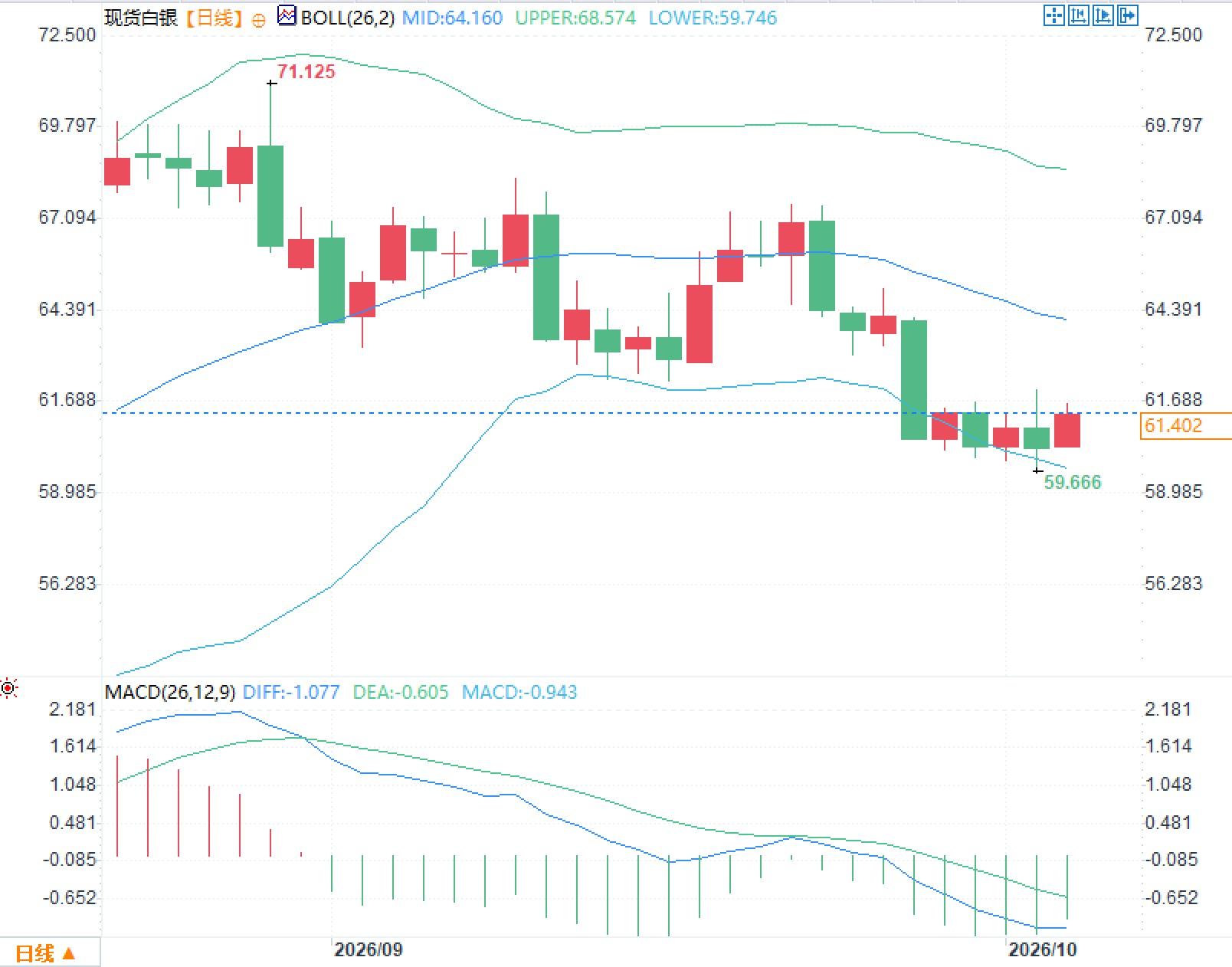 The MACD parameters DIFF is -1.077, DEA is -0.605, and the histogram is -0.943, all three being in the weak zone. This means that the downward momentum has not yet been fully digested, but after the price rebounded from near the lower band, the synchronous relationship between volatility and momentum is changing.
The slowdown in US employment has altered the pace of interest rate hikes, not financial conditions.
September nonfarm payrolls increased by only 29,000, the unemployment rate rose to 4.2%, and the labor force participation rate was 61.8%. Average hourly earnings increased by only 0.1% month-on-month and 3.0% year-on-year. The combined job gains for July and August were revised down by 60,000. The core signal from the employment data is not an economic slowdown, but a significant weakening of hiring intensity, with the labor market further shifting towards "low hiring, low layoffs." This directly reduces the necessity for a further rate hike in October, but is insufficient to reverse inflation pricing alone. The Federal Reserve just raised the federal funds target range by 25 basis points to 3.75%-4.00% in September, and will hold another policy meeting on October 27-28. The latest interest rate futures pricing shows that the probability of a rate hike in October has dropped to about 18%, but the pricing for another rate hike in December is still about 81%. Therefore, silver is experiencing a temporary easing of policy pressure, rather than a comprehensive easing of the entire yield curve.Long-term yields remain the core constraint on silver pricing.
Following the release of the jobs report, the US 2-year yield initially declined but subsequently rebounded; the 10-year yield closed at approximately 5.26% on Friday, and the 2-year yield at approximately 4.82%. This indicates that the bond market did not directly interpret weak employment as a sign of continued easing, with pricing still focused on inflation, fiscal supply, and term premiums. For silver, what truly matters are real interest rates and long-term nominal yields, as the opportunity cost of holding non-interest-bearing assets is primarily determined by these two factors. The continued high levels of crude oil prices further reinforce this divergence. Brent crude is currently around $101 per barrel. High energy costs affect inflation expectations through the transportation, chemical, and manufacturing chains, reducing the sensitivity of long-term interest rates to a single weak data point. Therefore, while a cooling employment situation can improve the short-term interest rate environment for silver, it is unlikely to completely offset the downward pressure on valuations from high yields.The daily chart structure reflects that the volatility center is still at a low level.
From the daily chart, spot silver rebounded from near a two-month low but remains below the Bollinger Middle Band. The Bollinger Middle Band has turned downward from its previous high, and the distance between the price and the lower band has widened. This structure indicates that the recent trading range remains low, but the short-term price has moved out of its weakest zone, and the trend and rebound are not moving in sync. The MACD parameters DIFF is -1.077, DEA is -0.605, and the histogram is -0.943, all three being in the weak zone. This means that the downward momentum has not yet been fully digested, but after the price rebounded from near the lower band, the synchronous relationship between volatility and momentum is changing.Why is silver more difficult to trade than gold? Just look at interest rates.
Silver possesses attributes of both precious and industrial metals. Lower interest rates typically reduce its opportunity cost, but the industrial sector is also affected by manufacturing activity, energy prices, and corporate capital expenditures. Current weak employment reduces pressure for near-term interest rate hikes, while high oil prices may increase production costs and compress profit margins in some industrial sectors, causing macroeconomic variables for silver to offset each other. Currently, the correlation between long-term yields, the US dollar, oil prices, and industrial data is more informative than simply tracking a single employment report.Frequently Asked Questions
Question 1: The US September non-farm payrolls were significantly weak, why is the silver price still limited? Answer: The employment data lowered the probability of an October rate hike, but the 10-year yield is still above 5.2%, indicating that long-term interest rates have not fallen sharply in tandem. For silver, the opportunity cost remains high, and improved near-term policy expectations can only partially offset the pressure on financial conditions. Question 2: What are the most noteworthy daily indicators right now? Answer: The price is still below the Bollinger Band middle line, and both the MACD's DIFF and DEA are below the zero line, indicating that the weak momentum has not yet been fully restored; at the same time, the price has moved away from near the lower band, and short-term volatility has somewhat subsided. Question 3: Why can't we only look at the Fed going forward? Answer: Silver is affected by interest rates, the US dollar, oil prices, and industrial demand simultaneously. Even if the Fed pauses its actions, as long as energy costs and long-term yields remain high, the valuation environment for precious metals may still diverge from short-term policy expectations. Therefore, it is necessary to observe inflation and the bond market in conjunction.- Risk Warning and Disclaimer
- The market involves risk, and trading may not be suitable for all investors. This article is for reference only and does not constitute personal investment advice, nor does it take into account certain users’ specific investment objectives, financial situation, or other needs. Any investment decisions made based on this information are at your own risk.