Why were long positions in USD/CAD still being increased on the eve of the FOMC minutes?
2026-10-06 10:12:17
On Tuesday (October 6) during the Asian session, the USD/CAD pair traded around 1.4260, extending its nearly month-long upward trend. The pair retreated slightly after hitting 1.4292 on Monday, but regained buying support on Tuesday, remaining near its highest level since April 2025. The Canadian dollar's downward pressure stems from three main factors: oil prices hovering near one-month lows, the Bank of Canada's dovish policy stance, and US-Canada trade tensions. Meanwhile, persistent Middle East geopolitical risk premiums and US Treasury yields remaining near multi-year highs have provided support for the US dollar. The market is currently pricing in a greater than 80% probability of a Fed rate hike before the end of the year, with traders awaiting Wednesday's FOMC meeting minutes for further policy path clues. The fundamental backdrop suggests that the path of least resistance for USD/CAD remains upward. 
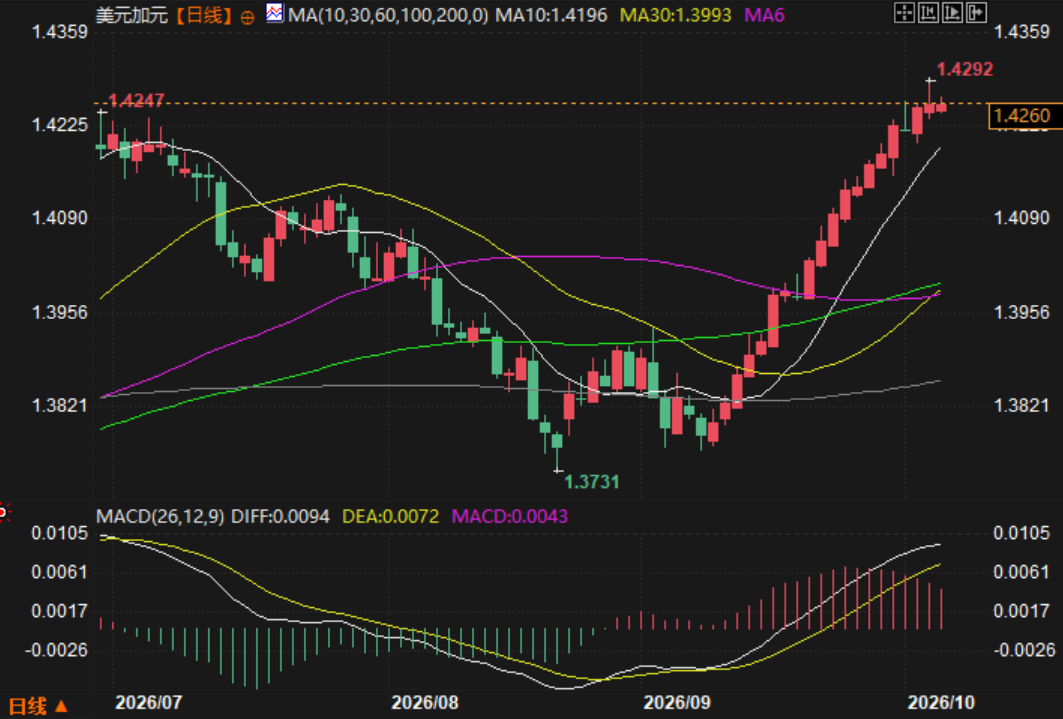 (USD/CAD daily chart, source: FX678) At 10:08 Beijing time, USD/CAD was trading at 1.4259/60.
Oil prices are weak: Middle East exports are recovering and G7 reserves releases ease supply concerns.
Crude oil prices hovering near one-month lows are a key factor weighing on the Canadian dollar. Resilient Middle Eastern oil exports, coupled with the G7's release of emergency reserves, have eased market concerns about supply disruptions. The G7 countries agreed last Friday to release 100 million barrels of diesel and crude oil from their emergency reserves and pledged not to restrict energy exports. Tracking data shows that Middle Eastern oil exports exceeded pre-war levels for most of the last week of September. For the Canadian dollar, weak oil prices directly weaken Canada's terms of trade. As a major energy exporter, the Canadian economy is highly correlated with oil prices, and falling oil prices typically put pressure on the Canadian dollar. Current oil prices near one-month lows are causing the Canadian dollar to underperform among commodity currencies.The Bank of Canada's dovish stance and US-Canada trade tensions are creating a double whammy.
The Bank of Canada's policy stance is another key factor weighing on the Canadian dollar. The Bank of Canada's overall dovish stance contrasts with the Federal Reserve's continued tightening stance, weakening the Canadian dollar's interest rate advantage. Furthermore, escalating trade tensions between the US and Canada have further exacerbated downward pressure on the Canadian dollar. These combined factors have made the Canadian dollar relatively weak among G10 currencies.The US dollar strengthened, supported by geopolitical risks and high US Treasury yields.
Regarding the US dollar, the persistent geopolitical risk premium has provided support for the safe-haven dollar. On Monday, the Houthi rebels in Yemen claimed responsibility for three military operations using ballistic missiles, cruise missiles, and drones against Saudi Arabian airports, oil facilities, and military bases. Furthermore, media reports indicate that Israel is preparing a potential attack on Iran, possibly coordinated with the US or conducted independently. These geopolitical risk events continue to provide safe-haven buying for the dollar. On the US economic data front, data released last week pointed to easing inflationary pressures, coupled with an unexpectedly weak September non-farm payroll report, weakening market expectations for a Fed rate hike in October. However, traders are still pricing in a greater than 80% probability of a Fed rate hike before the end of the year. The deepening fiscal shock in France has led to a continued sell-off in the fixed-income market, keeping US Treasury yields near multi-year highs. This yield advantage provides sustained interest rate differential support for the dollar.The market awaits the FOMC minutes, but fundamentals favor a stronger dollar.
The US dollar is currently trading below its highest level since April 2025 as traders await further clues about the Federal Reserve's policy path. Therefore, market focus will be on the FOMC meeting minutes released on Wednesday. In addition, speeches by influential FOMC members and ongoing geopolitical news will play a key role in driving the dollar. Although the dollar has retreated slightly after hitting its highest level since April 2025 on Monday, the fundamental backdrop suggests that the path of least resistance for the USD/CAD pair remains upward. Weak oil prices, a dovish stance from the Bank of Canada, US-Canada trade tensions, geopolitical risk premiums, and high US Treasury yields—these five factors collectively weigh on the Canadian dollar and support the US dollar.Summarize
Oil prices hovering near one-month lows, the Bank of Canada's dovish stance, and US-Canada trade tensions are key factors weighing on the Canadian dollar. Meanwhile, persistent Middle East geopolitical risk premiums, including Houthi attacks on Saudi targets and potential Israeli attacks on Iran, are providing safe-haven buying for the US dollar. US Treasury yields remain near multi-year highs, further supporting the dollar. The market awaits Wednesday's FOMC meeting minutes, but the fundamental backdrop suggests the path of least resistance for the USD/CAD pair remains upward. The 1.4300 level is a key short-term resistance; a break above this level could lead to further testing of the April 2025 highs. Support lies around 1.4200. Oil price movements, the FOMC minutes, and geopolitical news will be the core variables determining the short-term direction. (USD/CAD daily chart, source: FX678) At 10:08 Beijing time, USD/CAD was trading at 1.4259/60.- Risk Warning and Disclaimer
- The market involves risk, and trading may not be suitable for all investors. This article is for reference only and does not constitute personal investment advice, nor does it take into account certain users’ specific investment objectives, financial situation, or other needs. Any investment decisions made based on this information are at your own risk.