Dollar surge: French crisis spillover impacts the Eurosystem
2026-10-06 10:14:18
French borrowing costs have historically surpassed those of Italy and Greece, while the yield on 30-year UK government bonds has hit a 28-year high. The European Central Bank's crisis tools, limited by legal constraints, cannot intervene in the French bond market, exposing structural flaws in the Eurozone's crisis response mechanism. In early October 2026, the yield on 10-year French government bonds approached 5%, and the spread between Franco-German 10-year bonds reached its highest level since the 2011-2012 Eurozone debt crisis. French public debt has reached 119% of GDP, with the debt scale continuing to rise, and the fiscal deficit consistently exceeding the EU's 3% threshold. Economic growth is only 0.5%, financing costs far exceed economic growth, and debt interest payments have already exceeded defense and education budgets, with the debt burden continuing to accumulate through compound interest. Unlike the crises in peripheral countries like Greece and Italy in 2012, this crisis is occurring in the Eurozone's second-largest economy. French politics is mired in a presidential election deadlock, with leading candidates in the 2027 presidential election refusing to accept the fiscal austerity conditions attached to the ECB's bailout. Le Pen advocates for expansionary fiscal policy, while Mélenchon proposes that the ECB directly cancel government bonds, a plan that directly violates the EU treaty prohibiting central bank monetary financing. Without a political force willing to push for fiscal reform, the preconditions for the ECB's bailout tools cannot be met, and there is no unconditional bailout. More than half of French government bonds are held by overseas investors; if foreign capital were to withdraw en masse, bond market volatility would be further amplified. 
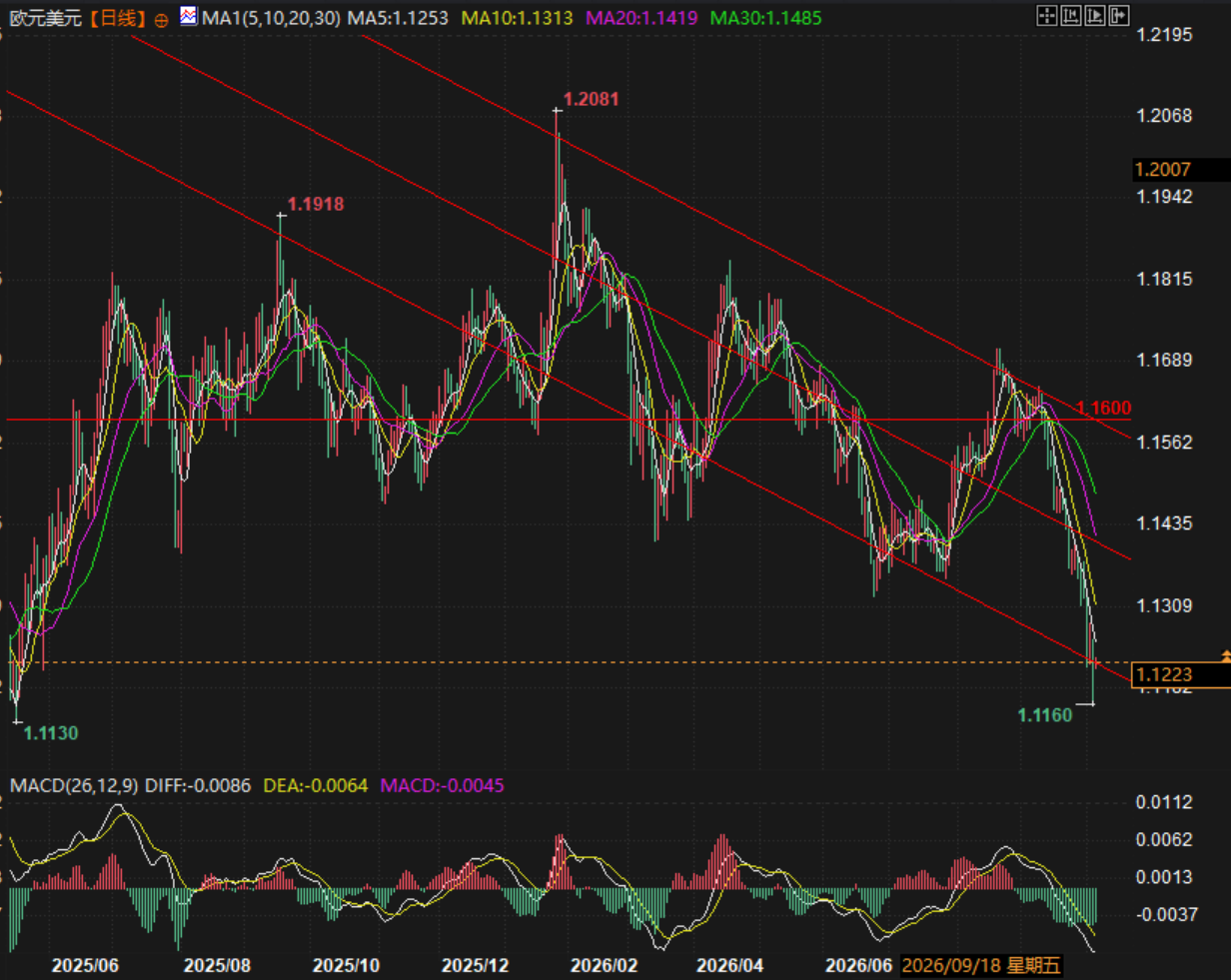 (Euro/USD daily chart, source: FX678) At 10:11 Beijing time, the euro/dollar exchange rate is currently 1.1216/17.
Public debt and budget measures, high school protests expand
France's public debt is projected to reach 121.7% of GDP by 2027. The government has proposed a €54 billion fiscal adjustment plan, including €43 billion in new measures, aiming to reduce the deficit to 5% of GDP. Debt servicing costs have become one of the largest items in the budget, with interest payments expected to reach €74.5 billion, exceeding education spending. In 2024, the government deficit reached 5.8% of GDP, and the debt was approximately 112.7% of GDP; the deficit is projected to be 5.1% in 2025 and 5.4% in 2026, with the debt ratio rising from 115.6% in 2025 to 121.7% in 2027. Meanwhile, large-scale protests have erupted in universities across the country, starting in schools in the Paris region and spreading nationwide. Students are dissatisfied with issues such as teacher shortages, overcrowded classrooms, and aging school buildings. As of October 2nd, approximately 400 high schools (10% of the national total) were closed or disrupted, and clashes occurred in over 700 schools, resulting in injuries to students, police, and educators. The protests escalated, including blocking school gates, burning garbage cans and vehicles, clashing with riot police, a teacher in Marseille being splashed with gasoline, and hundreds of people being arrested, mostly teenagers and young immigrants.Risks spread outward: impacting the entire Eurozone and shattering the traditional security framework.
The euro is merely a monetary union, not a unified fiscal union, and creditor nations like Germany have long refused to share debt. The 2012 bailout plan could only be applied to smaller, more insulated peripheral countries; this system was incapable of rescuing core pillars like France. The risk transmission path has completely reversed. In the past, crises spread from peripheral countries outwards, but on the day of the recent French bond market turmoil, the yield spread between Italian and German government bonds nearly doubled. Capital is no longer simply fleeing from France to other core eurozone countries; instead, it's selling off the vast majority of eurozone sovereign bonds, retaining only German bonds as safe assets. Market perception has fundamentally changed: the supporting logic of the Franco-German dual-core system has been broken, leaving only Germany as a safe asset in the eurozone, creating a structural crack in the region's sovereign credit system.The ECB kept interest rates unchanged; attention will be focused on this week's meeting minutes.
The ECB's current deposit rate is 2.50%. The most recent rate hike occurred on September 10th, and the next interest rate decision meeting is scheduled for October 29th. The probability of maintaining the current rate is as high as 87%, with only a 13% chance of a rate hike. The December 17th meeting is another key window this year, with the market pricing in a 25bp rate hike to 2.75% at 72.2%. Opinions within the ECB are divided. Chief Economist Lane believes that rising energy prices and increased long-term borrowing costs have suppressed demand, and subsequent rate hikes may be fewer than previously expected by the market. Bundesbank President Nagel, however, stated that he has not yet seen inflation transmit to wages and corporate pricing. Eurozone inflation rebounded to 3.8% in September, a new high since September 2023, coupled with a year-on-year increase of 8.2% in producer prices, making policy decisions more difficult. If the final number of rate hikes is less than expected, the support for the euro against the dollar will be weakened. Coupled with political risks such as the French debt crisis and the snap election in Spain, the euro faces multiple pressures. The minutes of the September policy meeting will be released this week; however, the minutes only record the discussions at the meeting on September 10 and do not include the new developments that followed, such as the significant widening of the spread between French and German bond yields.Transmission to the Euro: Exchange rate under pressure; key themes to watch for future price movements.
The euro is persistently suppressed by debt risk premiums, making a sustained upward trend unlikely. High volatility and weak recovery will likely be the norm in the medium term. Euro depreciation has two effects: on the one hand, it lowers the valuation of dollar-denominated European assets, dragging down stock and bond markets; on the other hand, it can reduce the prices of European exports, bringing limited export benefits, but it cannot offset the impact of systemic risks. To judge the future trend of the euro, several key clues need to be observed. First, the outcome of the French 2027 fiscal year budget parliamentary vote, which is the biggest short-term turning point, as three consecutive years of budget wrangling have repeatedly impacted market confidence; second, the fiscal reform statements of election candidates, as only a credible medium- to long-term fiscal consolidation plan can restore France's sovereign credit; third, the yield spreads of highly indebted countries like Italy, used to assess whether risks continue to spread; fourth, statements from ECB officials and adjustments to the QT pace, observing whether the central bank is releasing signals of stability. Externally, US Treasury yields and the US-EU monetary policy interest rate differential determine the euro's fluctuation range, and changes in overseas funds' holdings of Eurozone bonds are a direct indicator of global risk appetite.Summary and Technical Analysis:
The 2012 European debt crisis was a cyclical risk of peripheral economies, which could be mitigated by external bailouts. However, the French crisis exposed structural problems within the Eurozone's core architecture; the old bailout paradigm has failed, and the market is undergoing a permanent risk repricing of Eurozone assets. Until credible fiscal reforms are implemented in France and cross-border risk contagion subsides, the debt crisis will continue to weigh on the euro, offering only short-term, temporary opportunities for recovery. Technically, the euro/dollar exchange rate is in a downtrend. After breaking through this channel, it has rebounded sharply, indicating a concentrated release of panic. The strength of the rebound needs close monitoring; otherwise, a second dip is possible. (Euro/USD daily chart, source: FX678) At 10:11 Beijing time, the euro/dollar exchange rate is currently 1.1216/17.
- Risk Warning and Disclaimer
- The market involves risk, and trading may not be suitable for all investors. This article is for reference only and does not constitute personal investment advice, nor does it take into account certain users’ specific investment objectives, financial situation, or other needs. Any investment decisions made based on this information are at your own risk.