













A chart shows that the Baltic crude oil futures index fell to a six-week low due to weakness in Capesize crude.
2026-10-07 01:08:17
Latest data shows that the Baltic Dry Index (BDI) closed at 3002 points on October 6, 2026, a new low since August 25, 2026, down 2.21% month-on-month, marking the second consecutive day of decline (including zero growth). Looking at the short-term charts, the BDI has seen positive growth 4 times, negative growth 7 times, and zero growth in the last 11 BDI data points. Specifically, the Panamax Freight Index (BPI) closed at 2366 points, up 0.08% from the previous value; the Capesize Freight Index (BCI) closed at 4638 points, down 4.03%; and the Supramax Freight Index (BSI) closed at 1795 points, up 0.28%. For detailed charts of the latest 720-day and 10-year trends of the Baltic Dry Index and its three main sub-indices, please refer to the charts specially created by FX678. 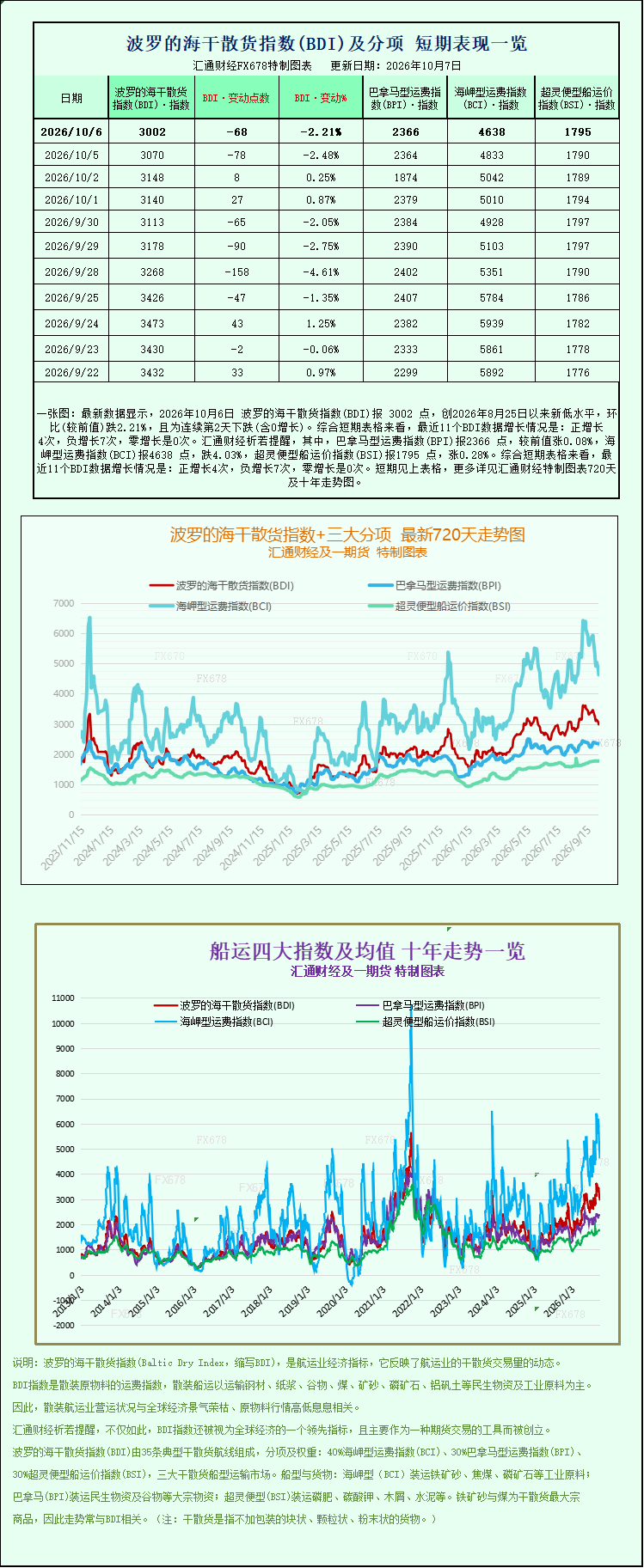 The international dry bulk shipping market remained under pressure, dragged down by a sharp drop in Capesize freight rates. The Baltic Dry Index (BDI) fell sharply to its lowest level in six weeks, completely erasing the previous peak season recovery and highlighting the weak global demand for dry bulk shipping. Data shows that the Baltic Dry Index, which tracks freight rates for Capesize, Panamax, and Supramax vessels, fell sharply by 68 points, a 2.2% decline, closing at 3002 points, a six-week low since August 25th, marking the official entry of the global dry bulk shipping market into a period of adjustment. This decline was not a broad-based drop; the market exhibited significant structural differentiation, with large vessel freight rates experiencing a deep correction, while medium and small vessel rates saw slight increases, reflecting the differences in shipping demand for different types of bulk commodities. Specific operating revenue data shows that the average daily operating revenue of Capesize vessels plummeted by $1,769 to $38,561, continuing its downward pressure for several consecutive trading days. Industry analysts point out that the core reason for this round of sharp decline in Capesize freight rates stems from a double whammy of negative factors on both the supply and demand sides. On the demand side, global steel mills continue to control production costs and reduce capacity, coupled with the early release of pre-holiday raw material restocking demand, leading to a significant cooling in import demand for iron ore and industrial coal, and a significant reduction in ocean-going bulk raw material shipping orders. On the supply side, the available capacity of Capesize vessels in the core shipping regions of East Asia and the Atlantic continues to increase, and the ample market capacity further exacerbates the downward pressure on freight rates, with the market benefits of the previous peak season largely fading. The small vessel market also saw a slight recovery, with the Supramax vessel index rising 5 points, or 0.3%, to 1795 points. Small vessels offer flexible transportation and diverse routes, suitable for regional short-haul freight and small-batch goods transportation needs, and are less affected by the weak global demand for industrial raw materials, thus maintaining resilience in the overall market downturn.
The international dry bulk shipping market remained under pressure, dragged down by a sharp drop in Capesize freight rates. The Baltic Dry Index (BDI) fell sharply to its lowest level in six weeks, completely erasing the previous peak season recovery and highlighting the weak global demand for dry bulk shipping. Data shows that the Baltic Dry Index, which tracks freight rates for Capesize, Panamax, and Supramax vessels, fell sharply by 68 points, a 2.2% decline, closing at 3002 points, a six-week low since August 25th, marking the official entry of the global dry bulk shipping market into a period of adjustment. This decline was not a broad-based drop; the market exhibited significant structural differentiation, with large vessel freight rates experiencing a deep correction, while medium and small vessel rates saw slight increases, reflecting the differences in shipping demand for different types of bulk commodities. Specific operating revenue data shows that the average daily operating revenue of Capesize vessels plummeted by $1,769 to $38,561, continuing its downward pressure for several consecutive trading days. Industry analysts point out that the core reason for this round of sharp decline in Capesize freight rates stems from a double whammy of negative factors on both the supply and demand sides. On the demand side, global steel mills continue to control production costs and reduce capacity, coupled with the early release of pre-holiday raw material restocking demand, leading to a significant cooling in import demand for iron ore and industrial coal, and a significant reduction in ocean-going bulk raw material shipping orders. On the supply side, the available capacity of Capesize vessels in the core shipping regions of East Asia and the Atlantic continues to increase, and the ample market capacity further exacerbates the downward pressure on freight rates, with the market benefits of the previous peak season largely fading. The small vessel market also saw a slight recovery, with the Supramax vessel index rising 5 points, or 0.3%, to 1795 points. Small vessels offer flexible transportation and diverse routes, suitable for regional short-haul freight and small-batch goods transportation needs, and are less affected by the weak global demand for industrial raw materials, thus maintaining resilience in the overall market downturn.
- Risk Warning and Disclaimer
- The market involves risk, and trading may not be suitable for all investors. This article is for reference only and does not constitute personal investment advice, nor does it take into account certain users’ specific investment objectives, financial situation, or other needs. Any investment decisions made based on this information are at your own risk.

