Japan's real wages rose for the eighth consecutive month, providing support for the Bank of Japan to raise interest rates.
2026-10-07 10:26:19
Data released by the Japanese government on Wednesday (October 7) showed that real wages rose 1.5% year-on-year in August, marking the eighth consecutive month of growth. While this was a slowdown from the revised 2% in July, it still continued the upward trend supporting further interest rate hikes by the Bank of Japan. For the Bank of Japan, the most important detail is base wages—fixed wages stabilizing around 4%, pointing to sustained wage growth rather than a short-term surge driven by bonuses. This is exactly the evidence policymakers hope to see before further tightening. 
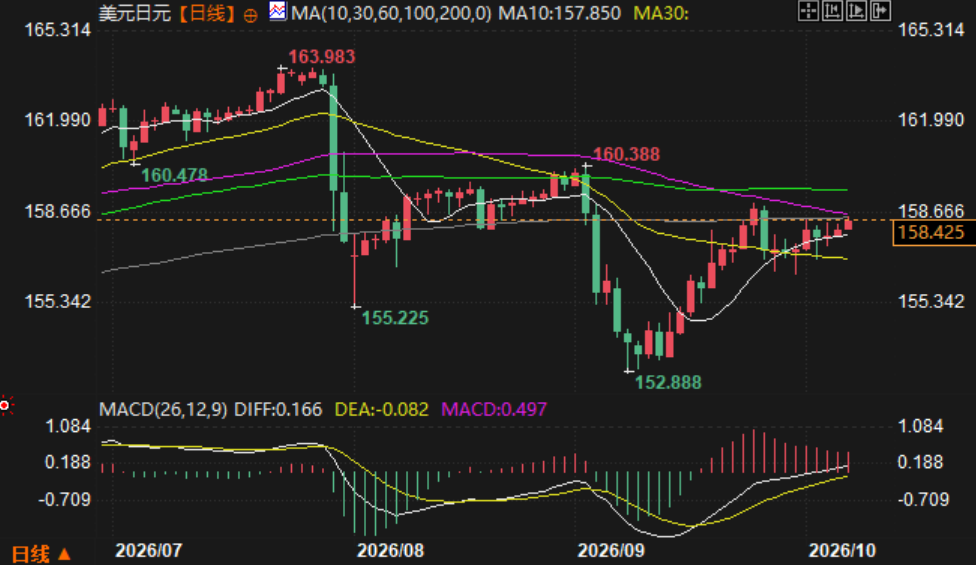 (USD/JPY daily chart, source: FX678) At 10:23 Beijing time, USD/JPY was trading at 158.42/43.
Real wages have risen for the eighth consecutive month; stable base salaries are key.
Japan's real wages rose 1.5% year-on-year in August, marking the eighth consecutive month of growth. The sustainability of this upward trend is noteworthy—for the Bank of Japan, which has long been committed to creating a virtuous cycle of "wages rising in tandem with prices," eight consecutive months of positive real wage growth is a crucial support for policy normalization. For the Bank of Japan, the most important detail is base wages. Fixed wage growth was close to 4%, unchanged from July, indicating that wage growth is sustained rather than a short-term spike driven by bonuses. Policymakers want to see precisely this kind of evidence before further tightening. The slowdown in overall income growth mainly stemmed from bonuses—special payments, after rising by about 5% in July, remained flat in August. This is a highly volatile monthly item and should not be misinterpreted as a substantial slowdown in wage growth.Inflation rates were only slightly above 2%, allowing real wages to maintain positive growth.
The key reason real wages have remained positive is that the inflation gauge used to calculate real wages is only slightly above 2%, unchanged from July and well below the approximately 3% level a year ago. This low inflation deflator is the core factor driving the continued positive growth in real wages. However, this factor is at risk. As Middle East conflicts push up oil prices, core inflation in Tokyo accelerated at its fastest pace in 10 months in September. If the inflation deflator rises, the increase in real wages will be quickly eroded. This tension echoes a business survey earlier today—service companies said that despite wage increases, inflation is still squeezing household purchasing power.Expectations of a Bank of Japan interest rate hike have strengthened: the rate was already raised to 1.25% in September.
This data strengthens the argument for further interest rate hikes by the Bank of Japan. The Bank of Japan raised its policy rate to 1.25% in September, while core inflation in Tokyo accelerated at its fastest pace in 10 months, further reinforcing the case for tightening. Steady growth in basic wages and continued positive real wages provide the central bank with data support on the wage side. This combination—sustained wage growth, accelerating inflation, and positive real wages—is an initial sign of the "virtuous cycle of wages and prices" that the Bank of Japan has been seeking for years. If this cycle is established, the Bank of Japan's policy normalization will have a more solid foundation.Not all signals are consistent: service sector confidence is declining, and there are disagreements within the central bank.
Not all signals point in the same direction. A business survey released earlier Wednesday showed a sharp decline in confidence among Japanese service businesses, with retailers and food producers saying inflation is eroding household purchasing power. This signal reminds markets that the beneficiaries of wage increases are not evenly distributed, and pressure on the household sector could constrain consumption. Bank of Japan board member Ayano Sato—who opposed a rate hike at the September meeting—also stated this week that she prefers a gradual pace of rate increases without a predetermined limit. This statement indicates that there remains disagreement within the committee regarding the rhythm of rate hikes. The September rate hike was approved by a majority vote, but the presence of dissenting voices means that further rate hikes will require more data to support them.Market Implications: The yen received marginal support, and the USD/JPY interest rate differential remains the dominant factor.
This data provides marginal support for the yen. Real wages have risen for the eighth consecutive month, with base wages stabilizing around 4%, providing wage-side data support for further interest rate hikes by the Bank of Japan. Market expectations for a December rate hike by the Bank of Japan may be further strengthened as a result. However, in the short term, the USD/JPY exchange rate will still be dominated by the USD/JPY interest rate differential. The yield on the 10-year US Treasury bond remains around 5.30%, and the probability of a Fed rate hike in December remains above 84%, meaning the significant interest rate differential remains unchanged. Therefore, the support for the yen from wage data is more likely to gradually take effect in the medium to long term, rather than immediately reversing the USD/JPY trend. If the Bank of Japan raises rates in December while the Fed holds rates steady, the effect of narrowing the interest rate differential will be more significant.Summarize
Japan's real wages rose for the eighth consecutive month in August, with base wages remaining stable at around 4%, providing wage-side data support for further interest rate hikes by the Bank of Japan. The key to maintaining positive real wage growth is that the inflation deflator is only slightly above 2%, but this factor is at risk of erosion as the Middle East conflict pushes up oil prices and core inflation accelerates in Tokyo. The Bank of Japan raised interest rates to 1.25% in September, with declining service sector confidence and internal disagreements within the central bank regarding the pace of rate hikes acting as counterbalances. For the yen, this data provides marginal support, but the USD/JPY interest rate differential remains the dominant factor in the short term. The core issue is whether the positive growth in real wages can be sustained, depending on whether the inflation deflator will be pushed up by oil prices. If inflation accelerates and erodes real wages, the Bank of Japan's room for interest rate hikes will be constrained; if wage growth continues to outpace inflation, the foundation for policy normalization will be more solid. The Bank of Japan's October meeting, the evolution of the Middle East situation, and US inflation data will be the core variables determining the short-term direction of the yen. (USD/JPY daily chart, source: FX678) At 10:23 Beijing time, USD/JPY was trading at 158.42/43.- Risk Warning and Disclaimer
- The market involves risk, and trading may not be suitable for all investors. This article is for reference only and does not constitute personal investment advice, nor does it take into account certain users’ specific investment objectives, financial situation, or other needs. Any investment decisions made based on this information are at your own risk.