Geopolitical risk aversion and high US Treasury yields have led to a consolidation of the US dollar index at high levels.
2026-10-07 10:56:17
On Wednesday in Asian trading, the dollar index, which measures the dollar against a basket of major currencies, rebounded on bargain hunting, regaining the 102.00 level and recovering some of the losses from the previous trading day's technical pullback. The dollar index closed down about 0.33% at 101.83 on Tuesday, after hitting 102.54 on Monday, its highest level since April 2025. The index is currently not far from this recent high, and the market is awaiting the release of the FOMC meeting minutes later for further clues about the Fed's policy path.  The logic driving the dollar's strength presents a combination of "cooling expectations and firm reality." On the one hand, last week's unexpectedly weak US non-farm payroll data for September (only 29,000 new jobs added, and the unemployment rate rising to 4.2%) significantly cooled market pricing in a Fed rate hike in October—according to the CME FedWatch Tool, the probability of an October rate hike has fallen to about 20% . On the other hand, the market still prices in about an 85% probability of another Fed rate hike before the end of the year , making the December meeting a new window for market betting. Meanwhile, US Treasury yields remain near multi-year highs after a sharp sell-off in global bond markets (the 10-year yield briefly touched a 24-year high of around 5.35% before slightly retreating), and the high interest rate level continues to strengthen the dollar's interest rate differential appeal. Geopolitical uncertainty provides additional support from a safe-haven perspective. The Yemeni government forces, in their "Operation Yemen Dawn," claimed to have regained control of several strategic points along the Red Sea coast, including the Zubab region near the Bab el-Mandeb Strait and the port city of Muha . The Iranian-backed Houthi rebels retaliated, striking several key targets in Saudi Arabia, including the Saudi Aramco oil refinery in Riyadh . Meanwhile, Iran significantly accelerated its attacks on oil tankers in the Strait of Hormuz over the past week , pushing international oil prices away from a one-month low. The continued disruption to energy supply, coupled with the dual risks in the Red Sea and the Strait of Hormuz, has led to a continued flow of safe-haven funds into dollar assets. From a global perspective, this round of dollar strengthening is a result of the combined effects of "interest rate differential advantage" and "safe-haven demand": the global bond market sell-off pushed up US Treasury yields, widening the dollar's interest rate advantage relative to other currencies; in Europe, the escalating fiscal and political risks in France put pressure on the euro, objectively "passively" boosting the dollar index; and the escalating situation in the Middle East further strengthened the dollar's safe-haven currency attributes. Market sentiment is generally bullish but cautious. Tonight's FOMC meeting minutes will be a key variable determining the short-term direction of the US dollar. Discussions in the minutes regarding the unexpected slowdown in September's non-farm payrolls, inflation stickiness, and the impact of AI investment on prices will directly affect the market's repricing of the probability of a December rate hike (currently around 85%). If the minutes signal "patient observation," the dollar may experience a temporary pullback; if the minutes emphasize inflation risks and leave room for further rate hikes, the dollar is expected to continue its upward trend of the past month. Investors are focusing on three points: the policy stance of the FOMC minutes, the direction of US Treasury yields, and the evolution of the Middle East situation (the Red Sea and the Strait of Hormuz) . From a technical perspective, the US dollar index maintains a short-term bullish structure on the daily chart. The 101.75-101.65 area, previously a resistance level, has now become support , and the overnight technical pullback found support in this area. The 14-day RSI is at 71.45 , indicating strong buying power, but it has also entered overbought territory, suggesting that the short-term upward trend may pause or experience a shallow pullback at any time. On the upside resistance side, 102.54 (Monday's high) is the first resistance level ; a break above this level could lead to a further challenge of the 103.00 psychological level. On the downside support side, 101.75-101.65 is the first line of defense , followed by the area around 101.40, with stronger support at the 101.00 psychological level. From the 4-hour chart, the index rebounded from around 101.76 and then climbed back above 102.00. Short-term momentum indicators have rebounded after falling from their highs. If the FOMC minutes are hawkish and drive a break above 102.54, the upward trend will be confirmed. Conversely, if the minutes are dovish, the index may fall back to test the 101.75-101.65 support zone.
 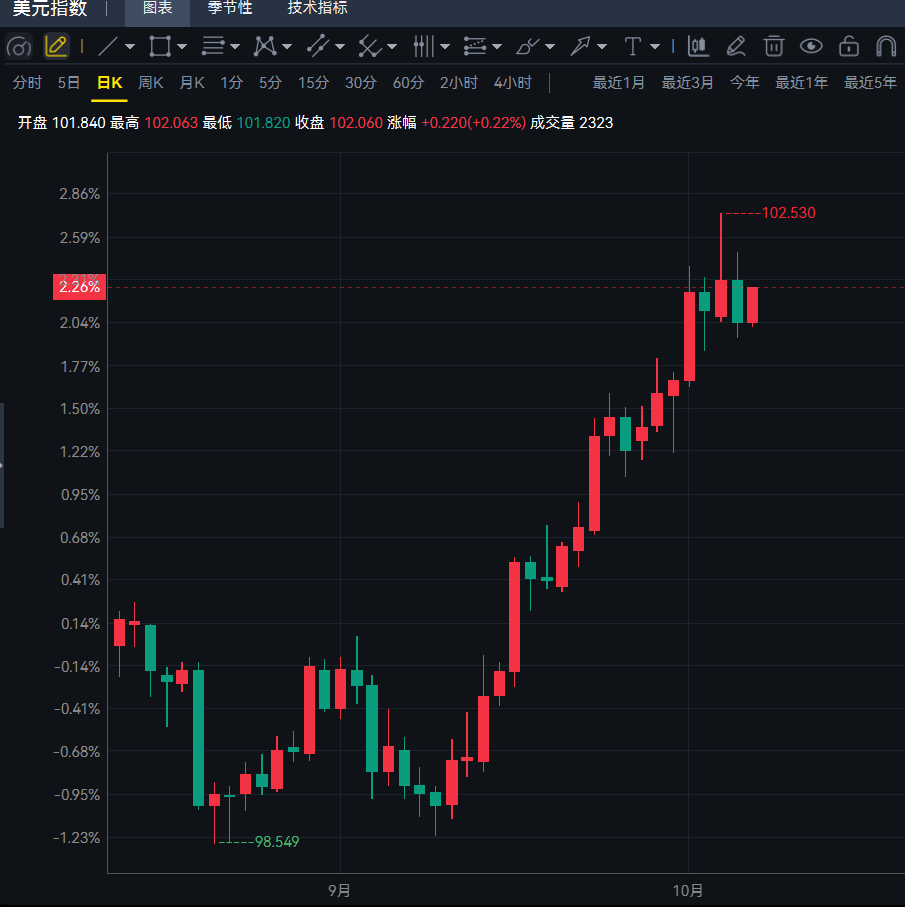 Editor's Summary : Overall, the US dollar is currently caught in a tug-of-war between "cooling policy expectations" and "strong real-world support." While the probability of a Fed rate hike in October has fallen to about 20%, the pricing of a rate hike by about 85% before the end of the year, persistently high US Treasury yields, geopolitical safe-haven demand, and European fiscal concerns collectively form the foundation for a strong dollar. The short-term bullish trend remains unchanged after the index regained the 102 level. Looking ahead, tonight's FOMC minutes will be a watershed moment for short-term direction—hawkish rhetoric could push the dollar above 102.54 and challenge the 103 level, while dovish signals could cause the index to fall back and test the 101.75-101.65 support zone. On the risk side, attention should be paid to a technical correction in overbought conditions, an unexpected easing of tensions in the Middle East, and renewed disruptions to rate hike expectations from US data.
The logic driving the dollar's strength presents a combination of "cooling expectations and firm reality." On the one hand, last week's unexpectedly weak US non-farm payroll data for September (only 29,000 new jobs added, and the unemployment rate rising to 4.2%) significantly cooled market pricing in a Fed rate hike in October—according to the CME FedWatch Tool, the probability of an October rate hike has fallen to about 20% . On the other hand, the market still prices in about an 85% probability of another Fed rate hike before the end of the year , making the December meeting a new window for market betting. Meanwhile, US Treasury yields remain near multi-year highs after a sharp sell-off in global bond markets (the 10-year yield briefly touched a 24-year high of around 5.35% before slightly retreating), and the high interest rate level continues to strengthen the dollar's interest rate differential appeal. Geopolitical uncertainty provides additional support from a safe-haven perspective. The Yemeni government forces, in their "Operation Yemen Dawn," claimed to have regained control of several strategic points along the Red Sea coast, including the Zubab region near the Bab el-Mandeb Strait and the port city of Muha . The Iranian-backed Houthi rebels retaliated, striking several key targets in Saudi Arabia, including the Saudi Aramco oil refinery in Riyadh . Meanwhile, Iran significantly accelerated its attacks on oil tankers in the Strait of Hormuz over the past week , pushing international oil prices away from a one-month low. The continued disruption to energy supply, coupled with the dual risks in the Red Sea and the Strait of Hormuz, has led to a continued flow of safe-haven funds into dollar assets. From a global perspective, this round of dollar strengthening is a result of the combined effects of "interest rate differential advantage" and "safe-haven demand": the global bond market sell-off pushed up US Treasury yields, widening the dollar's interest rate advantage relative to other currencies; in Europe, the escalating fiscal and political risks in France put pressure on the euro, objectively "passively" boosting the dollar index; and the escalating situation in the Middle East further strengthened the dollar's safe-haven currency attributes. Market sentiment is generally bullish but cautious. Tonight's FOMC meeting minutes will be a key variable determining the short-term direction of the US dollar. Discussions in the minutes regarding the unexpected slowdown in September's non-farm payrolls, inflation stickiness, and the impact of AI investment on prices will directly affect the market's repricing of the probability of a December rate hike (currently around 85%). If the minutes signal "patient observation," the dollar may experience a temporary pullback; if the minutes emphasize inflation risks and leave room for further rate hikes, the dollar is expected to continue its upward trend of the past month. Investors are focusing on three points: the policy stance of the FOMC minutes, the direction of US Treasury yields, and the evolution of the Middle East situation (the Red Sea and the Strait of Hormuz) . From a technical perspective, the US dollar index maintains a short-term bullish structure on the daily chart. The 101.75-101.65 area, previously a resistance level, has now become support , and the overnight technical pullback found support in this area. The 14-day RSI is at 71.45 , indicating strong buying power, but it has also entered overbought territory, suggesting that the short-term upward trend may pause or experience a shallow pullback at any time. On the upside resistance side, 102.54 (Monday's high) is the first resistance level ; a break above this level could lead to a further challenge of the 103.00 psychological level. On the downside support side, 101.75-101.65 is the first line of defense , followed by the area around 101.40, with stronger support at the 101.00 psychological level. From the 4-hour chart, the index rebounded from around 101.76 and then climbed back above 102.00. Short-term momentum indicators have rebounded after falling from their highs. If the FOMC minutes are hawkish and drive a break above 102.54, the upward trend will be confirmed. Conversely, if the minutes are dovish, the index may fall back to test the 101.75-101.65 support zone. Editor's Summary : Overall, the US dollar is currently caught in a tug-of-war between "cooling policy expectations" and "strong real-world support." While the probability of a Fed rate hike in October has fallen to about 20%, the pricing of a rate hike by about 85% before the end of the year, persistently high US Treasury yields, geopolitical safe-haven demand, and European fiscal concerns collectively form the foundation for a strong dollar. The short-term bullish trend remains unchanged after the index regained the 102 level. Looking ahead, tonight's FOMC minutes will be a watershed moment for short-term direction—hawkish rhetoric could push the dollar above 102.54 and challenge the 103 level, while dovish signals could cause the index to fall back and test the 101.75-101.65 support zone. On the risk side, attention should be paid to a technical correction in overbought conditions, an unexpected easing of tensions in the Middle East, and renewed disruptions to rate hike expectations from US data.
- Risk Warning and Disclaimer
- The market involves risk, and trading may not be suitable for all investors. This article is for reference only and does not constitute personal investment advice, nor does it take into account certain users’ specific investment objectives, financial situation, or other needs. Any investment decisions made based on this information are at your own risk.