The US dollar remained range-bound at high levels, while the British pound traded sideways against the US dollar.
2026-10-07 10:38:17
The pound sterling traded lower against the dollar in Asian trading on Wednesday, hovering around 1.3250 , giving back some of the gains from the previous session – on Tuesday, the pound had risen about 0.3% to 1.3263, a new high since October 1st. The immediate factor suppressing the pound was the renewed strength of the dollar: rising international oil prices reignited market concerns about a rebound in inflation, thus strengthening expectations of further interest rate hikes by the Federal Reserve, providing buying support for the dollar. According to the CME FedWatch Tool, the market is pricing in a 20% probability of a 25 basis point rate hike by the Fed in October , a bet that had cooled significantly after last week's weak US jobs data, but the new round of rising oil prices is raising interest rate expectations again.  The downside potential of the pound is constrained by two factors. First, the unexpectedly weak US non-farm payroll data for September (only 29,000 new jobs and an unemployment rate rising to 4.2%) continues to suppress the pricing of a Fed rate hike in October, and the dollar's interest rate advantage may not continue to expand. Second, inflationary pressures within the UK are providing "policy support" for the pound. Bank of England Monetary Policy Committee member Mann explicitly warned on Tuesday that inflation above the 2% target has become "solidified" in the UK economy . She is particularly concerned that inflation could rise to around 4% around the end of the year (the usual peak season for annual wage negotiations) —once the wage-price spiral intensifies, inflation will become more entrenched. Mann has voted for a 25 basis point rate hike to 4% since July and is one of the most hawkish members of the Monetary Policy Committee. Her statements have reinforced market expectations that the Bank of England will maintain high interest rates for a longer period, providing downside support for the pound. The difference in policy pace between the two central banks constitutes the core game currently playing out between the pound and the dollar. Regarding the Federal Reserve, the September meeting saw a 25 basis point rate hike to 3.75%-4.00%, but cooling employment data and officials' statements that "there is no need to rush into action" have made the market hesitant about another rate hike in October. As for the Bank of England, the benchmark interest rate has remained at 3.75% for several months, but high energy costs and sticky inflation have led the market to price in a rate hike to 4% in November at approximately 80% . Against this backdrop, the exchange rate is driven more by marginal changes in the dollar – if oil prices continue to rise and US inflation expectations reignite, the dollar will receive additional support; conversely, if the FOMC minutes confirm that the Fed will remain patient, a dollar pullback will open up space for a pound rebound. Institutional perspectives also note the divergence in dollar trading. Market surveys show that G10 currencies have not performed evenly against the dollar , with most currencies recording gains before the North American session opened on Tuesday. This uneven performance reflects the fragmented nature of dollar trading, rather than a uniform trend of strength or weakness. Meanwhile, persistently high energy costs and inflation concerns are reinforcing market pricing in a prolonged period of high interest rates from the Bank of England – precisely the risk chain emphasized by Mann: solidified high inflation → wage negotiations pushing up prices → the central bank forced to maintain tightening. For the pound, this policy expectation provides relatively certain bottom support. Tonight's FOMC meeting minutes will be a crucial juncture in the dollar-pound game: discussions in the minutes regarding the unexpected slowdown in September's non-farm payrolls, the sustainability of inflation, and the impact of AI investment on price pressures will directly determine the market's pricing in the Fed's December meeting and even next year's policy path. If the minutes signal "patient observation," the dollar may see a temporary pullback, and the pound/dollar exchange rate could recover above 1.33; if the minutes emphasize inflation risks and leave room for further rate hikes, the dollar will consolidate its strength, and the pound may face renewed pressure. Investors are focusing on three points: the policy stance of the FOMC minutes, the sustainability of the oil price rebound, and the subsequent performance of UK inflation and wage data . From a technical perspective, the GBP/USD pair maintains a bearish tone on the daily chart. The exchange rate remains capped by a cluster of moving averages formed by the 9-day moving average (approximately 1.3259) and the 50-day moving average (approximately 1.3387) , with prices continuing to decline below these moving averages. The 14-day RSI is at 39.3 , below the 50 midline, suggesting that downward pressure continues rather than a reversal signal is imminent. On the resistance side, the 9-day moving average at 1.3259 is the first line of resistance, with a denser technical resistance at the 50-day moving average at 1.3387 . As long as the exchange rate remains below this cluster of moving averages, any rebound is likely to be met with selling pressure. Only a daily close above 1.3387 can negate the current downtrend. On the support side, the recent lows and the psychological level of 1.32 form a support line. A break below this level could lead to further testing of the 1.3150 area. From a 4-hour chart perspective, the exchange rate is consolidating weakly around 1.3250, with short-term moving averages flattening and the direction uncertain, and indicators operating in the weak zone. If the FOMC minutes are dovish and push the dollar down, the pound may recover towards the 1.33-1.3387 area, but without a valid breakout, any rebound should be treated as technical.
 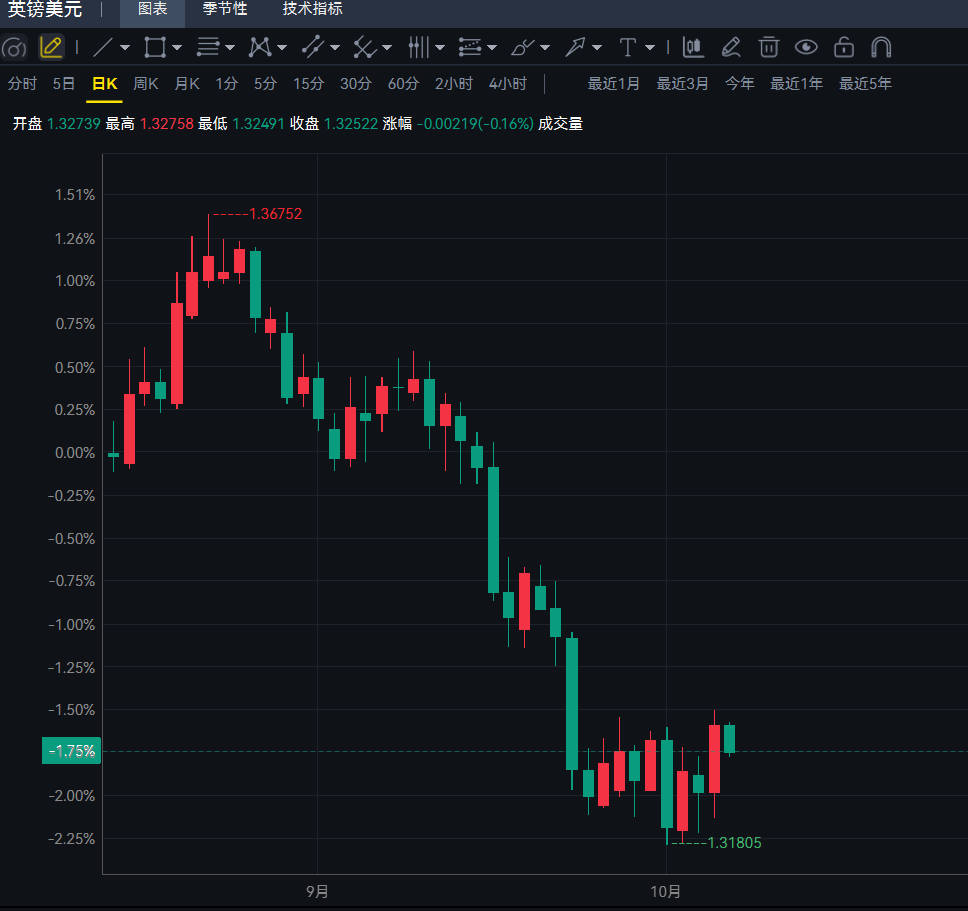 Editor's Summary : Overall, the pound/dollar exchange rate is caught in a tug-of-war between a strengthening dollar and a hawkish Bank of England stance. Rising oil prices have boosted expectations of US inflation and interest rate hikes, providing support for the dollar, while the risk of stagnant UK inflation and statements from hawkish Bank of England members have limited the pound's downside, resulting in narrow fluctuations around 1.3250. Looking ahead, tonight's FOMC minutes will be a key variable for short-term direction—a dovish signal could push the pound towards 1.33 and even the 1.3387 resistance zone, while hawkish rhetoric could put pressure on the exchange rate and test the 1.32 level. On the risk front, oil price movements and the Middle East situation remain the dominant external variables for the dollar's strength, and wage and inflation data ahead of the UK's November policy meeting are also worth noting.
The downside potential of the pound is constrained by two factors. First, the unexpectedly weak US non-farm payroll data for September (only 29,000 new jobs and an unemployment rate rising to 4.2%) continues to suppress the pricing of a Fed rate hike in October, and the dollar's interest rate advantage may not continue to expand. Second, inflationary pressures within the UK are providing "policy support" for the pound. Bank of England Monetary Policy Committee member Mann explicitly warned on Tuesday that inflation above the 2% target has become "solidified" in the UK economy . She is particularly concerned that inflation could rise to around 4% around the end of the year (the usual peak season for annual wage negotiations) —once the wage-price spiral intensifies, inflation will become more entrenched. Mann has voted for a 25 basis point rate hike to 4% since July and is one of the most hawkish members of the Monetary Policy Committee. Her statements have reinforced market expectations that the Bank of England will maintain high interest rates for a longer period, providing downside support for the pound. The difference in policy pace between the two central banks constitutes the core game currently playing out between the pound and the dollar. Regarding the Federal Reserve, the September meeting saw a 25 basis point rate hike to 3.75%-4.00%, but cooling employment data and officials' statements that "there is no need to rush into action" have made the market hesitant about another rate hike in October. As for the Bank of England, the benchmark interest rate has remained at 3.75% for several months, but high energy costs and sticky inflation have led the market to price in a rate hike to 4% in November at approximately 80% . Against this backdrop, the exchange rate is driven more by marginal changes in the dollar – if oil prices continue to rise and US inflation expectations reignite, the dollar will receive additional support; conversely, if the FOMC minutes confirm that the Fed will remain patient, a dollar pullback will open up space for a pound rebound. Institutional perspectives also note the divergence in dollar trading. Market surveys show that G10 currencies have not performed evenly against the dollar , with most currencies recording gains before the North American session opened on Tuesday. This uneven performance reflects the fragmented nature of dollar trading, rather than a uniform trend of strength or weakness. Meanwhile, persistently high energy costs and inflation concerns are reinforcing market pricing in a prolonged period of high interest rates from the Bank of England – precisely the risk chain emphasized by Mann: solidified high inflation → wage negotiations pushing up prices → the central bank forced to maintain tightening. For the pound, this policy expectation provides relatively certain bottom support. Tonight's FOMC meeting minutes will be a crucial juncture in the dollar-pound game: discussions in the minutes regarding the unexpected slowdown in September's non-farm payrolls, the sustainability of inflation, and the impact of AI investment on price pressures will directly determine the market's pricing in the Fed's December meeting and even next year's policy path. If the minutes signal "patient observation," the dollar may see a temporary pullback, and the pound/dollar exchange rate could recover above 1.33; if the minutes emphasize inflation risks and leave room for further rate hikes, the dollar will consolidate its strength, and the pound may face renewed pressure. Investors are focusing on three points: the policy stance of the FOMC minutes, the sustainability of the oil price rebound, and the subsequent performance of UK inflation and wage data . From a technical perspective, the GBP/USD pair maintains a bearish tone on the daily chart. The exchange rate remains capped by a cluster of moving averages formed by the 9-day moving average (approximately 1.3259) and the 50-day moving average (approximately 1.3387) , with prices continuing to decline below these moving averages. The 14-day RSI is at 39.3 , below the 50 midline, suggesting that downward pressure continues rather than a reversal signal is imminent. On the resistance side, the 9-day moving average at 1.3259 is the first line of resistance, with a denser technical resistance at the 50-day moving average at 1.3387 . As long as the exchange rate remains below this cluster of moving averages, any rebound is likely to be met with selling pressure. Only a daily close above 1.3387 can negate the current downtrend. On the support side, the recent lows and the psychological level of 1.32 form a support line. A break below this level could lead to further testing of the 1.3150 area. From a 4-hour chart perspective, the exchange rate is consolidating weakly around 1.3250, with short-term moving averages flattening and the direction uncertain, and indicators operating in the weak zone. If the FOMC minutes are dovish and push the dollar down, the pound may recover towards the 1.33-1.3387 area, but without a valid breakout, any rebound should be treated as technical. Editor's Summary : Overall, the pound/dollar exchange rate is caught in a tug-of-war between a strengthening dollar and a hawkish Bank of England stance. Rising oil prices have boosted expectations of US inflation and interest rate hikes, providing support for the dollar, while the risk of stagnant UK inflation and statements from hawkish Bank of England members have limited the pound's downside, resulting in narrow fluctuations around 1.3250. Looking ahead, tonight's FOMC minutes will be a key variable for short-term direction—a dovish signal could push the pound towards 1.33 and even the 1.3387 resistance zone, while hawkish rhetoric could put pressure on the exchange rate and test the 1.32 level. On the risk front, oil price movements and the Middle East situation remain the dominant external variables for the dollar's strength, and wage and inflation data ahead of the UK's November policy meeting are also worth noting.
- Risk Warning and Disclaimer
- The market involves risk, and trading may not be suitable for all investors. This article is for reference only and does not constitute personal investment advice, nor does it take into account certain users’ specific investment objectives, financial situation, or other needs. Any investment decisions made based on this information are at your own risk.