Can Australian households withstand interest rate hikes? Deutsche Bank and the Reserve Bank of Australia offer different answers.
2026-10-07 12:00:21
The Australian dollar traded slightly lower against the US dollar during Asian trading hours on Wednesday (October 7), currently hovering around 0.6970. Despite the slight downward pressure on the exchange rate, the latest assessment of Australian household balance sheets provides a new perspective on the Reserve Bank of Australia's (RBA) policy path. Deutsche Bank stated that Australian households are better able to withstand RBA rate hikes than expected, despite their heavy debt burden. The bank's macro strategist, Lachlan Dynan, estimates that the household debt-to-asset ratio has fallen to its lowest level since 1997, asset growth remains strong, and the debt-to-income ratio is stabilizing. In its Financial Stability Review on October 1, the RBA stated that most mortgage-holding households are still able to cope with more severe conditions, but also pointed to some areas of stress. This debate is crucial to the policy outlook: if households become less sensitive to each rate hike, the central bank may need to tighten more aggressively to slow demand. 
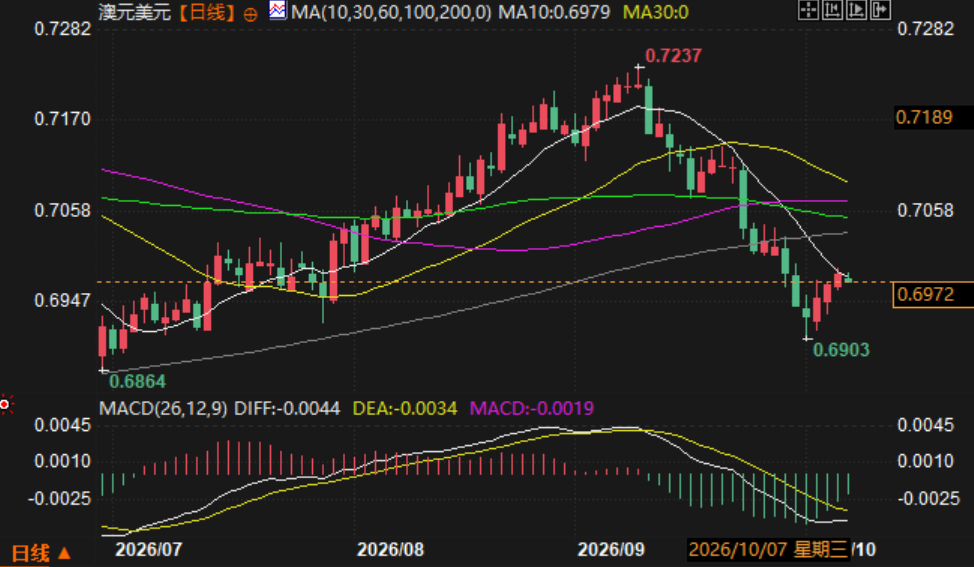 (Australian dollar against US dollar daily chart, source: EasyForex) At 11:55 Beijing time, the Australian dollar was trading at 0.6972/73 against the US dollar.
Deutsche Bank's core assessment: Debt-to-asset ratio falls to its lowest level since 1997.
Deutsche Bank macro strategist Lachlan Dynan stated that improved household balance sheets are helping borrowers absorb tighter policies. Household asset growth remains strong, and the debt-to-income ratio is stabilizing; he estimates the household debt-to-asset ratio is now at its lowest level since 1997. He added that the crowding-out effect of monetary policy on household disposable income through the cash flow channel appears weaker than in the past decade. Dynan believes that broader balance sheet strength, not just housing, may help offset wealth losses from weaker house prices. At the heart of this assessment is that Australian households' asset growth (including housing, stocks, and superannuation) is sufficient to offset debt-side pressures, improving net wealth and thus reducing the dampening effect of interest rate hikes on consumption.In contrast to internal warnings from the Reserve Bank of Australia: the potential impact of falling AI stocks and house prices.
Deutsche Bank's view contrasts with internal documents from the Reserve Bank of Australia (RBA). According to prominent media reports, these documents estimate that a permanent 20% drop in AI stocks, coupled with losses spreading to a broader stock market, could reduce long-term consumption by approximately 2.5%, not including the impact of falling house prices. Media estimates suggest that Australian housing wealth has already lost approximately A$510 billion since the end of March. This comparison reveals the core of the current debate: Deutsche Bank focuses on the static strength of household balance sheets, while the RBA focuses on the dynamic impact of falling asset prices. If house prices and AI stocks both fall sharply simultaneously, household net wealth could deteriorate rapidly, putting Deutsche Bank's optimistic assessment to the test.The Reserve Bank of Australia's own assessment: Most households are still able to cope, but there is localized pressure.
The Reserve Bank of Australia's own assessment partially aligns with Deutsche Bank's viewpoint. In its October 1st Financial Stability Assessment, the central bank stated that most mortgage-holding households remain capable of coping with more severe conditions, even with a significant drop in house prices, but also identified certain areas of stress. This assessment of "overall soundness with localized pressures" provides policymakers with some buffer, but also implies that policy adjustments may be necessary if areas of stress expand.Policy implications: If household sensitivity decreases, the Reserve Bank of Australia may need to raise interest rates further.
This debate has significant implications for the policy outlook. Last month, Dynan stated that a pessimistic view on housing is warranted, while still expecting the Reserve Bank of Australia (RBA) to continue tightening, as a greater housing slump might be needed to rebalance the overall economy. If households become less sensitive to each rate hike, the central bank may need to tighten more aggressively to slow demand. The core logic here is that the transmission effect of monetary policy depends on household sensitivity. If improvements in household balance sheets reduce the dampening effect of each rate hike on consumption, then the central bank would need to raise rates more to achieve the same tightening effect. This provides theoretical support for another rate hike in November.Policy Path: Decision on November 3rd, disagreements among the four major banks, pressure on oil prices.
The Reserve Bank of Australia (RBA) raised the cash rate to a 15-year high of 4.6% on September 29, marking its fourth rate hike this year, as oil prices above $100 per barrel exacerbated inflationary pressures. Variable mortgage repayments will increase from October 9 to reflect this change. The next policy decision will be announced on November 3, preceded by the release of September quarterly inflation data on October 28. Reports indicate that the four major banks are divided on whether to raise rates a fifth time to 4.85%. Oil prices above $100 per barrel have kept inflationary pressures high, leaving the RBA with little room to make exceptions for households. Even with improved household balance sheets, the central bank is unlikely to slow its tightening pace as long as inflationary pressures persist. This backdrop suggests that a November rate hike remains a possibility, a view supported by Deutsche Bank.Summarize
Deutsche Bank believes Australian households are better able to withstand the RBA's rate hikes than expected, with household debt-to-asset ratios falling to their lowest level since 1997, and the transmission effect of monetary policy through cash flow channels weaker than in the past decade. This view contrasts with warnings in internal RBA documents—which estimate that falling AI stocks and house prices could significantly impact consumption. The RBA's own assessment indicates that most households are still able to cope, but there are localized pressures. The policy implication of this debate is that if households become less sensitive to each rate hike, the central bank may need to raise rates more to slow demand, providing theoretical support for a fifth rate hike in November. The four major banks are divided on the November decision, and the September quarterly inflation data will be released on October 28. Oil prices above $100/barrel are perpetuating inflationary pressures, leaving the RBA with little room to ease its tightening pace. For the Australian dollar, continued rate hikes by the RBA would provide some support, especially against currencies where central banks are nearing the end of their tightening cycle. (Australian dollar against US dollar daily chart, source: EasyForex) At 11:55 Beijing time, the Australian dollar was trading at 0.6972/73 against the US dollar.- Risk Warning and Disclaimer
- The market involves risk, and trading may not be suitable for all investors. This article is for reference only and does not constitute personal investment advice, nor does it take into account certain users’ specific investment objectives, financial situation, or other needs. Any investment decisions made based on this information are at your own risk.